Unit 113 is the science, and it is more useful than it looks. Almost everything in it explains something you will actually see on a job — why a pipe splits in winter, why the hot water sits at the top of a cylinder, why foil goes behind a radiator.
Units, and the two conversions you will do every day
Every trade uses agreed units so a measurement means the same thing to everyone. The internationally recognised set is the SI units: length in metres and millimetres, time in seconds, temperature in kelvin, area in square metres, and volume of water in litres.
Plumbing is measured in millimetres — pipe sizes, clip spacing, tails — and longer runs in metres. There are 1000 mm in a metre, so:
- mm to m: divide by 1000. 2400 mm = 2.4 m.
- m to mm: multiply by 1000. 1.8 m = 1800 mm.
The mistake to avoid is adding metres to millimetres without converting first. 4 m plus 750 mm is 4750 mm, not 754 of anything.
One more that is worth carrying: 1 litre of water weighs 1 kg. A 210 litre cylinder therefore holds over 200 kg of water — which is why the floor under it matters.
The four temperatures
Which state water is in depends only on its temperature.
- 0 °C — freezing. Water becomes ice.
- 4 °C — maximum density. Water is at its heaviest for its volume.
- 100 °C — boiling, at normal atmospheric pressure.
And two expansion figures that both matter:
- Water to steam: it expands about 1600 times. A small amount of water becomes an enormous amount of steam, which is why an uncontrolled boiling system is so dangerous.
- Water to ice: it expands by about 10%.
That second one is unusual — nearly every other substance shrinks when it freezes. Water grows, which is why a frozen pipe splits. And the split is usually only found when it thaws and starts leaking.
The 4 °C figure explains something you have seen all your life: because water is densest at 4 °C, the coldest water in a pond sinks only until it reaches that, and anything colder is lighter and stays on top. So ice floats and ponds freeze from the surface down, rather than solid.
What water does to plumbing
Water is called the universal solvent because it dissolves so much — which is why it picks up minerals from the ground and metals from pipework.
- Hard water contains dissolved calcium and magnesium. It lathers poorly and leaves limescale: heating it makes the calcium come out of solution as a hard deposit that coats heat exchangers and immersion heaters, blocks pipework and wastes fuel.
- Soft water has few dissolved minerals. It lathers easily and leaves no scale, but is more likely to be slightly acidic and to corrode metal.
- pH runs from 0 to 14. Below 7 is acidic, 7 is neutral (pure water), above 7 is alkaline. Acidic water attacks metals.
Two more effects worth understanding. Water gets lighter as it gets hotter, so in a system that relies on it, hot water rises and cooler water falls and it circulates on its own without a pump — that is gravity circulation, and it is why the hot water is always at the top of a cylinder.
And capillary attraction is a liquid being drawn into a very narrow gap, against gravity; the narrower the gap, the further it travels. That is the entire principle behind solder fittings. It also works against you: it pulls water through a hairline crack and up between two overlapping surfaces.
Materials
- Ferrous metals contain iron — low carbon steel pipe, cast iron. They rust unless protected.
- Non-ferrous metals have none — copper, lead, aluminium, zinc. They do not rust.
- Alloys are two or more metals mixed — brass (copper and zinc), solder, gunmetal.
- Thermoplastics soften when heated and can be reshaped — polythene, PVC, ABS, polypropylene.
- Thermo-setting plastics set hard once formed and cannot be softened again — toilet seats, some handles and casings.
- Ceramics are clay based and fired hard — basins, WCs, tiles. Easy to clean, but brittle.
The quick site test: a magnet sticks to ferrous metal and not to copper, brass or lead.
The properties you need to name: strength (load before failure), hardness (resisting scratching and wear), ductility (drawn out or bent without breaking — copper is ductile, which is why it bends cold), malleability (hammered or pressed into shape — lead is very malleable, which is why it was used for flashings), insulation, and tensile strength (pulling force before it snaps).
Atmospheric corrosion is metal attacked by the air around it, and it needs both oxygen and moisture — which is why metal rusts in damp air and not in dry. Pollution and salt speed it up. Ferrous metals suffer worst, because rust flakes off and exposes fresh metal underneath so it keeps going. Copper and lead form a surface film instead, which protects the metal below — the green on old copper, the grey on lead.
How heat moves
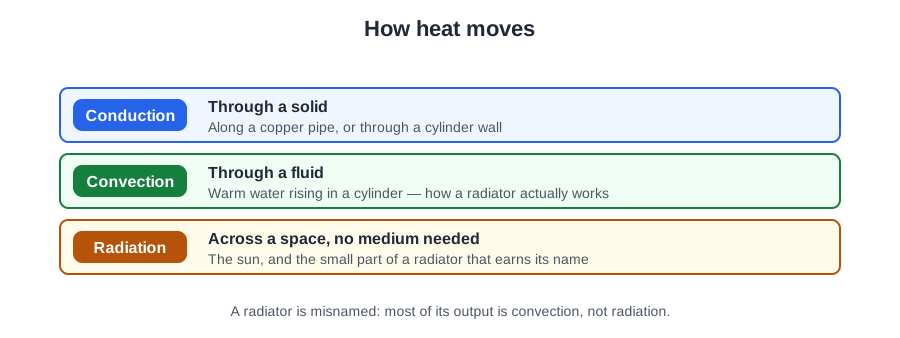
Heat always moves from hotter to colder, by three methods.
- Conduction — through a solid, passed from particle to particle. Metals do it well, plastics do not. Heat passing through the wall of a copper pipe into the water.
- Convection — through a liquid or gas that moves. Warm fluid rises, cool fluid falls, a current forms. The hot water at the top of a cylinder.
- Radiation — as rays through space, needing nothing to travel through. The warmth on your face in front of a hot surface; how the sun heats a solar panel.
A “radiator” is a misleading name: most of its output is actually convection, with only a small part genuine radiation.
Surface finish changes how well something radiates and absorbs heat. Dull dark surfaces are good radiators and absorbers — which is why a solar panel absorber is matt black. Shiny surfaces are poor radiators and good reflectors — which is why foil behind a radiator reflects heat back into the room instead of letting it soak into the wall, and why a cylinder jacket has a shiny face.
And insulation slows heat transfer down. Its benefits are energy efficiency and prevention of heat loss — plus two more worth knowing in plumbing: it protects pipework in unheated spaces from freezing, and it stops condensation forming on cold pipes and dripping onto a ceiling.
🔢 The numbers worth memorising
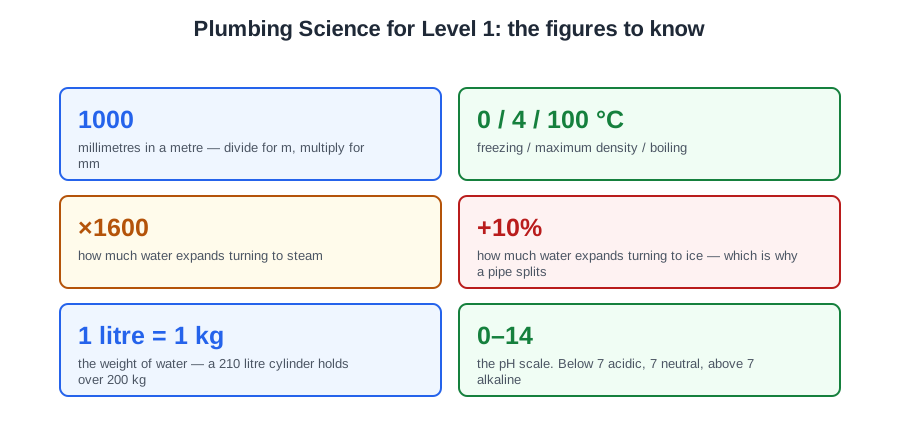
- 1000
- millimetres in a metre — divide for m, multiply for mm
- 0 / 4 / 100 °C
- freezing / maximum density / boiling
- ×1600
- how much water expands turning to steam
- +10%
- how much water expands turning to ice — which is why a pipe splits
- 1 litre = 1 kg
- the weight of water — a 210 litre cylinder holds over 200 kg
- 0–14
- the pH scale. Below 7 acidic, 7 neutral, above 7 alkaline
⚠️ Where people go wrong
- Water expands when it freezes. Nearly everything else shrinks — and that is exactly why pipes split.
- Maximum density is at 4 °C, not 0 °C. It is why ice floats and ponds freeze from the top down.
- A radiator mostly convects. Only a small part of its output is genuine radiation.
- Radiation needs nothing to travel through. Conduction needs a solid, convection a moving fluid.
- Convert before you add. 4 m + 750 mm = 4750 mm.
- Corrosion needs oxygen AND moisture. Which is why metal rusts in damp air and not in dry.
📝 8-Question Self-Test
Straight from the Level 1 course question bank. Click an option to see whether you got it right — the explanation appears instantly, and there is nothing to submit.
The kelvin is the SI unit, though temperatures are read in degrees Celsius in practice.
There are 1000 mm in a metre, so divide by 1000. 2400 ÷ 1000 = 2.4 m.
Construction drawings are dimensioned in millimetres almost without exception, and there are a thousand in a metre. A radiator shown as 1200 is 1200 mm, or 1.2 m.
Time is the second, area is the square metre, and the volume of water is the litre. Flow rate puts the first two together — litres per second. A litre of water also weighs a kilogram.
Area = m2 is one of the named SI units, and it is the one that decides what size radiator a room gets: heat is lost per square metre of each surface.
Length = metre (m) and millimetres (mm). Construction drawings are dimensioned in millimetres almost without exception, and there are a thousand in a metre. Getting this wrong by a factor of a thousand is the classic apprentice error.
Flow rate puts two of the named SI units together: the litre for the volume of water and the second for time. A litre of water also weighs a kilogram.
Construction drawings are dimensioned in millimetres almost without exception, and there are a thousand in a metre. 1200 is 1.2 m. Getting this wrong by a factor of a thousand is the classic apprentice error, and it is always obvious afterwards.
- All 72 Level 1 guides — one per lesson, across all ten units
- The Level 1 glossary — 620 terms in plain English