Water dissolves so many things it is called the universal solvent. Almost every fault in this lesson comes from something water picked up on the way to the tap.
The terminology
| Term | Means |
|---|---|
| Solubility | Water’s ability to dissolve other substances. It dissolves so much that it is called the universal solvent |
| Wholesome | Fit to drink — treated, tested and safe |
| Hard | Contains dissolved calcium and magnesium. Lathers poorly and leaves limescale |
| Soft | Few dissolved minerals. Lathers easily, no scale, but more likely to be slightly acidic and corrode metal |
| Alkaline | pH above 7 |
| Acidic | pH below 7. Attacks metals |
The solubility line explains almost everything else on this page. Water picks up minerals as it passes through the ground, and it picks up metal from the pipework it sits in. Hard water, limescale and corrosion are all consequences of one property.
Hard and soft: neither is simply better
This is worth being clear about, because it is easy to assume soft water is the good kind.
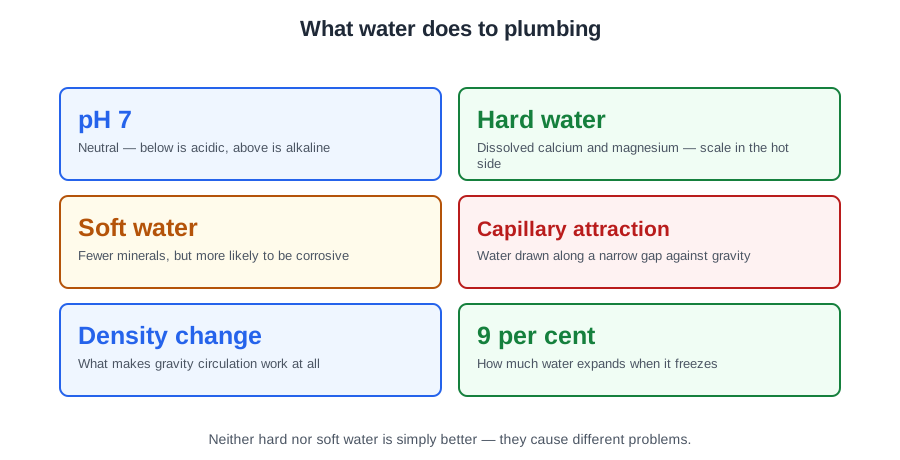
- Hard water lathers poorly, furs kettles and blocks heat exchangers — but it lays down a thin protective coating inside pipework.
- Soft water lathers easily and leaves no scale — but it is more likely to be slightly acidic and corrode metal.
So each has a fault, and the faults are opposite. Which one you are dealing with depends entirely on the geology where you are working.
The pH scale
Acidity and alkalinity are measured on the pH scale, which runs from 0 to 14.
- Below 7 — acidic
- 7 — neutral. Pure water
- Above 7 — alkaline
Three numbers to hold: 0, 7 and 14. Everything else follows from where a value sits relative to 7.
The effects of water in plumbing systems
Limescale
In hard water areas, heating the water makes dissolved calcium come out of solution as a hard deposit.
The mechanism is the important part: the calcium is invisible and harmless while dissolved. Heat is what makes it precipitate — which is exactly why scale forms on the hottest surfaces: immersion heaters, heat exchangers, kettle elements.
What it does:
- Coats heat exchangers and immersion heaters
- Blocks pipework
- Wastes fuel, because heat has to pass through the scale before it reaches the water
That last one is why scale is expensive rather than just untidy. Scale is a poor conductor, so it acts as insulation in exactly the place you least want it.
Corrosion
Water attacks metals, especially where it is acidic or where two different metals are in contact.
It shows as:
- leaks,
- discoloured water,
- radiators that fill with black sludge.
The black sludge is worth naming: it is magnetite, iron oxide from the inside of steel radiators, and it is the reason heating systems are flushed and dosed with inhibitor.
Changes of density, and gravity circulation
Water gets lighter as it gets hotter.
In a system that relies on it, hot water rises and cooler water falls, so the water moves round on its own without a pump. That is gravity circulation.
Two things it explains:
- How an old cylinder is heated from a back boiler — no pump involved, just the difference in density between the flow and the return.
- Why the hot water is always at the top of a cylinder. Which is why hot is drawn from the top and the cold feed enters at the bottom.
Capillary attraction
Capillary attraction is the way a liquid is drawn into a very narrow gap, against gravity. The narrower the gap, the further it travels.
Working for you
It is the whole principle behind solder fittings. The gap between pipe and fitting is tiny, so when the solder melts it is drawn right through the joint and fills it completely — even upwards.
That is why a capillary joint can be made in any orientation, and why the fitting is a deliberately close fit rather than a loose one.
Working against you
The same effect pulls water through a hairline crack, and up between two overlapping surfaces.
Which is why roof and flashing details are made with a deliberate gap or a drip to break the capillary path. If two surfaces are pressed close together, water climbs between them; give them either a proper gap or a drip edge, and it cannot.
One effect, two consequences, and knowing it is the same effect is what makes both make sense.
🔢 The numbers worth memorising
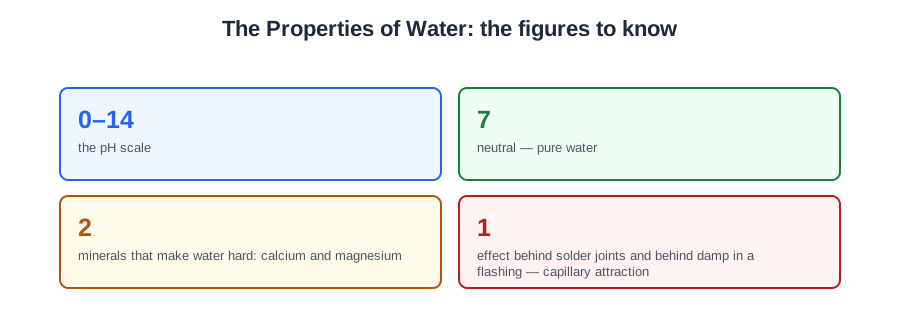
- 0–14
- the pH scale
- 7
- neutral — pure water
- 2
- minerals that make water hard: calcium and magnesium
- 1
- effect behind solder joints and behind damp in a flashing — capillary attraction
⚠️ Where people go wrong
- Assuming soft water is simply better. It is more likely to be acidic and corrode metal.
- Saying limescale forms everywhere. Heat makes it precipitate, so it forms on the hottest surfaces.
- Getting the pH scale backwards. Below 7 is acidic; above 7 is alkaline.
- Thinking capillary attraction is only useful. The same effect draws water through a hairline crack.
- Forgetting why hot is drawn from the top of a cylinder. Hot water is less dense, so it rises.
📝 8-Question Self-Test
Straight from the Level 1 course question bank. Click an option to see whether you got it right — the explanation appears instantly, and there is nothing to submit.
The pH scale runs from 0 to 14. Below 7 is acidic, 7 is neutral, above 7 is alkaline.
Water dissolves so much that it is called the universal solvent — which is why it picks up minerals from the ground and metals from pipework.
Wholesome means fit to drink: treated, tested and safe.
Hard water contains dissolved calcium and magnesium. It lathers poorly and leaves limescale.
The pH scale, which runs from 0 to 14. Below 7 is acidic, 7 is neutral, above 7 is alkaline.
The pH scale runs 0 to 14. Below 7 acidic, 7 neutral (pure water), above 7 alkaline.
Wholesome is the answer, and the paper offers pure and drinking alongside it. Pure water is H2O and nothing else, which you could not get from a tap. Wholesome means fit for human consumption and meeting the legal standard.
Solubility, wholesome, hard, alkaline, soft and acidic are the named terms. Ductility is a property of a metal, not of water.
- Start here: Plumbing Science for Level 1 — the whole unit in one piece
- All 72 Level 1 guides — one per lesson, across all ten units
- The Level 1 glossary — 620 terms in plain English