A screwed system cannot be taken apart in the middle — unless somebody put a union in. Understanding why is the key to this whole lesson.
Methods of joining
Screwed
The usual method. A thread is cut onto the pipe end and it screws into a threaded fitting, sealed with PTFE tape or with jointing compound and hemp.
PTFE is polytetrafluoroethylene — a thin white tape that fills the tiny spiral gap in the thread. Hemp is natural fibre, wound into the thread with a paste; it swells slightly when wet, which is why it has been used for a hundred years.
Compression
A nut and olive, as on copper. Used for connections to other materials and where a thread cannot be cut — for instance where the pipe is already installed and cannot be turned.
The fittings
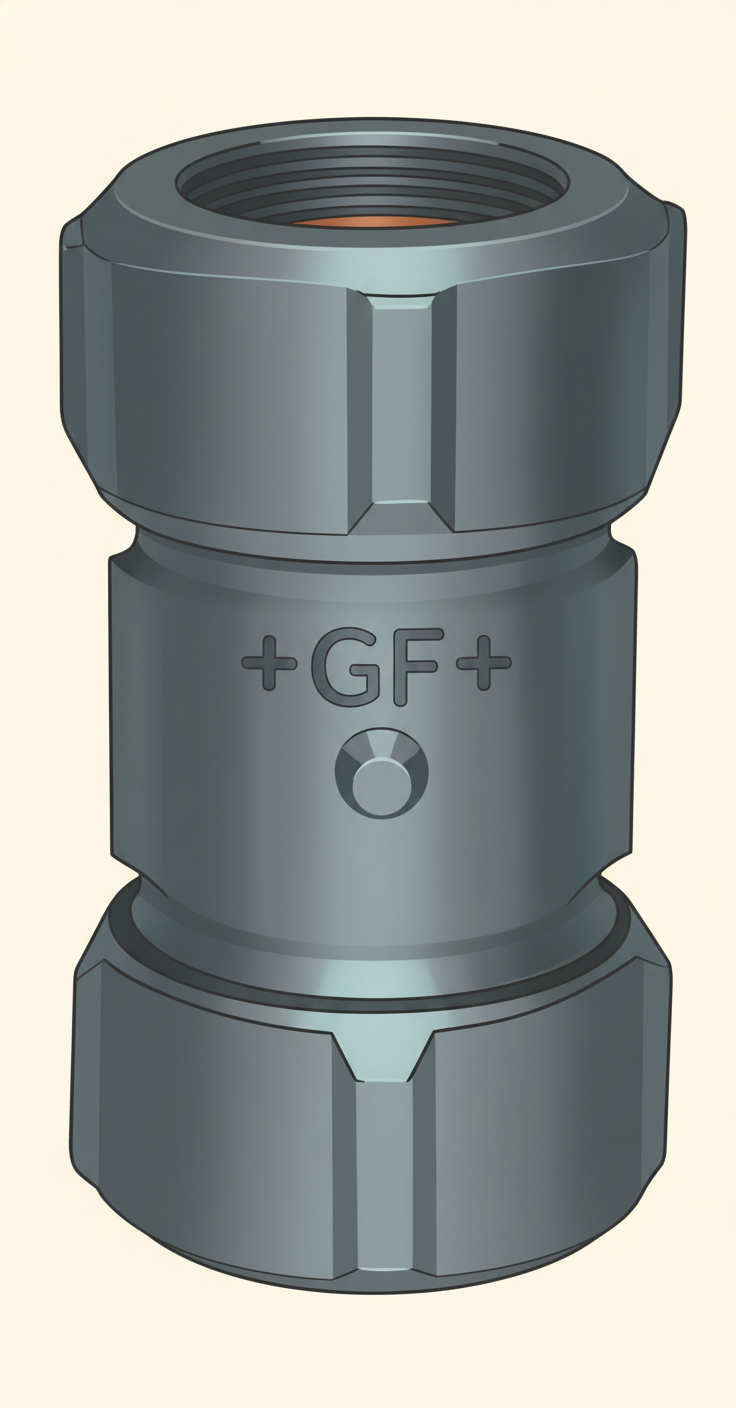
- Elbow — changes direction.
- Tee — takes a branch off a run.
- Coupling — joins two straight lengths. Sometimes called a socket.
- Reducer — joins one size to another.
- Union — see below. This is the one that matters.
Why a union is essential
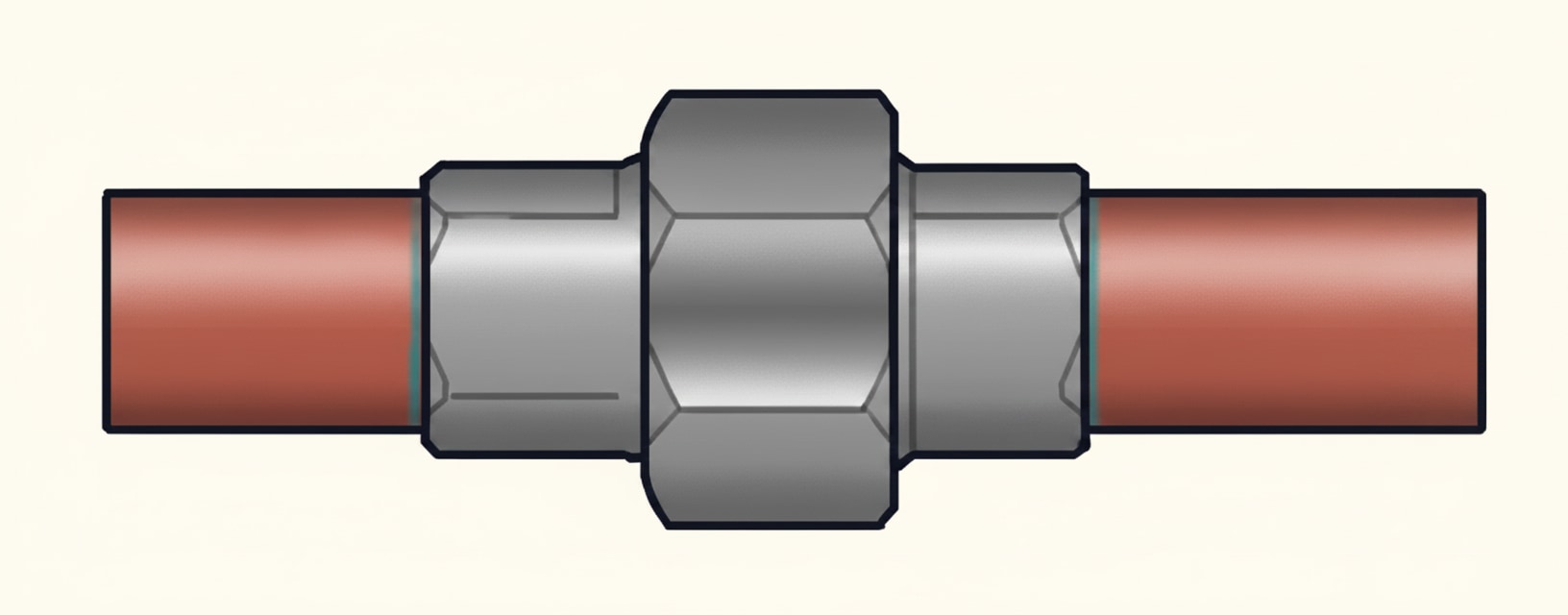
Think about what a screwed joint actually does. To tighten it, the pipe has to turn. So to make a joint at one end of a length, you screw the pipe into the fitting — which means the other end of that pipe is turning too.
Now imagine a run of pipe with fittings at both ends, both tight. To undo one, you would have to turn the pipe — which tightens or loosens the other. You cannot take a screwed system apart in the middle. You would have to unscrew the whole run from one end.
A union solves this. It is a three-part fitting: two halves that screw onto the two pipe ends, and a large nut that pulls the two halves together. Undo the nut and the two halves separate without either pipe turning.
So a union is what makes a threaded system maintainable. You put one wherever something will need to be removed — either side of a pump, at a boiler connection, at a valve.
Sizes
LCS is still often sold in imperial sizes, quoted as the bore — the inside — not the outside like copper.
- ½ inch and ¾ inch
- Their metric equivalents, 15 mm and 20 mm
That difference catches people out. 15 mm copper is 15 mm on the outside. 15 mm LCS is roughly 15 mm on the inside, and with a thick steel wall around it, so the pipe is noticeably fatter.
The word for the inside measurement is the bore. Copper and plastic are sized on outside diameter; low carbon steel is sized on bore.
Grades
LCS comes in three grades, which differ in wall thickness and are identified by a coloured band painted round the pipe:
- Light
- Medium — the usual grade for domestic heating pipework
- Heavy — thickest wall, for higher pressures and buried work
The bore stays the same across the grades; the outside grows as the wall gets thicker. That is what makes bore the sensible thing to size it by.
Clips
- Cast school board clips — a cast saddle screwed to the surface.
- Munsen rings — a two-part ring that clamps round the pipe and screws to a backplate. The usual way of carrying steel pipe.
- Backplates — screwed to the wall to take a Munsen ring, holding the pipe off the surface.
Clip spacing
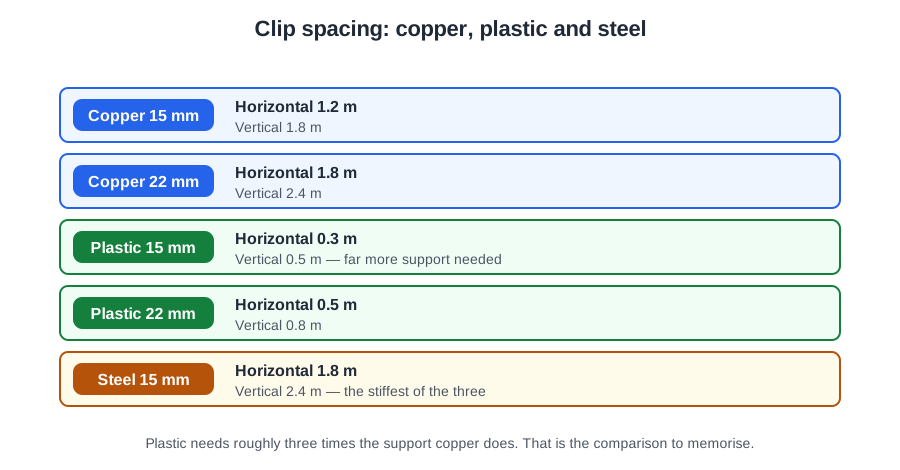
| Pipe | Horizontal | Vertical |
|---|---|---|
| 15 mm (½”) | 1.8 m | 2.4 m |
| 20 mm (¾”) | 2.4 m | 3.0 m |
Check the manufacturer’s instructions, which take priority.
Steel is the stiffest of the three materials, so it needs the fewest clips — the opposite end of the scale from plastic.
The comparison worth memorising
Clip spacing across the three materials, 15 mm horizontal:
- Plastic — 0.3 m
- Copper — 1.2 m
- Low carbon steel — 1.8 m
The stiffer the pipe, the further apart the clips. If you can hold that one sentence, you can reason out any of the three tables.
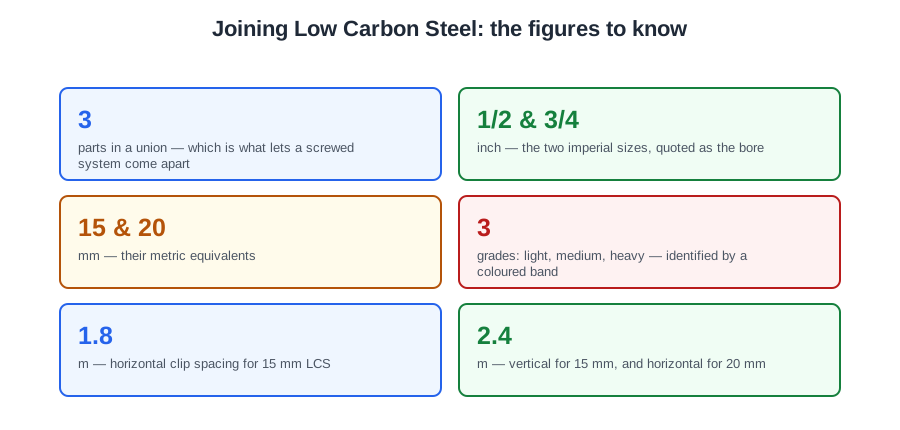
🔢 The numbers worth memorising
- 3
- parts in a union — which is what lets a screwed system come apart
- 1/2 & 3/4
- inch — the two imperial sizes, quoted as the bore
- 15 & 20
- mm — their metric equivalents
- 3
- grades: light, medium, heavy — identified by a coloured band
- 1.8
- m — horizontal clip spacing for 15 mm LCS
- 2.4
- m — vertical for 15 mm, and horizontal for 20 mm
⚠️ Where people go wrong
- Sizing LCS on the outside diameter. It is sized on the bore, unlike copper and plastic.
- Forgetting the union. Without one, a screwed system cannot be taken apart in the middle.
- Naming the wrong grade for domestic heating. It is medium.
- Thinking the grades differ in bore. The bore is the same; the wall thickness changes.
- Using copper clip spacings. Steel is stiffer and needs fewer clips.
📝 8-Question Self-Test
Straight from the Level 1 course question bank. Click an option to see whether you got it right — the explanation appears instantly, and there is nothing to submit.
A union is a three-part fitting, and without one a screwed system cannot be dismantled in the middle.
Steel is sized on the hole down the middle; copper on the outside of the tube. So a 15 mm steel pipe has a 15 mm bore plus the wall on either side, and sits visibly fatter than 15 mm copper.
The thread makes the mechanical connection but does not seal on its own. It needs PTFE tape wrapped in the direction the fitting turns, or jointing compound with hemp.
Compression is used for connections to other materials and where a thread cannot be cut.
Elbows, tees, couplings, reducers and unions. The union is the one copper does not have: a three part fitting that lets a screwed run be broken, which matters when every joint is a tapered thread that only tightens one way.
Screwed, also called threading, and compression. Screwed uses a tapered male thread with jointing compound and PTFE or hemp, wound up tight with a stillson. Compression works as it does on copper.
Couplings join in line, elbows turn a corner, reducers step down a size. Tees take a branch and unions let a screwed run be broken without unwinding the whole thing.
The die is the hardened cutter that forms the thread; the stock holds it and gives leverage.
Going deeper: the same ground at Level 2
Level 1 gives you the shape of this. The Level 2 guides below take it considerably further — the regulations, the calculations and the detail you will need next. Free to read, same as these.
- Start here: Low Carbon Steel Pipework for Level 1 — the whole unit in one piece
- All 72 Level 1 guides — one per lesson, across all ten units
- The Level 1 glossary — 620 terms in plain English