Plastic sags between clips, and a sag holds water. That is how an installation that passed its test on the day blocks up two winters later.
Why waste pipe needs supporting at all
Waste pipe carries water, and unsupported plastic sags. It does not sag on the day it is installed — it sags slowly, under its own weight and the weight of the water, helped along by every hot discharge that softens it slightly.
Then two things follow:
- The sag holds standing water, which silts up and blocks.
- On a long run, the pipe moves enough to pull a joint apart.
Both of those are failures that appear a long time after the person who fitted it has gone.
The clips
- 32 mm waste pipe clip
- 40 mm waste pipe clip
- 110 mm waste pipe clip — often a bracket rather than a simple clip, because of the weight it has to carry.
Clips are sized to the pipe. Not approximately — exactly:
- A clip that is too big lets the pipe move, which is the thing the clip was there to prevent.
- A clip forced on too tight stops the pipe expanding, which is the other thing plastic needs to be allowed to do.
Clip spacing
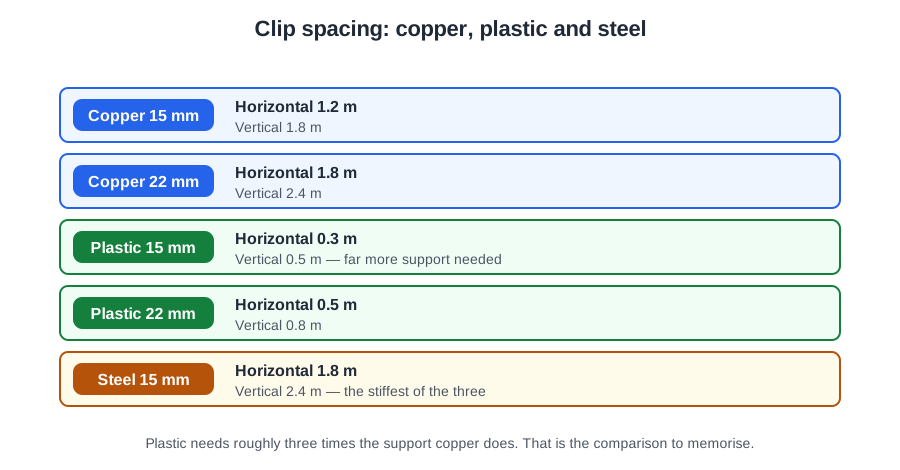
| Pipe | Horizontal | Vertical |
|---|---|---|
| 32 mm | 0.5 m | 1.2 m |
| 40 mm | 0.5 m | 1.2 m |
| 110 mm | 1 m | 2 m |
Always check the manufacturer’s instructions, which take priority.
Two patterns worth noticing
The table is much easier to remember once you see why the numbers go the way they do.
Horizontal needs more support than vertical
Compare the two columns: every horizontal figure is less than half the vertical one.
The reason is the direction of gravity relative to the pipe. On a horizontal run, gravity pulls the pipe sideways out of line — straight into a sag. On a vertical run, gravity pulls along the pipe, and the pipe is perfectly strong in that direction. The clips on a vertical run are mostly stopping it sliding down, not stopping it bending.
Bigger pipe needs fewer clips
110 mm goes further between clips than 32 mm, which feels backwards because it is heavier.
The reason is stiffness. A larger diameter pipe with a thicker wall resists bending far more than a small one — stiffness grows much faster than weight as the pipe gets bigger. So the bigger pipe wins.
Test yourself on the figures
Spacing is only half of it. The other half is how far a waste pipe may run and how steeply it may fall, and those two numbers work against each other — too steep and the water outruns the solids, too flat and it sits. Fill the gaps below and it marks you as you go, with the reason rather than a tick.
No account needed. Nothing to install.
Your first-try score is what counts here, the same as in the course. Sign in and it is recorded against the lesson. Try it all free for 14 days — no card needed.
Where clips always go
Whatever the spacing table says, put a clip:
- Close to every joint
- At every bend
- At every branch
- Where the pipe passes through a wall
Those are the points that carry load and the points that pull apart. A bend, in particular, is where the water changes direction and pushes against the pipe every time the appliance discharges.
The spacing figures are a maximum for a plain straight run. Anywhere something is happening, a clip goes near it.
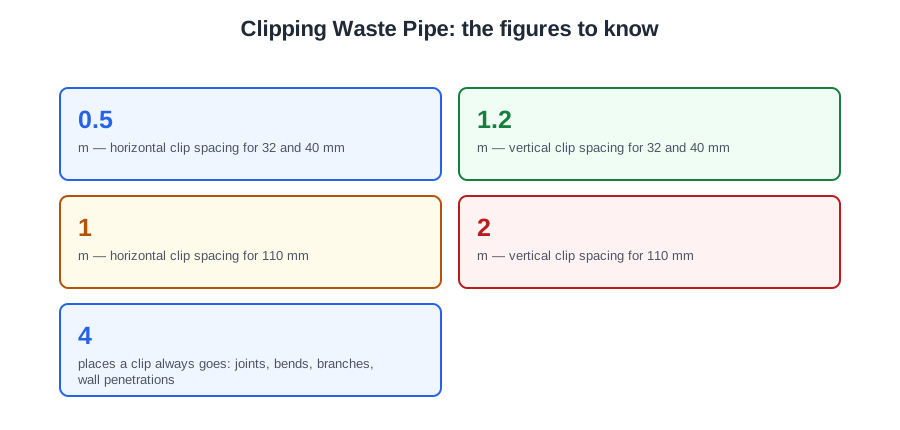
🔢 The numbers worth memorising
- 0.5
- m — horizontal clip spacing for 32 and 40 mm
- 1.2
- m — vertical clip spacing for 32 and 40 mm
- 1
- m — horizontal clip spacing for 110 mm
- 2
- m — vertical clip spacing for 110 mm
- 4
- places a clip always goes: joints, bends, branches, wall penetrations
⚠️ Where people go wrong
- Using the vertical spacing on a horizontal run. Horizontal needs roughly twice as many clips.
- Assuming bigger pipe needs more clips. It is stiffer, so it needs fewer.
- Using an oversized clip. The pipe moves, which is what the clip was there to stop.
- Forcing a clip on too tight. The pipe then cannot expand.
- Spacing to the table and ignoring the fittings. A clip goes near every joint, bend and branch.
📝 8-Question Self-Test
Straight from the Level 1 course question bank. Click an option to see whether you got it right — the explanation appears instantly, and there is nothing to submit.
32 mm and 40 mm are clipped at 0.5 m horizontally and 1.2 m vertically. 110 mm is 1 m and 2 m.
110 mm pipe is heavy, so its support is often a bracket rather than a simple clip.
Clips are sized to the pipe. Too big lets the pipe move; forced on too tight stops it expanding.
Clips are sized to the pipe: 32 mm, 40 mm and 110 mm.
Put a clip close to every joint, bend and branch, and where the pipe passes through a wall. Those are the points that carry load and the points that pull apart.
110 mm: 1 m horizontal, 2 m vertical. 32 mm and 40 mm: 0.5 m horizontal, 1.2 m vertical.
Clips match the pipe: 32 mm, 40 mm and 110 mm. The 110 is a far heavier bracket because it carries a soil stack rather than a basin waste. The paper shows clips and asks which size of pipe they suit.
1.2 m for 40 mm vertical waste. The pattern is the one you know from every other material: vertical spacing is wider than horizontal, and bigger pipe needs fewer clips.
Going deeper: the same ground at Level 2
Level 1 gives you the shape of this. The Level 2 guides below take it considerably further — the regulations, the calculations and the detail you will need next. Free to read, same as these.
- Start here: Above Ground Drainage for Level 1 — the whole unit in one piece
- All 72 Level 1 guides — one per lesson, across all ten units
- The Level 1 glossary — 620 terms in plain English