Two sizes cover nearly all domestic copper. Get the clip spacing right as well and the system is quiet — unclipped pipe is the usual cause of banging.
Typical sizes
Domestic copper is measured on its outside diameter. Worth stating plainly, because low carbon steel is measured on the inside, and mixing the two up is a classic mistake.
- 15 mm — connections to basins, WCs, radiators, and most branch pipework.
- 22 mm — baths, and main distribution pipes feeding several outlets.
The logic is flow. A bath needs to fill in a reasonable time and a distribution pipe is feeding several things at once, so both need a bigger bore. A basin does not.
The fittings
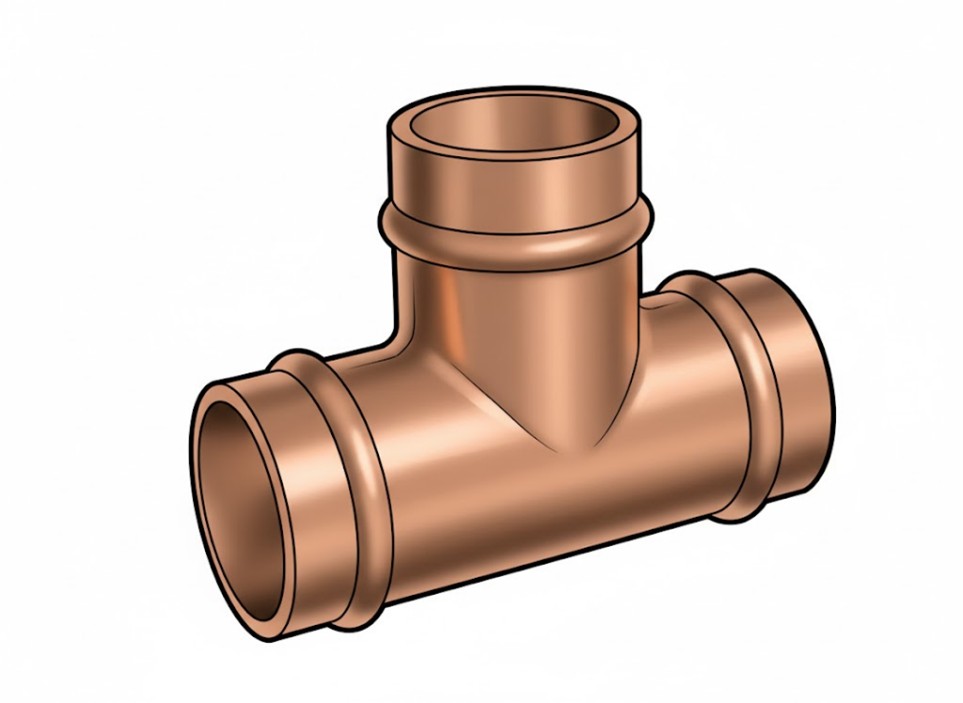
- Elbow — changes direction, usually 90°.
- Tee — takes a branch off a run.
- Coupling — joins two straight lengths.
- Reducer — joins one size to another, 22 mm down to 15 mm.
- Tap connector — connects pipework to the threaded tail of a tap or a float operated valve (the valve in a cistern, often still called a ballvalve).
And two kinds of soldered fitting, which are worth keeping separate in your head:
- Solder ring — a capillary fitting with the solder already in a ring inside it. Also called Yorkshire, after the maker.
- End feed — a capillary fitting with no solder in it. You feed solder into the mouth of the joint yourself. Cheaper, and it needs more skill.
The clips
- Plastic push on clips for copper — the pipe snaps into them.
- Brass school board clips — a brass saddle screwed to the surface. Neat where the pipe is on show, which is why you see them on exposed pipework in older buildings.
- Plastic clips — screwed saddle clips.
- Nail clips — a clip with a masonry nail through it. Quick, and used for pipe that will be hidden.
Clip spacing
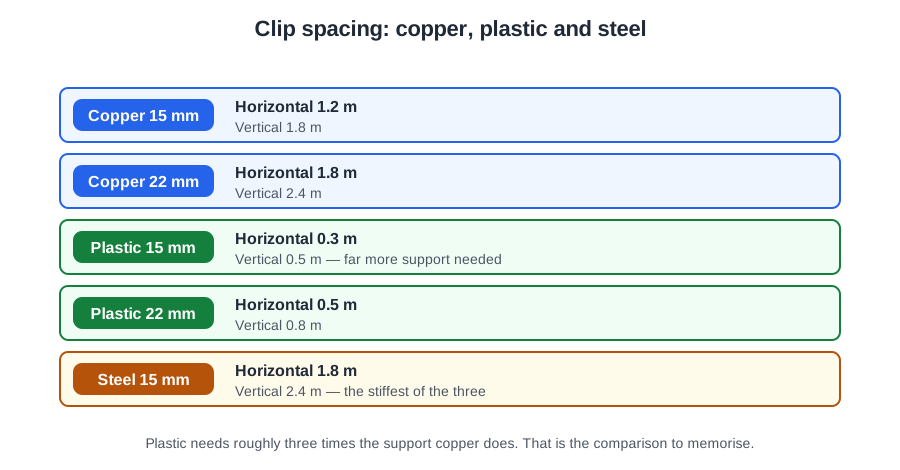
| Pipe | Horizontal | Vertical |
|---|---|---|
| 15 mm | 1.2 m | 1.8 m |
| 22 mm | 1.8 m | 2.4 m |
The same two patterns as waste pipe, and for the same reasons:
- Horizontal runs need more support than vertical, because gravity is pulling the pipe out of line rather than along it.
- Bigger pipe needs fewer clips, because it is stiffer.
And whatever the table says, clip close to a fitting, a bend and an appliance connection, so the weight is never hanging on the joint.
Why unclipped pipe bangs
This is the practical reason the spacing matters, and it is worth knowing because you will be asked about it by customers long before you are asked about it in an exam.
When a tap is closed quickly, the water in the pipe stops suddenly. It has weight and it was moving, so stopping it produces a shock — the pressure spike is called water hammer. That shock makes the pipe jump.
A properly clipped pipe absorbs it and you hear nothing. A loose pipe moves and hits the joist, and the bang travels through the whole house.
So the first thing to check on a banging system is not the taps. It is whether anybody clipped the pipe.
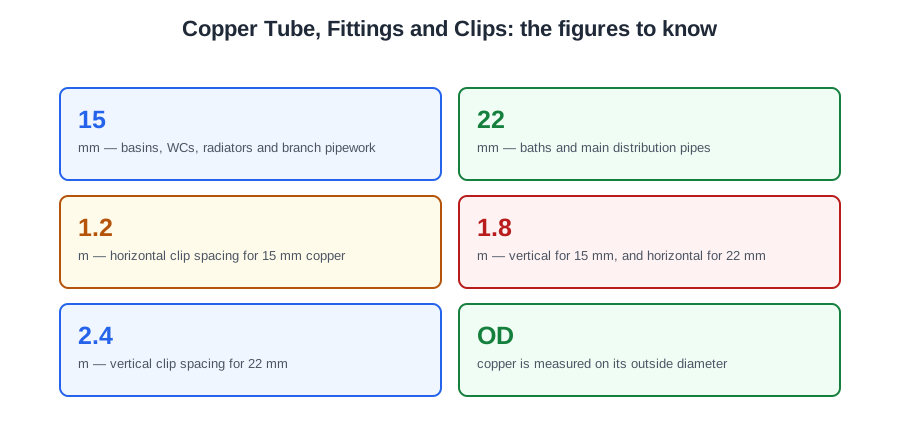
🔢 The numbers worth memorising
- 15
- mm — basins, WCs, radiators and branch pipework
- 22
- mm — baths and main distribution pipes
- 1.2
- m — horizontal clip spacing for 15 mm copper
- 1.8
- m — vertical for 15 mm, and horizontal for 22 mm
- 2.4
- m — vertical clip spacing for 22 mm
- OD
- copper is measured on its outside diameter
⚠️ Where people go wrong
- Confusing solder ring with end feed. Solder ring has the solder in it; end feed does not.
- Measuring copper on the inside. Copper is sized on the outside diameter.
- Using vertical spacings on a horizontal run.
- Spacing to the table and skipping the fittings. Clip close to bends, fittings and appliance connections.
- Blaming the taps for banging pipes. Unclipped pipe is the usual cause.
📝 8-Question Self-Test
Straight from the Level 1 course question bank. Click an option to see whether you got it right — the explanation appears instantly, and there is nothing to submit.
15 mm and 22 mm. Copper is measured on its outside diameter.
A tap connector connects pipework to the threaded tail of a tap or a ballvalve.
A solder ring capillary fitting has the solder already in a ring inside it. It is also called a Yorkshire.
A reducer joins one size to another — 22 mm down to 15 mm, for instance.
Domestic copper is measured on its outside diameter — unlike low carbon steel, which is quoted on the bore.
22 mm is used for baths and for main distribution pipes feeding several outlets. 15 mm does basins, WCs, radiators and most branch pipework.
Elbows, tees, couplings, reducers and tap connectors, plus the two soldered types — solder ring and end feed. Munsen rings are a steel pipe support, not a copper fitting.
A solder ring fitting has the solder in a ring inside the socket — heat it and it flows. An end feed has none, and you feed solder into the mouth of the joint. End feed is cheaper; solder ring is more forgiving.
Going deeper: the same ground at Level 2
Level 1 gives you the shape of this. The Level 2 guides below take it considerably further — the regulations, the calculations and the detail you will need next. Free to read, same as these.
- Start here: Copper Pipework for Level 1 — the whole unit in one piece
- All 72 Level 1 guides — one per lesson, across all ten units
- The Level 1 glossary — 620 terms in plain English