Low carbon steel — mild steel, or just "iron" on site — is heavy, rigid pipe joined by cutting a thread onto it. It is the oldest way of doing it and it teaches you more about pipework than anything else at Level 1.
Two ways to join it
Screwed is the usual method: a thread is cut onto the pipe end and it screws into a threaded fitting, sealed with PTFE tape or with jointing compound and hemp.
Compression — a nut and olive, as on copper — is used for connections to other materials and where a thread cannot be cut.
The fittings, and the one that saves you
Four are the same shapes as every other material: elbow, tee, coupling (sometimes called a socket) and reducer.
The fifth is the interesting one. A union is a three-part fitting that can be undone without unscrewing the whole run.
Think about why that is needed. On threaded pipework every joint tightens the same way. Once a run is screwed together there is no way to take it apart in the middle — you would have to unscrew it from one end, undoing everything in between. A union gives you a place to break it. On a screwed system it is essential rather than convenient.
Sizes: imperial, and measured differently
LCS is still often sold in imperial sizes, and — this is the bit that catches people — they are quoted as the bore, the inside, not the outside like copper.
- ½ inch ≈ 15 mm
- ¾ inch ≈ 20 mm
So 15 mm copper is 15 mm on the outside, while 15 mm LCS is roughly 15 mm on the inside and noticeably fatter. Note also that steel goes 15 and 20, where copper goes 15 and 22.
Three grades
LCS comes in three grades, which differ in wall thickness and are identified by a coloured band: light, medium and heavy. Medium is the usual grade for domestic heating pipework; heavy has the thickest wall, for higher pressures and buried work.
Cutting a thread
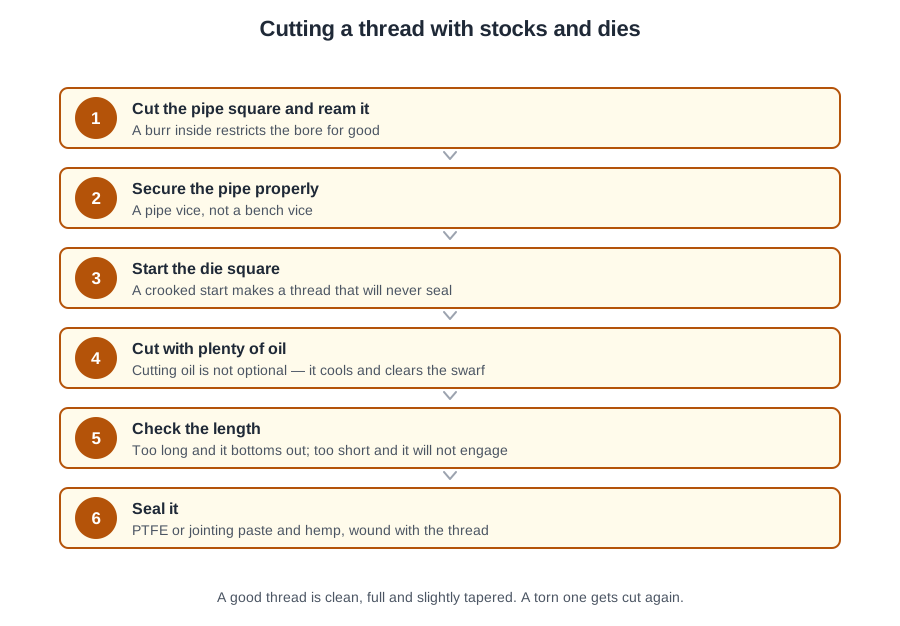
The die is a hardened ring with cutting teeth that cuts a spiral groove into the pipe. The stock is the frame that holds it and gives you the leverage.
- Clamp the pipe in a pipe vice, with only a short length projecting. A length of steel pipe swinging round under a stock is a serious injury.
- Cut it square and deburr — a burr fouls the die.
- Fit the correct die for the pipe size into the stock.
- Start the die square onto the pipe end, pressing firmly until it bites. This is the step that decides whether the thread is any good; once it has bitten crooked, nothing later will straighten it.
- Apply plenty of cutting oil, and keep applying it.
- Turn forward about half a turn, then back a quarter turn to break the swarf. Repeat.
- Stop when the pipe end is flush with the outer face of the die. That gives the standard thread length.
- Wind off, clean the swarf, and check it.
A good thread is clean and sharp, square to the pipe, slightly tapered so it tightens as it goes in, and the right length — too short and the fitting will not reach, too long and bare thread is left showing, which rusts.
Cutting oil is not optional. It cools and lubricates the die. Threading dry blunts the die, tears the thread and produces a joint that cannot be sealed.
Sealing and clipping
The thread makes the mechanical connection but does not seal on its own. Wrap PTFE tape in the direction the fitting turns, or use jointing compound with hemp, then tighten with two stillsons — one holding, one turning.
Steel is carried on cast school board clips (a cast saddle screwed to the surface), Munsen rings (a two-part ring that clamps round the pipe and screws to a backplate — the usual method), and backplates screwed to the wall to take them.
- 15 mm (½") — 1.8 m horizontal, 2.4 m vertical.
- 20 mm (¾") — 2.4 m horizontal, 3.0 m vertical.
Put the three materials side by side at 15 mm horizontal and the pattern is obvious: plastic 0.3 m, copper 1.2 m, steel 1.8 m. The stiffer the pipe, the further apart the clips.
🔢 The numbers worth memorising
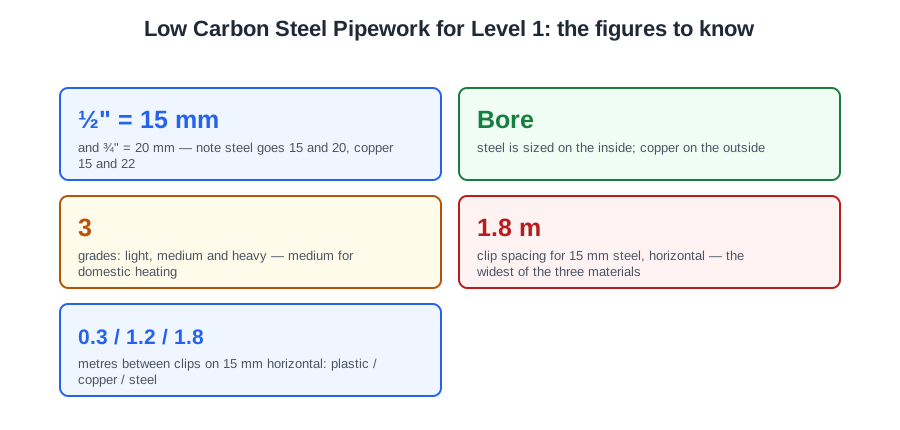
- ½" = 15 mm
- and ¾" = 20 mm — note steel goes 15 and 20, copper 15 and 22
- Bore
- steel is sized on the inside; copper on the outside
- 3
- grades: light, medium and heavy — medium for domestic heating
- 1.8 m
- clip spacing for 15 mm steel, horizontal — the widest of the three materials
- 0.3 / 1.2 / 1.8
- metres between clips on 15 mm horizontal: plastic / copper / steel
⚠️ Where people go wrong
- ¾ inch is 20 mm, not 22 mm. Copper goes 15 and 22; steel goes 15 and 20.
- Steel is measured on the bore. So 15 mm steel is noticeably fatter than 15 mm copper.
- Never thread dry. Cutting oil cools and lubricates the die; without it the thread tears and cannot be sealed.
- Getting the die square at the start is everything. A crooked thread cannot be rescued later.
- The thread does not seal on its own. It needs PTFE tape, or jointing compound and hemp.
📝 8-Question Self-Test
Straight from the Level 1 course question bank. Click an option to see whether you got it right — the explanation appears instantly, and there is nothing to submit.
The die is the hardened cutter that forms the thread; the stock holds it and gives leverage.
One wrench holds the fitting while the other turns the pipe, so the rest of the run is not twisted.
Cutting oil cools the die, lubricates the cut and gives a clean thread. Threading dry ruins dies.
A stillson pipe wrench grips and turns pipe and fittings — its jaws bite harder the more you pull. Two are used together: one to hold, one to turn.
LCS is heavy, rigid pipe. Bending it needs hydraulic force — it will not bend by hand.
Appropriate PPE for LCS means eye protection and gloves: freshly cut steel and a new thread are razor sharp, and the swarf is worse.
Correct use of tools: the pipe is properly clamped in a vice or stand before cutting or threading. A length of steel pipe swinging round is a serious injury.
Cutting oil cools and lubricates the die. Threading dry blunts the die, tears the thread and produces a joint that cannot be sealed.
Going deeper: the same ground at Level 2
Level 1 gives you the shape of this. The Level 2 guides below take it considerably further — the regulations, the calculations and the detail you will need next. Free to read, same as these.
- All 72 Level 1 guides — one per lesson, across all ten units
- The Level 1 glossary — 620 terms in plain English