Low carbon steel is heavy, rigid pipe joined by cutting a thread onto it. Everything about the toolkit follows from those two facts.
What the material is, and what it is called
Low carbon steel — LCS — is steel with a low proportion of carbon in it, which makes it strong but still soft enough to cut and thread. On site you will hear it called mild steel, or simply iron, and all three mean the same pipe.
It is joined by cutting a thread onto it, which is a different idea from anything else on the course, and it means bigger tools than copper needs.
The tools
LCS pipe cutter
Cutting steel pipe square. Heavier than a copper cutter, with a hardened wheel. A copper cutter will not touch steel.
Deburring tool
Removing the burr the cutter pushes into the bore.
On steel this burr is substantial — far bigger than the one on copper — and will restrict the flow if left. It is also the first thing a die will foul on when you come to cut a thread.
Hydraulic bender
Bending steel pipe. It needs hydraulic force — this pipe will not bend by hand. That is the point of naming the tool: there is no scissor bender equivalent for steel.
Stillson pipe wrench
Gripping and turning pipe and fittings.
The clever part is worth knowing: the jaws bite harder the more you pull. A Stillson has a slightly loose moving jaw, and the pulling force rocks it into the pipe. So it grips round pipe that a spanner could never hold.
Two are used together — one to hold, one to turn. Same principle as two adjustable spanners on a compression fitting, and more important here because the forces are much larger.
Electric threading machine
Cutting threads quickly and consistently. Powered, so it demands respect — see the safety section.
Hand stocks and dies
Cutting a thread by hand. The stock is the handle and holder; the die is the hardened cutter that forms the thread.
Two words that get muddled constantly, and they are asked about separately. Stock = the frame. Die = the cutter.
Safety requirements
Correct use of tools
Pipe properly clamped in a vice or stand before cutting or threading.
This is the one that matters most. Cutting a thread applies a lot of turning force to the pipe, and if the pipe is not held, the pipe turns instead of the die. A length of steel pipe swinging round is a serious injury — it is heavy, it is at waist height, and it does not stop.
Tools maintained in good condition
Sharp dies, sound wrench jaws.
Appropriate PPE
Eye protection, and gloves: freshly cut steel and a new thread are razor sharp, and the swarf is worse. Steel swarf comes off in fine curls that go through skin easily and are hard to see.
The electric threading machine
It gets its own paragraph because the hazard is a different kind: it is a machine that grips a pipe and spins it.
- Keep loose clothing, long hair, gloves and rags away from the rotating pipe.
- Know where the foot switch is before you start.
Note that gloves are on that list even though gloves are recommended everywhere else in this lesson. That is not a contradiction — it is the same rule as with a drill. Near anything rotating, a glove that catches takes your hand with it. Gloves for handling the pipe and the swarf; no gloves at the machine.
Basic maintenance
- Replace the cutter wheel when it stops cutting cleanly.
- Keep dies sharp and clean. A blunt die tears a rough thread that will not seal — and a thread that will not seal cannot be fixed afterwards, only cut off and done again.
- Use cutting oil when threading. It cools the die, lubricates the cut and gives a clean thread. Threading dry ruins dies.
- Keep the Stillson jaws clean and sharp; worn teeth slip, and a slipping Stillson under load sends your hand into whatever is behind it.
- Clean swarf off everything and lightly oil the tools, because steel tools rust — unlike most of the copper toolkit.
🔢 The numbers worth memorising
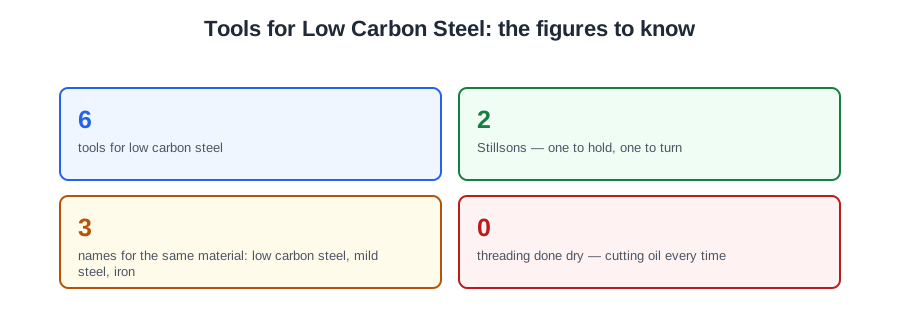
- 6
- tools for low carbon steel
- 2
- Stillsons — one to hold, one to turn
- 3
- names for the same material: low carbon steel, mild steel, iron
- 0
- threading done dry — cutting oil every time
⚠️ Where people go wrong
- Confusing the stock and the die. The stock is the frame; the die is the cutter.
- Threading without clamping the pipe. The pipe turns instead, and it is heavy.
- Threading dry. Cutting oil cools, lubricates and saves the die.
- Wearing gloves at the threading machine. Gloves for handling swarf; never near the rotating pipe.
- Using a copper pipe cutter on steel. LCS needs a heavier cutter with a hardened wheel.
📝 8-Question Self-Test
Straight from the Level 1 course question bank. Click an option to see whether you got it right — the explanation appears instantly, and there is nothing to submit.
The die is the hardened cutter that forms the thread; the stock holds it and gives leverage.
One wrench holds the fitting while the other turns the pipe, so the rest of the run is not twisted.
Cutting oil cools the die, lubricates the cut and gives a clean thread. Threading dry ruins dies.
A stillson pipe wrench grips and turns pipe and fittings — its jaws bite harder the more you pull. Two are used together: one to hold, one to turn.
LCS is heavy, rigid pipe. Bending it needs hydraulic force — it will not bend by hand.
Appropriate PPE for LCS means eye protection and gloves: freshly cut steel and a new thread are razor sharp, and the swarf is worse.
Correct use of tools: the pipe is properly clamped in a vice or stand before cutting or threading. A length of steel pipe swinging round is a serious injury.
Cutting oil cools and lubricates the die. Threading dry blunts the die, tears the thread and produces a joint that cannot be sealed.
Going deeper: the same ground at Level 2
Level 1 gives you the shape of this. The Level 2 guides below take it considerably further — the regulations, the calculations and the detail you will need next. Free to read, same as these.
- Start here: Low Carbon Steel Pipework for Level 1 — the whole unit in one piece
- All 72 Level 1 guides — one per lesson, across all ten units
- The Level 1 glossary — 620 terms in plain English