The PPE people skip is almost always the mask and the ear defenders, and almost never the gloves. That is exactly the wrong way round.
The short answer
Eight items: protective clothing, safety helmet, high visibility wear, safety footwear, eye protection, hearing protection, gloves, dust mask or respirator. Each protects against a specific named hazard, and our Level 1 lesson pairs them up for the exam.
This is about the parts that decide whether it works at all.
Who pays
Your employer. PPE has to be provided free of charge and it cannot be stopped out of your wages — not for the item, not for a replacement, and not as a deposit. That is the law, not a matter of firm policy.
Boots are where this gets argued about, because people want their own. That is fine, and plenty of employers contribute; what is not fine is being told you must buy your own before you can start.
Face fit testing, and why a beard is a real problem
A tight-fitting mask only works if it seals against skin. If air can get round the edge it will, because that is the path of least resistance, and you breathe the dust instead of filtering it.
Which is why face fit testing exists: a check that the specific mask fits the specific face. It is a legal requirement for tight-fitting respirators, and it is why one person's mask is not automatically right for another.
Stubble breaks the seal. That is not a rule invented to annoy anybody — it is the reason the mask stops working. If you will not shave, the answer is a loose-fitting powered respirator, which seals differently.
The ratings actually mean something
Dust masks are rated FFP1, FFP2 and FFP3 for how much they filter, and for silica dust from cutting brick, block or concrete, FFP3 is the one. A nuisance dust mask from a DIY shop is not the same product and will not do it.
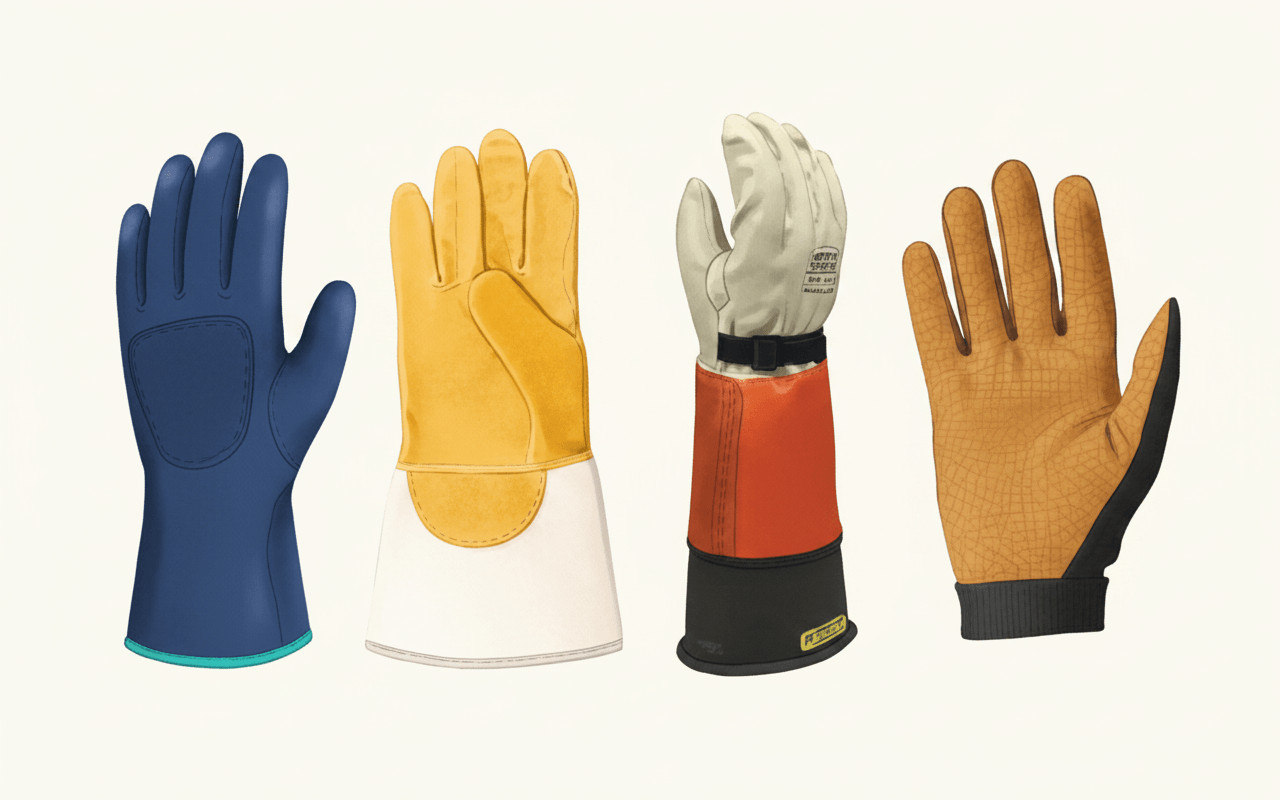
Gloves carry EN ratings for cut, abrasion, tear and puncture, which is why "gloves" is not one thing. Cut-resistant gloves for handling sheet metal are a different item from the ones you wear to keep your hands clean, and the wrong pair gives you the confidence of protection without the protection.
Eye protection likewise: safety glasses stop things coming from in front, goggles seal against dust and splashes, and a face shield covers the whole face for grinding.
The two plumbers skip
Hearing protection and the mask — and it is not a coincidence. Both protect against damage that builds up invisibly over years, so there is no moment where your body tells you that you should have worn it.
Gloves get worn because a cut hurts today. Hearing damage and lung damage never hurt today, and by the time they do, they are permanent. Those are the two where wearing it when you cannot feel a reason is the whole skill.
The bit that is not PPE at all
PPE is the last line of defence, and a job that relies on it is usually a job that was set up wrong. Cutting wet beats a mask. On-tool extraction beats a mask. A quieter tool beats defenders. Assembling at ground level beats a harness.
The regulations put it last on purpose, because it protects one person, only while worn, and only if it fits.
What comes next
At Level 2 this becomes the hierarchy of control properly, plus COSHH assessments that decide what protection a given substance needs. And the day you employ somebody, providing it becomes your duty rather than somebody else's.
🔢 The numbers worth memorising
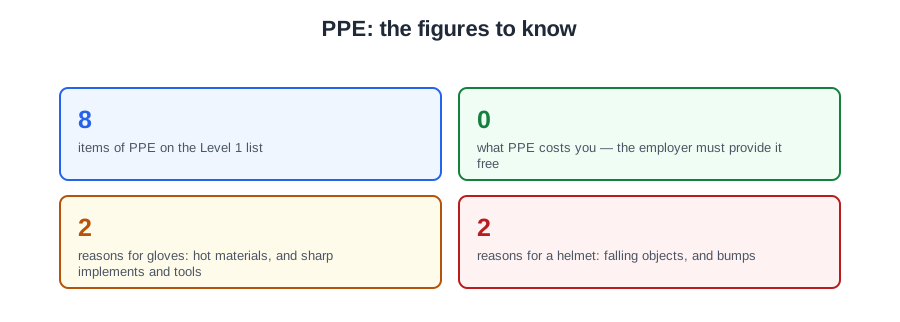
- 8
- items of PPE on the Level 1 list
- 0
- what PPE costs you — the employer must provide it free
- 2
- reasons for gloves: hot materials, and sharp implements and tools
- 2
- reasons for a helmet: falling objects, and bumps
⚠️ Where people go wrong
- Naming the item without the purpose. The mark is for what it protects against.
- Giving one reason for gloves or for a helmet when the list has two.
- Treating PPE as the first control. It is the last line — remove or control the hazard first.
- Wearing gloves near a rotating tool. A caught glove pulls your hand in.
- Assuming any mask does the job. If it does not seal to your face, it does nothing.
📝 8-Question Self-Test
Straight from the Level 1 course question bank. Click an option to see whether you got it right — the explanation appears instantly, and there is nothing to submit.
A safety helmet protects against falling objects and bumps.
Gloves protect against hot materials and sharp implements and tools.
PPE is the last line of defence. Removing the hazard altogether always comes first.
High visibility wear exists so you can be clearly seen around site, especially near plant and vehicles.
A dust mask or respirator. It has to fit — one that leaks around the edge protects nobody.
The exam asks for the purpose, not just the name: gloves are for hot materials and sharp implements and tools.
Both halves: the risk of equipment or materials falling on the head, and protecting the head in confined spaces. Things dropping on you, and you hitting things.
The risk of being hit by moving plant and vehicles on site. It does nothing except make you visible, and in poor light and bad weather that is a great deal.
Going deeper: the same ground at Level 2
Level 1 gives you the shape of this. The Level 2 guides below take it considerably further — the regulations, the calculations and the detail you will need next. Free to read, same as these.
- Start here: Safe Working for Level 1 Plumbers — the whole unit in one piece
- All 72 Level 1 guides — one per lesson, across all ten units
- The Level 1 glossary — 620 terms in plain English