Three sizes covers nearly all of domestic waste. Getting one of them wrong is the most common mistake on the unit, and it empties a bath’s trap.
The three sizes
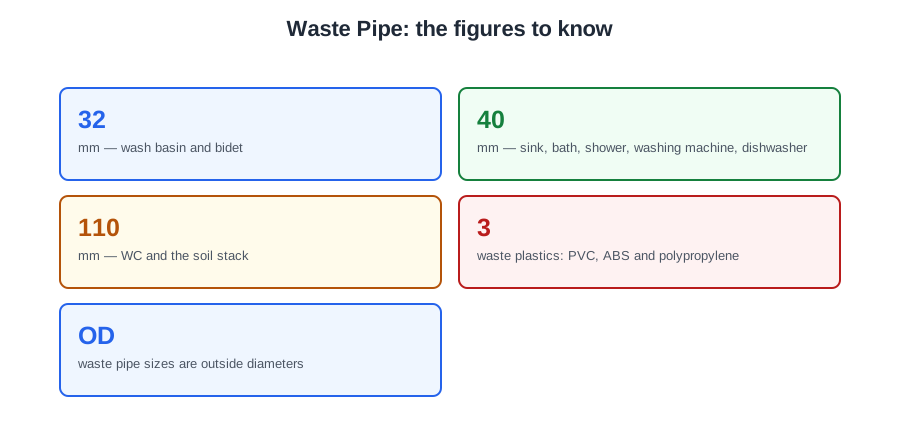
- 32 mm — wash basin, bidet.
- 40 mm — sink, bath, shower, washing machine, dishwasher.
- 110 mm — WC, and the soil stack itself.
The 40 mm list is the long one, so a good way to learn all three is: basins and bidets are 32, WCs and the stack are 110, and everything else in a normal house is 40.
Why undersizing matters
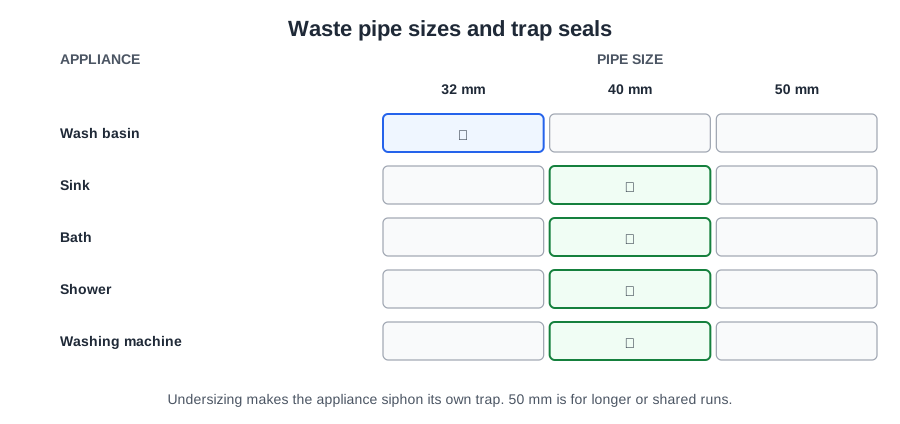
Undersizing is the common mistake, and the usual case is a bath run in 32 mm.
Two things go wrong:
- It empties slowly. A bath holds a lot of water and the customer notices.
- It can siphon its own trap dry.
That second one is the serious fault, and it is worth understanding now because it comes back at Level 2.
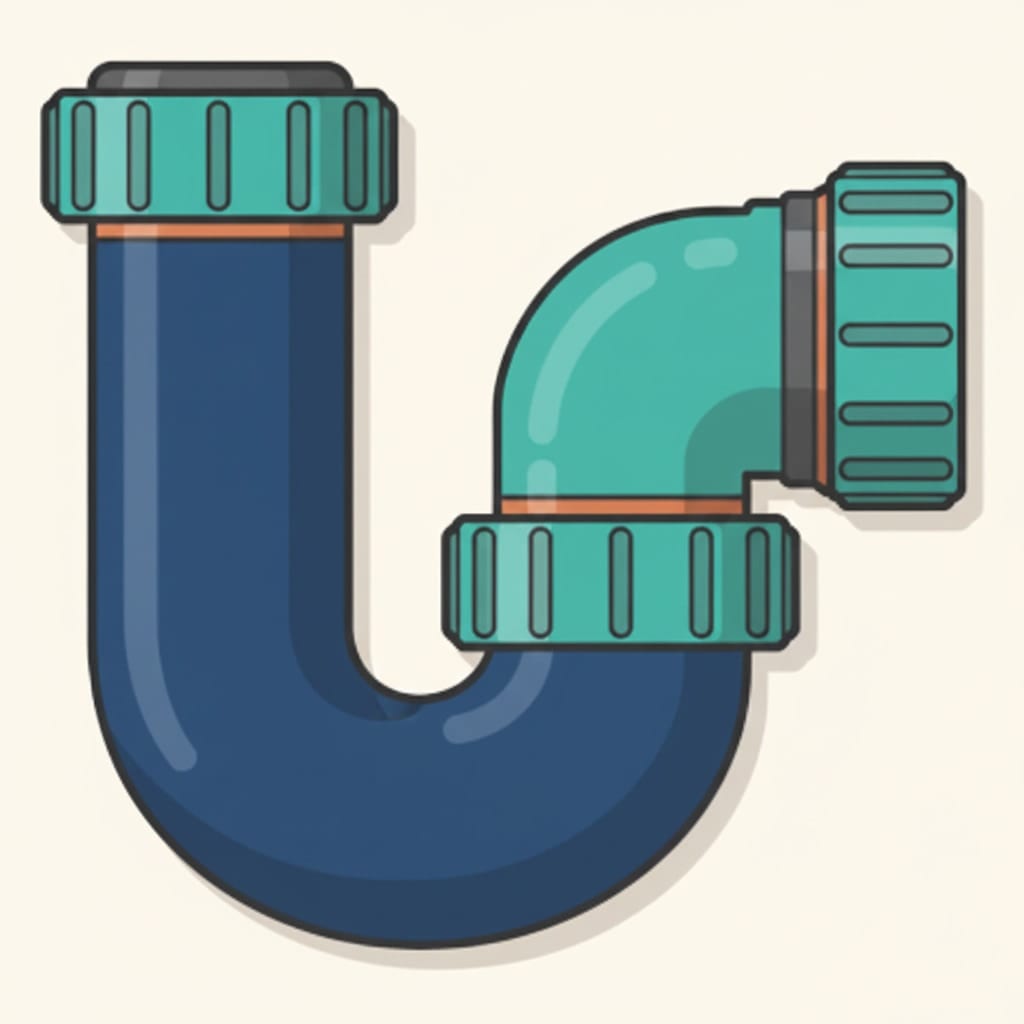
A trap is the bend under an appliance that holds a small amount of water. That water is a seal — it blocks the drain smell from coming back up into the room. If a full bore of water runs down an undersized pipe, it fills the whole pipe, and the water behind it drags the trap water out with it by suction. The trap is left empty, and the room smells of drains.
So a size that looks like it would only be slower is actually a fault that reaches the customer’s nose.
The fittings
Push fit waste fittings
A socket with a rubber seal inside it. Pipe pushes in and the seal grips.
Compression waste fittings
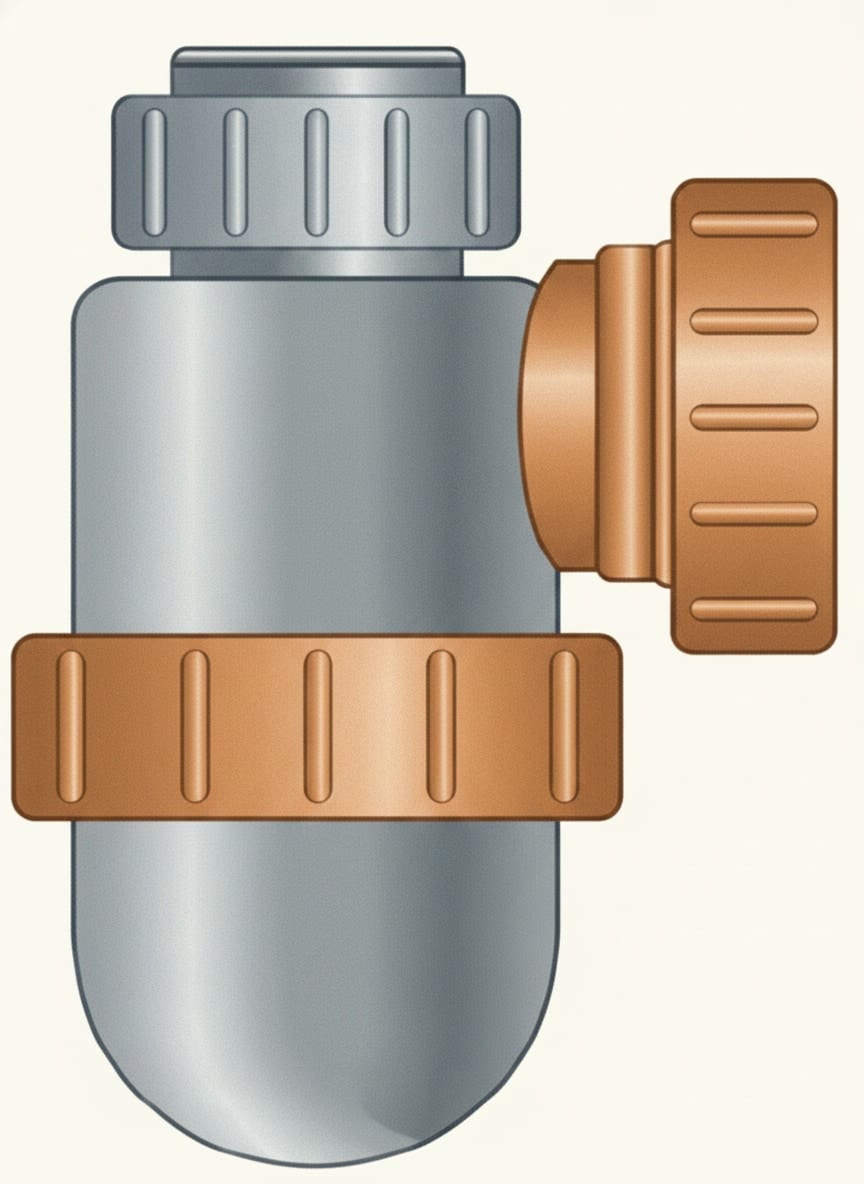
A nut and a seal that tighten onto the pipe. Common on traps and appliance connections, because they can be undone and remade.
Solvent weld fittings
Welded to the pipe with cement. The ones to name:
- Elbows — change direction.
- Tees — join a branch in.
- Couplings — join two straight lengths.
- Reducers — connect one size to another, for example a 40 mm branch into a 32 mm run.
Strap on boss
Clamps around a soil pipe and lets you cut in a new branch connection where there is no spare socket.
This is the fitting for adding a basin or a washing machine to an existing stack without replacing the stack. Very common on refurbishment work.
Plug fittings
Blank off an unused socket or branch. Also used to seal a system for testing, which is the answer people forget — you cannot pressure test or air test a system that is open at one end.
Two warnings worth taking seriously
Waste pipe sizes are outside diameters
“40 mm pipe” means 40 mm measured across the outside. This is not true of every pipe you will meet in plumbing, so it is worth fixing now.
The three plastics are not always interchangeable
Waste pipe comes in three materials:
- PVC (polyvinyl chloride)
- ABS (acrylonitrile butadiene styrene)
- Polypropylene (PP)
Different makes size and joint them slightly differently, and polypropylene cannot be solvent welded at all — the cement will not soften it, so it is push fit only.
Check that the fitting and the pipe are the same system before you cement anything. A solvent weld joint cannot be taken apart to correct, so this is a check you make before, not after.
🔢 The numbers worth memorising
- 32
- mm — wash basin and bidet
- 40
- mm — sink, bath, shower, washing machine, dishwasher
- 110
- mm — WC and the soil stack
- 3
- waste plastics: PVC, ABS and polypropylene
- OD
- waste pipe sizes are outside diameters
⚠️ Where people go wrong
- Running a bath in 32 mm. It empties slowly and can siphon its own trap dry.
- Assuming waste sizes are internal. They are outside diameters.
- Trying to solvent weld polypropylene. It will not weld — it is push fit only.
- Mixing makes and materials on a solvent joint. Check the system first; the joint cannot be undone.
- Forgetting that plug fittings are used to seal a system for testing, not just to blank a socket.
📝 8-Question Self-Test
Straight from the Level 1 course question bank. Click an option to see whether you got it right — the explanation appears instantly, and there is nothing to submit.
40 mm serves a sink, bath, shower, washing machine and dishwasher. 32 mm is for a basin, 110 mm for a WC.
A plug is a blank. Fittings and stacks come with more inlets than a job needs, and the spare ones are capped rather than left open. Almost every stack has one or two.
32 mm serves a wash basin and a bidet. 40 mm serves sink, bath, shower, washing machine and dishwasher. 110 mm is the WC and the stack.
A bath on 32 mm empties slowly and can siphon its own trap dry, which lets drain smells into the room. A bath takes 40 mm.
Bath 40 mm, wash basin 32 mm. The logic is flow: a basin empties slowly through a small waste, and a bath dumps eighty litres and needs more. 110 mm is soil pipe, for the WC and the stack.
Three sizes: 32 mm, 40 mm and 110 mm. 32 mm on a wash basin, 40 mm on a bath, sink, shower or washing machine, and 110 mm for the WC and the soil stack.
Plug fittings blank off an unused socket or branch, and are used to seal a system for testing.
Compression waste fittings use a nut and a seal that tighten onto the pipe, and are common on traps and appliance connections because they undo easily.
Going deeper: the same ground at Level 2
Level 1 gives you the shape of this. The Level 2 guides below take it considerably further — the regulations, the calculations and the detail you will need next. Free to read, same as these.
- Start here: Above Ground Drainage for Level 1 — the whole unit in one piece
- All 72 Level 1 guides — one per lesson, across all ten units
- The Level 1 glossary — 620 terms in plain English