A whole gutter run is made from about seven standard fittings. Learn what each one does and you can describe any house from the pavement.
Working along the run
The easiest way to learn these is to follow the water: along the gutter, into the outlet, down the wall, and out at the bottom.
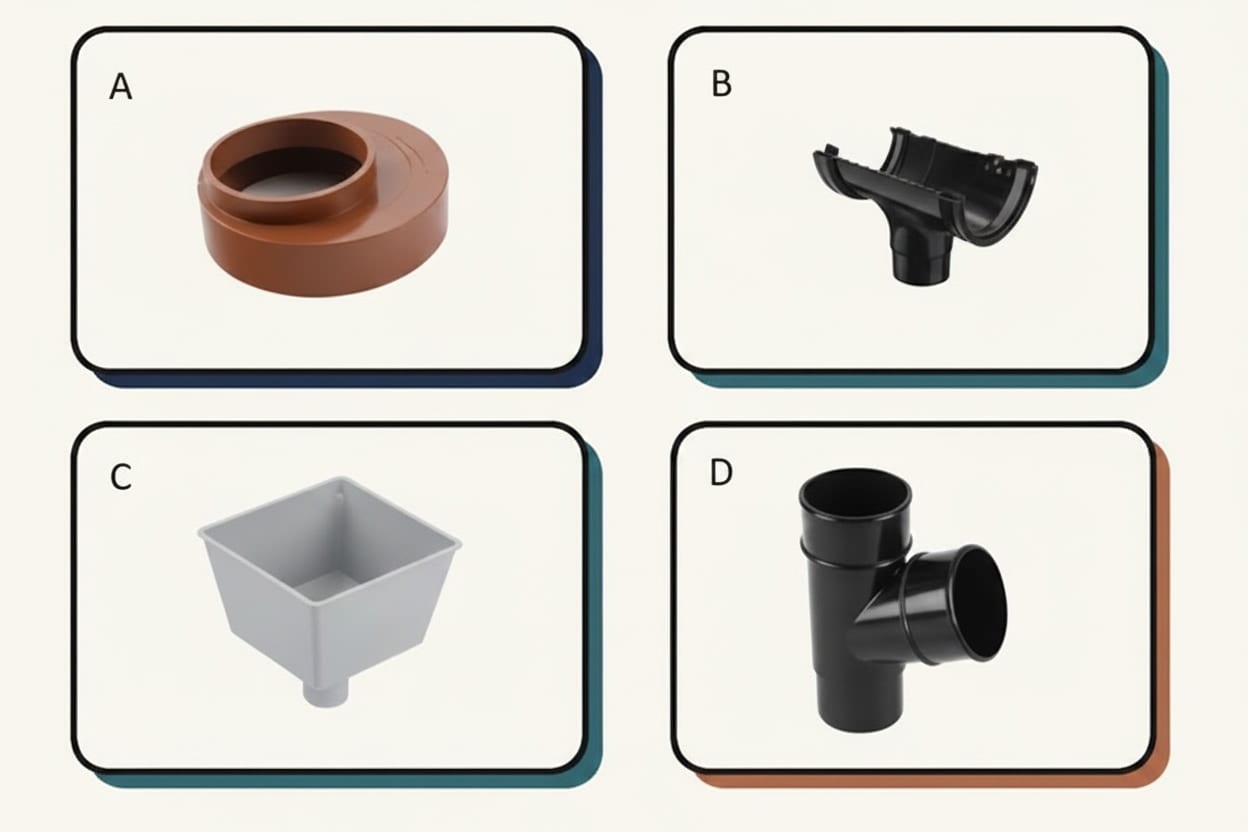
Union bracket
Joins two lengths of gutter together and supports the joint at the same time.
Both halves of that matter. It is a connector and a bracket — which is why a joint in a gutter is always supported, and why you do not need a separate bracket right next to it.
Running outlet
The take-off in the middle of a run where the downpipe leaves the gutter.
“Running” is the clue: it sits in the run of the gutter with gutter continuing on both sides. A stop end outlet, by contrast, is one at the very end.
External stop end
Closes the end of a gutter, fitting over the outside of the gutter end.
Internal stop end
Closes the end from inside the gutter.
Used where the gutter runs up tight to a wall and there is no room outside it for an external one — a terraced house where the gutter finishes against the neighbour’s wall, for instance. That is the whole reason the internal version exists, and it is the reason a question will give you.
Downpipe connector
Joins lengths of downpipe together. Also called a pipe socket or coupler.
Offset bend
A pair of bends that steps the downpipe back to the wall from the gutter, which overhangs the wall by design.
Also called a swan neck, and both names get used, so know them as one thing. Some are supplied as a moulded one-piece offset, others as two separate bends and a short length of pipe between them, which lets you set the offset to whatever the overhang happens to be.
Shoe
The last fitting at the bottom, angled to throw the water away from the wall into a gully.
Without a shoe the water runs straight down the face of the brickwork, which stains it and, over years, saturates it. A missing or broken shoe is one of the most common causes of a damp patch on an internal wall.
The clips and brackets
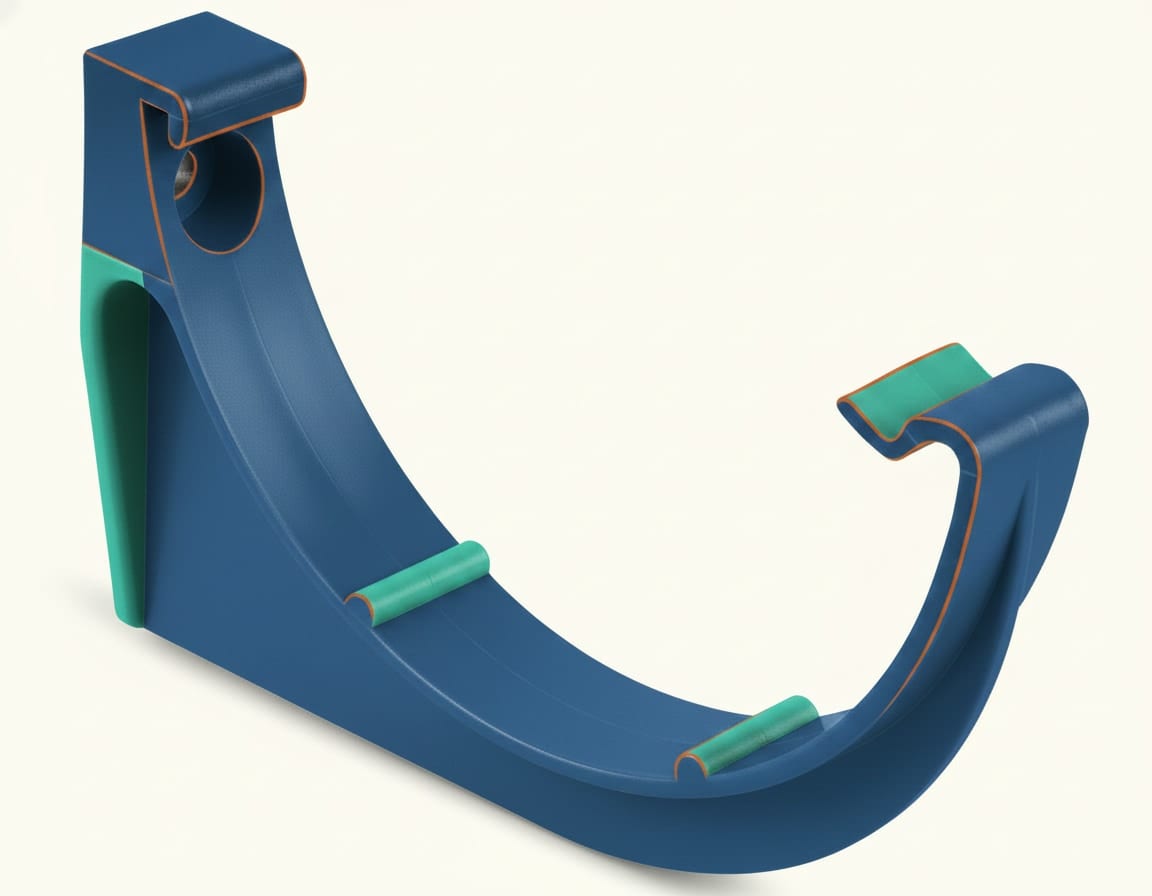
Gutter fascia support brackets
Screwed to the fascia board to carry the gutter. The fascia is the flat board fixed along the ends of the roof rafters, and it is what nearly all guttering hangs from. You will see it written both fascia and facia, and both mean the same board.
Downpipe clips
Hold the downpipe to the wall — and hold it slightly off the wall, which is deliberate for two reasons:
- The wall behind it can be painted.
- Water running down the outside of the pipe does not stain the brickwork.
Learning it
Two pairs cause nearly all the confusion, so check you can separate them:
- External and internal stop end — outside the gutter end, or inside it where there is no room.
- Union bracket and downpipe connector — one joins gutter, the other joins downpipe.
Then remember that the offset bend is the swan neck, and that the shoe is the one at the bottom.
🔢 The numbers worth memorising
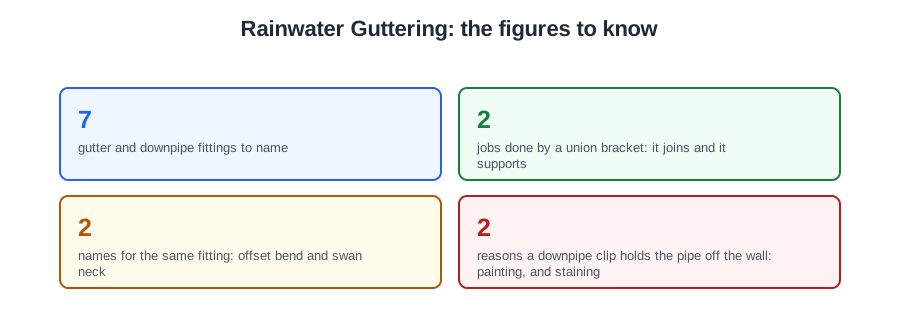
- 7
- gutter and downpipe fittings to name
- 2
- jobs done by a union bracket: it joins and it supports
- 2
- names for the same fitting: offset bend and swan neck
- 2
- reasons a downpipe clip holds the pipe off the wall: painting, and staining
⚠️ Where people go wrong
- Confusing the two stop ends. External fits over the outside; internal is used where there is no room outside.
- Not knowing that offset bend and swan neck are the same fitting.
- Forgetting the union bracket supports the joint as well as making it.
- Leaving the shoe off. Water then runs down the wall and causes damp.
📝 8-Question Self-Test
Straight from the Level 1 course question bank. Click an option to see whether you got it right — the explanation appears instantly, and there is nothing to submit.
A union bracket joins two lengths of gutter and carries the joint.
The shoe is angled so the water is thrown clear of the wall into the gully.
An internal stop end closes the gutter from inside, for where there is no room outside it.
Union bracket — it joins two lengths of gutter and supports them, which is why both words are in the name.
A running outlet takes the water out of the gutter and down into the downpipe, and it sits along the run rather than at the end — which is what running means here.
External stop end fits over the outside of the gutter; internal stop end sits inside it. Which you need depends on whether the gutter ends at a bare edge or runs into something.
Downpipe connector, offset bend and shoe are the downpipe fittings. The offset bend, also called a swan neck, brings the downpipe back from the overhanging gutter line to the face of the wall.
The gutter sits at the edge of an overhanging roof and the downpipe runs down the face of the wall. The offset bend, or swan neck, bridges the two. Without it the pipe cannot be clipped to the wall at all.
Going deeper: the same ground at Level 2
Level 1 gives you the shape of this. The Level 2 guides below take it considerably further — the regulations, the calculations and the detail you will need next. Free to read, same as these.
- Start here: Above Ground Drainage for Level 1 — the whole unit in one piece
- All 72 Level 1 guides — one per lesson, across all ten units
- The Level 1 glossary — 620 terms in plain English