Plastic needs roughly four times as many clips as copper. It is the same flexibility that makes it quick to run that makes it sag between supports.
Typical sizes
The same as copper — 15 mm and 22 mm — so the two systems connect straight to each other.
That is deliberate rather than a coincidence. It means plastic can be used to extend or repair a copper system without adaptors, which is a large part of why it took over.
The clips
- Plastic push on clips — the pipe snaps in.
- Plastic clips — screwed saddle clips.
- Nail clips — a clip with a masonry nail, for pipe that will be hidden.
Clip spacing
| Pipe | Horizontal | Vertical |
|---|---|---|
| 15 mm | 0.3 m | 0.5 m |
| 22 mm | 0.5 m | 0.8 m |
Check the manufacturer’s instructions, which take priority.
Compare that with copper
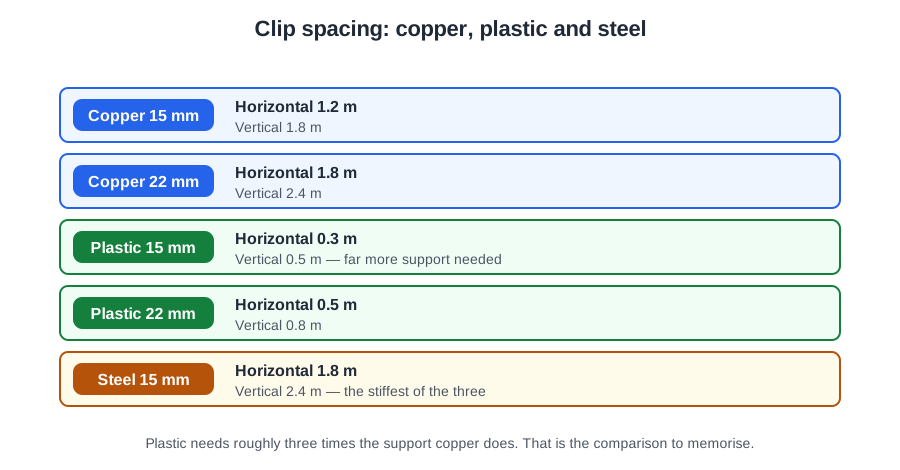
This is the comparison worth carrying, because it is the point of the lesson:
- Plastic 15 mm horizontal: 0.3 m
- Copper 15 mm horizontal: 1.2 m
Plastic needs roughly four times as many clips.
The reason is the flexibility. Copper is rigid enough to hold its own line over more than a metre; plastic is not, so it sags into a dip between supports. And a dip in a pressure pipe is not the same problem as a dip in a waste pipe — it does not block, but it does mean the run is never quite where the drawing says it is, and it puts a permanent bend load on the joints at each end.
The two patterns from the other materials still hold within the table: horizontal needs more support than vertical, and bigger pipe needs fewer clips because it is stiffer.
Two more support rules
Leave a snake on a hot run
Plastic expands more than copper when it warms up. On a long hot run — a heating flow, a hot water distribution pipe — leave a gentle snake in the pipe rather than pulling it dead straight, so it has somewhere to go.
A pipe pulled straight and clipped tight at both ends has nowhere to expand into, so it pushes against its own clips and joints. A gentle curve absorbs the growth without anything moving.
This is the same problem as the expansion gap in guttering, solved a different way: guttering gets a gap at the joint, and pressure pipe gets slack in the run.
Support at every fitting and appliance connection
So the weight of the pipe is never hanging on the joint.
Same rule as copper, waste and steel — but it matters most here, because plastic is the material most likely to droop and put load on a fitting.
The whole picture
Once you have done all three materials, the pattern is worth seeing in one place. For 15 mm pipe, run horizontally:
- Plastic — 0.3 m
- Copper — 1.2 m
- Low carbon steel — 1.8 m
The stiffer the pipe, the further apart the clips. One idea covers all three tables, and if you remember it you can reason your way to the right answer even when the exact figure has gone.
🔢 The numbers worth memorising
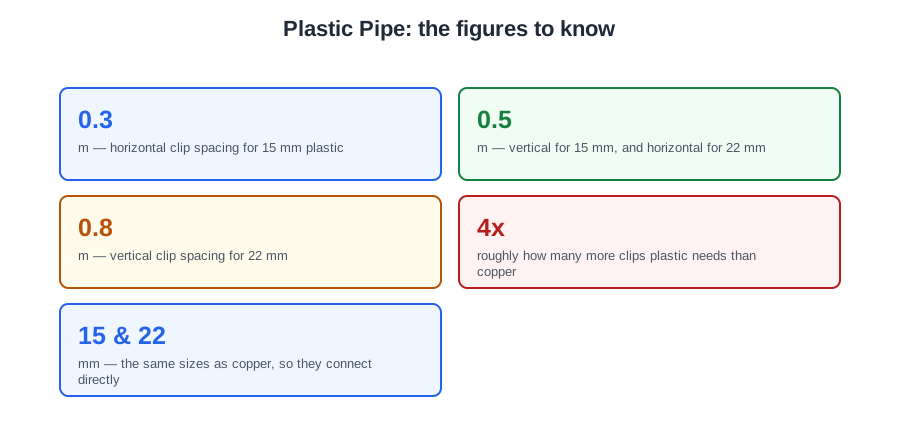
- 0.3
- m — horizontal clip spacing for 15 mm plastic
- 0.5
- m — vertical for 15 mm, and horizontal for 22 mm
- 0.8
- m — vertical clip spacing for 22 mm
- 4x
- roughly how many more clips plastic needs than copper
- 15 & 22
- mm — the same sizes as copper, so they connect directly
⚠️ Where people go wrong
- Using copper spacings on plastic. Plastic needs about four times as many clips.
- Pulling a hot run dead straight. Leave a gentle snake so it can expand.
- Forgetting to support at fittings and appliance connections.
- Assuming the manufacturer’s figures match the table. Theirs take priority.
📝 8-Question Self-Test
Straight from the Level 1 course question bank. Click an option to see whether you got it right — the explanation appears instantly, and there is nothing to submit.
Plastic push on clips, plastic clips and nail clips.
0.3 m horizontally and 0.5 m vertically. Plastic needs about four times as many clips as copper.
15 mm and 22 mm — the same as copper, so the two systems connect straight to each other.
The sizes match copper so the two systems connect straight to each other.
The sizes are the same, so a 22 mm fitting joins them directly. That is the whole point of matching copper's sizes.
Plastic push on clips — the pipe snaps in. Plastic screwed saddle clips and nail clips are the others.
A nail clip has a masonry nail through it and is used for pipe that will be hidden.
Plastic expands more than copper when it warms up, so leave a gentle snake in the pipe rather than pulling it dead straight.
Going deeper: the same ground at Level 2
Level 1 gives you the shape of this. The Level 2 guides below take it considerably further — the regulations, the calculations and the detail you will need next. Free to read, same as these.
- Start here: Plastic Pressure Pipework for Level 1 — the whole unit in one piece
- All 72 Level 1 guides — one per lesson, across all ten units
- The Level 1 glossary — 620 terms in plain English