The water coming out of a tap today is the same water that has been going round for millions of years. Everything between the source and the tap exists to make it fit to drink again.
The origin of water
All water on earth is recycled through the water cycle. The sun evaporates water from the sea; it condenses into cloud; it falls as rain; it runs into rivers or soaks into the ground; and it returns to the sea.
That is what “the origin of water” means, and it is worth stating plainly because it is genuinely striking: there is no new water. None is being made. The water in the cylinder you fit next week has been through that loop more times than anyone can count.
The five sources
Water is collected from five sources, and they differ in how clean they start out.
- River — surface water taken from a river. Plentiful, but the dirtiest: it has run over land and through towns to get there.
- Spring — water emerging naturally from the ground, already filtered by the rock it came through.
- Upland surface — rainwater collected off high ground into a reservoir. Little contamination, because few people live there.
- Deep well — a borehole into deep rock. Very clean, because the water has filtered through a long depth of ground.
- Shallow well — a well into the water table near the surface. More easily contaminated from the ground above it.
The pattern
The deeper and the higher, the cleaner.
Deep wells and upland surface water need the least treatment; river and shallow well water need the most. If you can hold that one sentence you can rank any of the five without memorising a table.
The reason is the same in both directions: dirt comes from people and from land use. Go deep and the ground filters it out. Go high and there is nobody upstream.
The six stages of supply
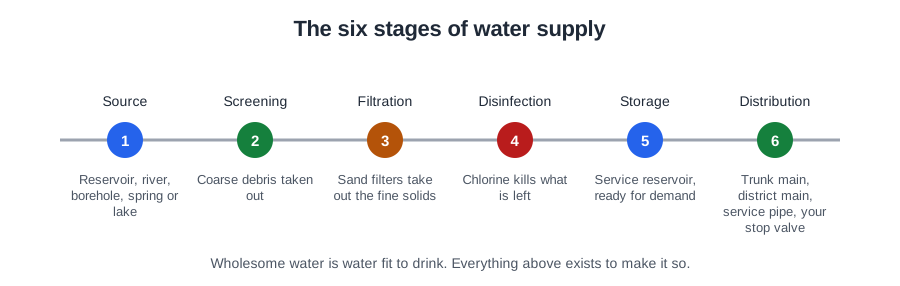
Between the source and the tap, water goes through six stages.
- Reservoir storage — held in quantity. This also lets heavy particles settle out on their own, before treatment even starts.
- Treatment — at the treatment works.
- Sedimentation — the water is held still so suspended solids sink to the bottom.
- Filtration — passed through sand and gravel beds to remove the finer particles that would not settle.
- Sterilisation — chlorine is added to kill bacteria. This is the stage that makes the water safe to drink.
- Distribution — pumped into the water mains and out to properties.
Sedimentation and filtration are not the same thing
They get confused because both remove solids. The difference is how:
- Sedimentation uses gravity — the water stands still and the heavy bits sink.
- Filtration uses a physical barrier — sand and gravel that the fine bits cannot pass through.
They are in that order for a reason. Settling out the heavy material first means the filters are not immediately clogged by it.
Wholesome water
Water that has been through all of this is described as wholesome: fit to drink.
That word is worth learning properly, because it is the word the Water Regulations use, and it is the standard everything else is measured against.
And here is the point that ties this lesson to the rest of your career: keeping the water wholesome once it is inside the building is the whole purpose of the water regulations, and it is your job. The water company delivers wholesome water to the boundary. What happens to it after that is down to how the plumbing was installed.
🔢 The numbers worth memorising
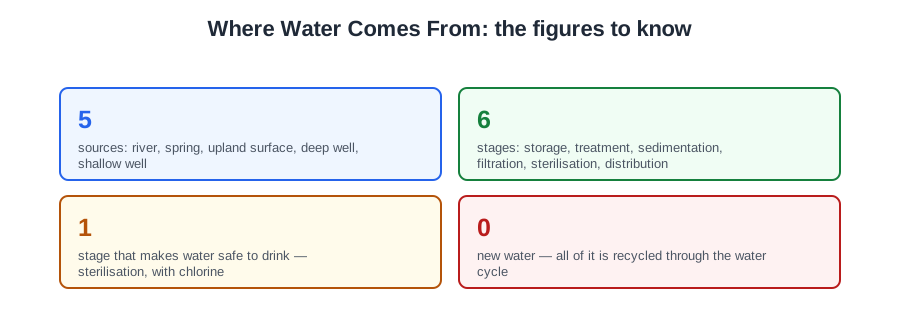
- 5
- sources: river, spring, upland surface, deep well, shallow well
- 6
- stages: storage, treatment, sedimentation, filtration, sterilisation, distribution
- 1
- stage that makes water safe to drink — sterilisation, with chlorine
- 0
- new water — all of it is recycled through the water cycle
⚠️ Where people go wrong
- Confusing sedimentation with filtration. Sedimentation uses gravity; filtration uses a barrier.
- Naming the wrong stage as the one that makes water safe. It is sterilisation.
- Ranking a river as clean because it is fresh water. It is the dirtiest of the five.
- Forgetting what wholesome means. It is the regulations’ word for water fit to drink.
📝 8-Question Self-Test
Straight from the Level 1 course question bank. Click an option to see whether you got it right — the explanation appears instantly, and there is nothing to submit.
The deeper and the higher, the cleaner. Deep wells and upland surface water need least treatment.
All water on earth is recycled through the water cycle: evaporation, condensation, rain, run-off and back to the sea.
All water on earth is recycled through the water cycle — the water coming out of a tap today is the same water that has been going round for millions of years.
The sun evaporates water from the sea, it condenses into cloud, falls as rain, runs into rivers or soaks into the ground, and returns to the sea.
River water is surface water that has run over land and through towns, so it needs the most treatment. The deeper and the higher, the cleaner.
A shallow well goes into the water table near the surface, so it is more easily contaminated from the ground above.
The six labels in order: heat from the sun, evaporation, water vapour, water saturated clouds, rain or snow, and the river running back to the sea to restart the process.
The five sources split into surface water — river and upland surface — and underground water — spring, deep well and shallow well.
Going deeper: the same ground at Level 2
Level 1 gives you the shape of this. The Level 2 guides below take it considerably further — the regulations, the calculations and the detail you will need next. Free to read, same as these.
- Start here: Installation, Repair and Maintenance for Level 1 — the whole unit in one piece
- All 72 Level 1 guides — one per lesson, across all ten units
- The Level 1 glossary — 620 terms in plain English