Two skills that turn out to be the same skill. Commissioning is following an order that lets each setting be made against a known state; fault finding is reading a system backwards to work out which state it is in. Both rest on the same thing: read the discharge first.
This article covers the last two lessons of the PlumbMate unvented hot water course: the commissioning sequence and why the order is not negotiable, diagnosing from what the discharge is doing, the classic installation defects, and the annual service. There is a 10-question mock test at the end.
Commissioning, in order
Commissioning follows a set order, and getting it wrong means you cannot set the system up correctly. Not “it takes longer” — you cannot do it, because each step depends on the state the one before it left the system in.
1. Set the expansion vessel pre-charge before filling
To the cold pressure, just below the relief setting — and before the system is filled.
This is first because it has to be. With water in the cylinder there is pressure on the other side of the diaphragm, and a gauge on the schrader valve is then reading the sum of the charge and the system pressure rather than the charge. You cannot set it accurately once the system is full, and a vessel set wrong is a system that discharges on every reheat forever afterwards.
2. Fill, vent the air, and leak-test at full pressure
Before going any further. Everything after this involves heat, and finding a weeping joint after the cylinder is hot is a much worse afternoon than finding it while everything is cold.
3. Test both relief valves — before the heat-up cycle
Lift the lever, confirm free discharge through the tundish, confirm a clean reseat. Both valves: expansion relief and temperature and pressure relief.
Note the position in the order. You test the safety valves before you first heat the cylinder, so that the first time the system ever comes up to temperature it does so with proven relief. Testing them afterwards is testing them after the risk has already been taken.
“Clean reseat” is half the test. A valve that opens and then weeps has failed, even though it discharged.
4. Heat up — and watch the expansion relief valve
On the heat-up cycle the expansion relief valve should NOT discharge. If it does, the pre-charge is wrong or the vessel has failed.
This is the check that validates step 1, which is why step 1 had to come first. A discharge here sends you back to the vessel, not onwards.
5. Set the temperatures
- Thermostat to 60–65 °C.
- The energy cut-out sits below the T&P valve, and everything sits under 100 °C.
The layering has to be right in the settings and not merely in the components. Three devices set to the wrong relative order is one device with two spectators.
6. Confirm the outlet
48 °C at the bath, via a TMV and a balanced cold supply. Both parts matter: the TMV cannot hold a blend without a balanced cold, so this step is also the test of whether the cold was taken from the right place at first fix.
7. Record and hand over
Finish with the commissioning or benchmark record and a proper customer handover, including the annual service.
The handover is not a formality. The customer is being given a pressure vessel with a maintenance requirement, and they need to know: the system needs servicing annually, the cut-out is reset by hand and a trip means something failed, and a discharge outside means call somebody rather than ignore it.
Fault finding: read the discharge first
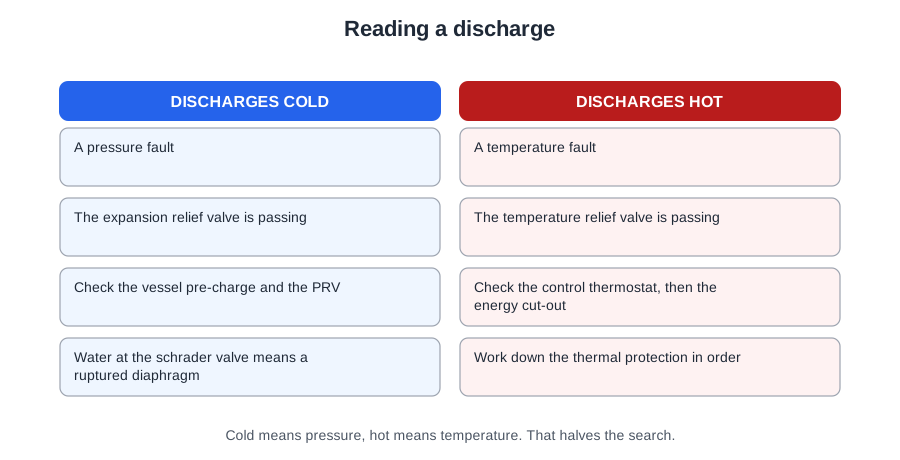
Which valve, when, and how hot. Those three observations do most of the diagnosis, and the organising rule is: pressure faults drip cold, temperature faults discharge hot.
The three signatures
Expansion valve dripping only when heating — the expansion vessel has lost its charge, or is waterlogged. Expansion has nowhere to go on reheat, the pressure rises past the valve setting, and it stops again when the system cools. The commonest unvented fault there is.
T&P discharging hot water and steam — overheating: the control thermostat and the energy cut-out have both failed. This is the third layer doing its job, which means two layers have already gone. It is not a T&P valve fault; it is a T&P valve report.
A burst of flow then weak flow — a blocked strainer. The stored volume leaves at pressure, then the refill rate is whatever the blockage allows.
What to do about overheating
Turn off the heat source, not the cold water — the cold is carrying heat away.
The instinct is to stop the discharge, and the way to stop it appears to be the cold supply. That is precisely backwards. The T&P valve is dumping hot water so that cold can flow in and cool the store; shut the cold off and you have removed the only cooling while leaving the heat input running.
Then: the energy cut-out is non-self-resetting. Fix the cause, then reset it by hand. Resetting without finding the cause puts the system back into service with one layer gone and no record that it ever went.
The classic installation defects
Four that come up repeatedly, all of them invisible on a working system:
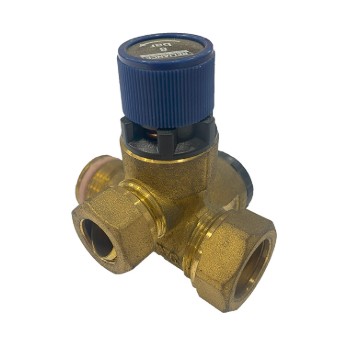
- The balanced cold in the wrong position — taken upstream of the PRV, so the mixer never holds a blend.
- A missing strainer — nothing protecting the PRV seat.
- The check valve missing or the wrong type.
- The T&P valve fitted too low — it must be in the hottest water at the top. Lower down it senses cooler water and lets the crown of the cylinder go past the temperature it exists to catch.
And the rule from lesson 7, repeated because it is the one people bend: failed safety valve, no correct spare — isolate and take out of use. Never cap, bypass, or fit the wrong valve.
The annual service
Six things, and it is worth doing all six rather than the two that are quick:
- Check and recharge the expansion vessel pre-charge.
- Test both relief valves — free discharge, clean reseat.
- Clean the strainer.
- Check the discharge arrangement — from lesson 6, and on an installation you did not fit this is the first time anybody has looked at it.
- Check the pressures.
- Record it.
The service is where the layered protection is actually maintained. Between services, a failed vessel and a seized relief valve produce no symptom the customer would notice — and a cylinder with a failed vessel and a valve that will not open is a cylinder with nothing between it and the thing this whole course is about.
Putting the course together
Nine lessons, and one idea running through all of them. There is no vent pipe, so every job the vent pipe did has to be done by a device. The devices are layered, each assuming the last has failed. The hazard is heat rather than pressure, so every safety device is a temperature device. And because the failure is invisible until it happens, the commissioning order, the annual service and the discharge arrangement are not administration — they are the parts of the system that keep the layers real.
📝 10-Question Mock Test
Click an option to see whether you got it right. Explanations appear instantly — no submitting at the end.
Set to the cold pressure, just below the relief setting, and set first — a vessel set wrong is a system that discharges on every reheat forever afterwards.
Testing them afterwards is testing them after the risk has already been taken. Both valves: lift the lever, confirm free discharge through the tundish, confirm a clean reseat — and a valve that opens then weeps has failed even though it discharged.
This is the check that validates the pre-charge, which is why the pre-charge had to be set first. On heat-up the expansion relief valve should not discharge at all.
It is the one commissioning step that catches a first-fix error made weeks earlier, and by then the cold branch is usually buried.
Which valve, when, and how hot. Feel the discharge, or feel the pipe, before doing anything else — it halves the diagnosis in one step.
It is not a T&P valve fault; it is a T&P valve report. Two layers have already gone, which is why resetting the cut-out without finding the cause is not an acceptable repair.
The instinct is to stop the discharge and the apparent way to do that is the cold supply. That is precisely backwards: the T&P valve dumps hot water so cold can flow in and cool the store.
Resetting without finding the cause puts the system back into service with one layer gone and no record that it ever went.
The other three describe correct practice. The classic defects are the balanced cold taken upstream of the PRV, a missing strainer, a missing or wrong check valve, and a T&P valve too low — sensing cooler water and letting the crown of the cylinder overheat.
The service is where the layered protection is actually maintained. Six things: recharge the vessel, test both relief valves, clean the strainer, check the discharge arrangement, check the pressures, and record it.
Commissioning and fault finding are the same skill pointed in opposite directions. Both start in the same place, and on an unvented cylinder that place is always the discharge.
The one to carry away: turn off the heat source, not the cold water. The instinct is to stop the discharge and the apparent way to do that is the cold supply — which removes the only thing cooling the cylinder while leaving the heat running.