Ask most plumbers why an unvented cylinder needs so many safety devices and you will get an answer about pressure. It is the wrong answer, and it is worth correcting early, because everything on the cylinder makes sense once you understand that the hazard is heat. A pressure vessel full of cold water that fails simply splits. The same vessel full of superheated water can take the building with it.
This article covers the first two lessons of the PlumbMate unvented hot water course: what an unvented system actually is, the terminology trap that catches people in assessments, the 15 litre threshold and where it came from, the honest advantages and drawbacks — and then the physics of why an overheated unvented cylinder is dangerous in a way that a cold one is not. There is a 10-question mock test at the end.
What an unvented system is
An unvented hot water system has no open vent pipe. It works above atmospheric pressure, fed straight from the cold main. There is no cistern in the loft, no vent pipe over it, and no feed by gravity.
That one absence is the whole subject. In a vented system the open vent pipe is doing several safety jobs quietly and for free: it holds the system at atmospheric pressure, it caps the temperature at 100 °C because the water can simply boil away up the pipe, and it gives expanding water somewhere to go. Take the vent pipe away and every one of those jobs has to be done by a dedicated control instead.
Read the rest of the course through that lens and the component list stops being something to memorise. Each device is a replacement for one thing the vent pipe used to do.
The terminology trap
Two words that get used interchangeably on site and must not be in an assessment:
- Unvented refers to the secondary system — the stored hot water supply, the water that comes out of the taps.
- Sealed refers to the primary circuit — the heating water going round the boiler and radiators.
A house can have a sealed heating system and a vented cylinder. It can have an unvented cylinder heated by an open vented primary. The two are independent, and describing an unvented cylinder as a “sealed system” is the kind of imprecision that turns into a wrong answer under pressure.
Where the 15 litre line comes from
A piece of history that explains a rule you will use constantly. Before 1986, connecting a hot store directly to the mains was banned in this country — with two exceptions: instantaneous heaters, and stores under 15 litres.
That threshold survives:
- Non-storage: 15 litres or less. Always permitted, and outside the regulated regime.
- Storage: over 15 litres. These are the systems the course is about, and the ones carrying the full requirements.
The reasoning is stored energy. Fifteen litres of very hot water is a scald risk and a nuisance. Two hundred litres is a different order of thing entirely, and the regulations draw the line where the consequence changes.
What they are good at, honestly
Worth being able to give a customer both sides rather than a sales pitch.
Advantages:
- Mains-pressure hot water throughout, so hot and cold arrive at the same pressure.
- Better showers without a pump, which is usually the reason the customer rang.
- No loft cistern — no tank to freeze, no tank to contaminate, no tank to leak through a ceiling.
- Sited almost anywhere, because it does not need height above the outlets. A cylinder can go in a garage, a cupboard downstairs, under the stairs.
- Quicker to install, with no cistern, no feed and no vent to run.
Drawbacks:
- No backup if the main fails. A vented system has a cistern's worth of water in hand; an unvented one has nothing. When the street main goes off, the house has no water at all.
- Needs good mains pressure and flow. This is the one that kills jobs at survey, and there is a figure to check against later in the course.
- Higher maintenance. It has safety devices, and safety devices need annual attention. That is a permanent commitment you are handing the customer.
- Possible pipe noise, because everything is now at mains pressure.
Why the danger is heat
Here is the part worth understanding properly rather than repeating.
Boiling point rises with pressure
Water boils at about 100 °C at atmospheric pressure. Raise the pressure and the boiling point rises with it — at one bar above atmospheric it is about 121 °C.
An unvented system typically runs at 2.5–3 bar above atmospheric. At that pressure, stored water can sit at around 140 °C and above without boiling. It is not steam. It looks exactly like water. It is quietly holding an enormous amount of energy that it cannot release while the pressure is on it.
The flash to steam
Now take the pressure away suddenly — a vessel failure, a seam splitting, a fitting letting go. The water is instantly far above its boiling point at the new pressure, and it flashes to steam.
Steam occupies roughly 1,600 times the volume of the water it came from. That expansion happens in a fraction of a second, in a confined space, and the result is not a leak. It is an explosion capable of destroying a building.
The comparison that makes it stick
Take the same cylinder, at the same pressure, full of cold water, and fail it. It splits. Water comes out. There is a mess and possibly a flood, and that is all.
The reason is that water is incompressible. A cold cylinder at 3 bar stores almost no energy in the water itself — there is nothing stored up to release, so there is no flash expansion. Pressure alone gives you a burst. Heat is what makes it explosive.
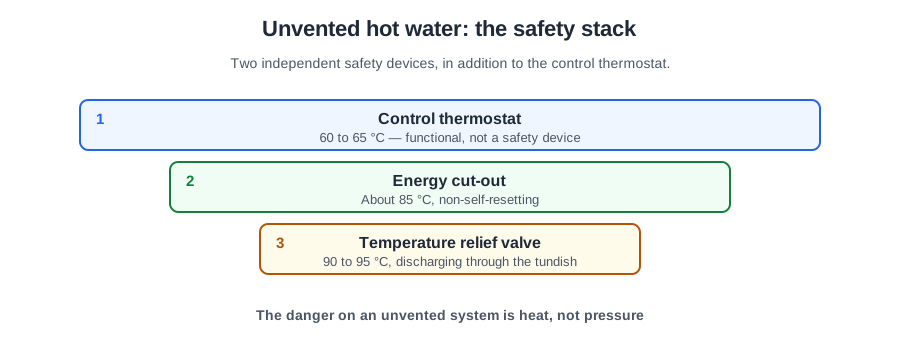
Which leads directly to the sentence the whole course is built on: because the hazard is heat, every unvented safety control exists to limit temperature.
The thermostat limits temperature. The energy cut-out limits temperature. The temperature and pressure relief valve limits temperature, and it does so by dumping hot water so that cold mains water flows in to replace it — which is also why, when a system is overheating, you turn off the heat source and not the cold water. The cold is the thing carrying the heat away.
Reading the rest of the course through this
Two categories of control, and the distinction runs through everything that follows:
- Functional controls protect the supply and keep the system working properly.
- Safety controls protect the user.
An expansion vessel is functional — without it the system is unpleasant and short-lived, but nobody is hurt. A temperature and pressure relief valve is a safety control, and it exists for a failure that has already got past two other devices.
When you meet a component and are not sure which it is, ask what happens if it is missing. If the answer is “the system works badly”, it is functional. If the answer is “nothing, until the day it matters”, it is a safety control — and those are the ones that are never optional, never bypassed and never substituted with the wrong part.
📝 10-Question Mock Test
Click an option to see whether you got it right. Explanations appear instantly — no submitting at the end.
One absence defines the whole subject. The vent pipe was holding the system at atmospheric pressure, capping the temperature at 100 °C and giving expansion somewhere to go — so every one of those jobs now needs a dedicated control.
They are independent. A house can have a sealed heating system and a vented cylinder, or an unvented cylinder on an open vented primary. Calling an unvented cylinder a “sealed system” is the kind of imprecision that becomes a wrong answer under pressure.
The line survives from the pre-1986 position, when connecting a hot store directly to the mains was banned except for instantaneous heaters and stores under 15 litres. The reasoning is stored energy — 15 litres is a scald risk, 200 litres is a different order of thing.
When the street main goes off, an unvented house has no water at all. The other real drawbacks are the need for good mains pressure and flow, higher maintenance because safety devices need annual attention, and possible pipe noise now everything is at mains pressure.
Boiling point rises with pressure: about 100 °C at atmospheric, about 121 °C at one bar above. At 2.5–3 bar the stored water can sit around 140 °C looking exactly like water, holding energy it cannot release while the pressure is on it.
The water is instantly far above its boiling point at the new pressure. That expansion happens in a fraction of a second in a confined space, and the result is an explosion rather than a leak.
The comparison that makes it stick. Pressure alone gives you a burst; heat is what makes it explosive. Which is why every unvented safety control is a temperature control.
The T&P valve works by dumping hot water so that cold mains water flows in to replace it. Shutting the cold off removes the only thing cooling the store.
A useful test when you are unsure which a component is: ask what happens if it is missing. “The system works badly” means functional. “Nothing, until the day it matters” means safety — and those are never optional, never bypassed and never substituted with the wrong part.
Read the whole component list through that lens and it stops being something to memorise. Each device replaces one thing the vent pipe used to do.
Everything that follows in the course is a consequence of one absence. No vent pipe means no free pressure relief, no free temperature cap and nowhere for expansion to go, so each of those has to be engineered back in as a device with a failure mode of its own.
The one to carry away: a cold cylinder at pressure splits; a hot one explodes. Water is incompressible, so pressure alone stores almost nothing. It is the superheat that flashes to steam at 1,600 times the volume — which is why every safety control on an unvented cylinder is a temperature control.