Solar thermal is the renewable technology most often explained badly. It gets confused with solar PV, sold as though it will heat a house, and sized by whoever has the most roof to fill. Done properly it is one of the most dependable things you can put on a domestic property — and the reason is that it does one job, in one season, and does not pretend otherwise.
This article covers Module 1 of the PlumbMate solar thermal course: what a solar thermal system actually delivers, the shape of the UK solar year, how orientation and tilt affect it and how much shading costs, the two collector types and where each wins, and the one measurement — aperture area — that decides whether the number you give a customer is honest. There is a 10-question mock test at the end.
Heat, not electricity
Start with the distinction that causes the most trouble on the phone. Solar thermal makes heat. Sunlight warms a fluid, that fluid carries the heat indoors, and it goes into a hot water cylinder. Solar PV makes electricity. Photovoltaic cells convert light directly into current. They look similar on a roof and they are entirely different technologies with different components, different regulations and different economics.
A customer who has read about "solar panels" may have either in mind, and it is worth establishing which within the first minute. A customer who wants their electricity bill down needs PV. A customer whose immersion heater runs all summer needs solar thermal.
What it realistically delivers
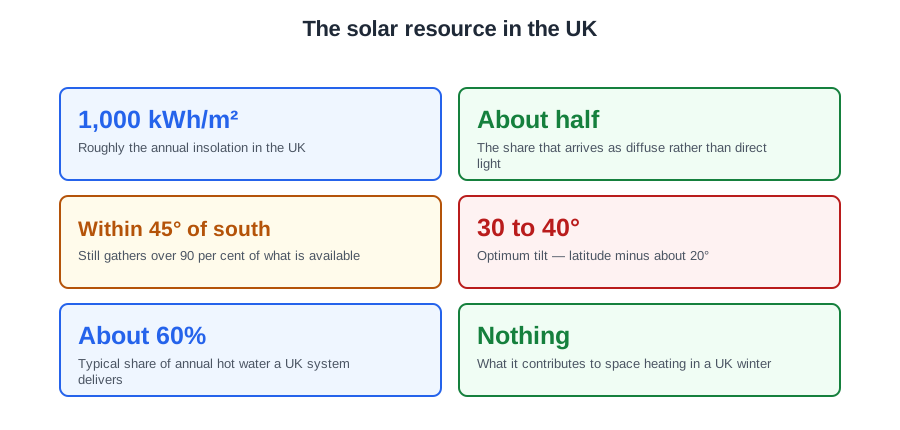
A well-designed UK system supplies around 60% of a household's annual hot water. Not all of it, and not space heating. That figure is worth being precise about because it is the whole basis of an honest conversation: the customer keeps their existing heat source, uses it far less in summer, and uses it much as before in winter.
The output is strongly seasonal. Through June and July a correctly sized system will meet essentially the whole hot water demand of the house and the boiler will barely fire. Through spring and autumn it contributes usefully — often taking the cold main from 10 °C to something the boiler only has to finish. Through December and January it contributes very little, and on some days nothing at all.
People sometimes ask why it cannot do space heating too. The arithmetic answers it: heating demand peaks in the depths of winter, which is exactly when the array is producing least. The two curves are almost perfectly out of phase. Hot water demand, by contrast, is roughly constant through the year — people wash in July as much as in January — which is why hot water is the load solar thermal is matched to.
The three things a building needs
Before any calculation, three things decide whether the job is possible at all:
- Rights to the roof area. A freeholder can decide; a leaseholder may not be able to, and a shared roof on a converted property often cannot be used without agreement.
- A largely unshaded collector location with acceptable orientation.
- Hot water supplied from a store. This is the one that stops jobs. Solar arrives when the sun shines, not when somebody opens a tap, so without a cylinder there is nothing to bridge the gap. A property on a combi has no store, and the honest answer is that the job includes a cylinder or it does not happen.
The solar resource, and the shape of the UK year
Two words are worth separating properly, because design guides use them precisely and candidates routinely swap them.
- Irradiance is the rate at which solar radiation arrives on a surface, in watts per square metre. It is an instantaneous figure — what the sun is doing right now.
- Insolation is the energy accumulated on that surface over a period, in kilowatt hours per square metre. It is a total — what the sun did over a day, a month, a year.
A third term, albedo, is the share of incoming radiation reflected straight back to space by cloud and by surfaces. It is why a bright overcast day still delivers usable energy and a heavy one does not.
Why the year has a shape
The seasons come from the 23.5° tilt of the Earth's axis relative to its orbital plane. They do not come from the orbit's distance, which is very nearly circular — the Earth is in fact marginally closer to the sun in the northern winter. When the northern hemisphere tilts towards the sun, two things happen at once: the days are longer, and the beam arrives more directly rather than glancing across the surface. Both pull the same way, which is why UK summer and winter are so far apart for a collector.
The projection effect
A beam striking a surface square-on concentrates its energy on the smallest possible area. Tilt the surface away and the same beam is spread over more area, so the energy received per square metre falls. That single idea is the whole reason orientation and tilt matter, and it is worth being able to state in one sentence — because everything in the next section follows from it.
Numbers worth carrying
A typical south-facing UK pitched roof of about 40 m² receives somewhere between 38,000 and 45,000 kWh of solar irradiation a year, north to south of the country. Five square metres of collector on that roof intercepts around 8,000 kWh. And a flat plate array in a good location returns roughly 350–450 kWh per m² per year of useful output.
Keep those last two clearly apart. Irradiation received and useful output delivered are different quantities, separated by the collector's efficiency, the system's losses and whether the household could actually use the heat when it arrived. A collector that intercepts 8,000 kWh and delivers 1,700 is not broken; that is roughly what a real system does.
The practical conclusion is one the course states early: the resource is not the constraint. There is far more energy landing on a British roof than a household needs for hot water. What constrains the job is collector area, the store, and what you can do with the heat when it arrives.
Orientation, tilt and shading
Azimuth and inclination
Design guides and assessments use two terms together. Azimuth is the compass direction the collector faces, normally quoted as degrees from due south — due south 0°, south-west +45°, due west +90°. The angle of inclination is the tilt from horizontal. Together they fix how the collector sits relative to the sun.
The optimum in the UK is due south at 30–40°, with 35° a sound default. But the penalty for missing it is gentle. East and west facing roofs still return around 80–90% of the south-facing figure, and the tilt optimum is a broad plateau rather than a knife edge — anything from about 25° to 45° is within a few percent.
This matters commercially. An engineer who turns down a west-facing roof is turning down a job that would have worked. The right conversation is that the array will produce a little less than a southern one, and that is the whole of it.
Shading is a different kind of problem
Shading is not a few percent. It removes the radiation outright for the hours it covers, and three things make it worse than it first appears:
- It bites hardest in the shoulder seasons. The sun is high only around midsummer. An obstruction that clears the array in June may shade it right through spring and autumn — and the shoulder seasons carry a large share of the annual yield.
- It gets worse every year. A tree that clips the corner of the array today will cover half of it in a decade.
- No amount of clever mounting recovers it. Orientation and tilt between them are worth a few percent; a fifth of the resource lost to a conifer cannot be angled back.
So the order of operations at survey is: deal with the shading, or size the system honestly around it. Both are respectable answers. Pretending it is not there is not.
The planning limits that constrain siting
Two dimensions govern most domestic work under permitted development in England, and they are worth knowing before you climb the ladder rather than after:
- On a pitched roof, equipment must project no more than 200 mm from the roof slope, and must not sit above the highest part of the roof excluding the chimney.
- On a flat roof, the highest part of the equipment must be no more than 600 mm above the highest part of the roof.
The flat roof figure is the one that catches people out: a ballasted frame at a steep tilt breaches 600 mm easily, so check the finished height before committing to a tilt angle. Module 3 of the course covers the full picture — listed buildings, conservation areas, Article 4 directions and prior approval.
Active and passive, direct and indirect
Two pairs of terms describe how a system is arranged, and they are independent of each other.
Active systems move the heat with a pump. Passive systems rely on natural circulation — the thermosyphon case, where hot fluid rises and cool fluid falls under density difference alone. A thermosyphon needs the store mounted above the collector, which is awkward in a British roof space and unforgiving in a freeze, so almost all UK domestic work is active.
Direct (open-loop) systems pass the potable water itself through the collector. Simple and efficient, and rare here: the water freezes in winter, scales in hard water areas, and there is no separation between the drinking supply and a collector sitting outdoors all year.
Indirect (closed-loop) systems circulate a sealed primary of water and glycol, which gives up its heat through a coil in the store. That gives freeze protection, corrosion protection and complete separation from the potable supply. It is the UK domestic standard, and the price is a heat exchanger — so the store always runs slightly cooler than the collector fluid.
Worth naming in passing: a PVT collector is the hybrid, producing heat and electricity from one panel. It is a real product and an occasional exam distractor.
Flat plate collectors
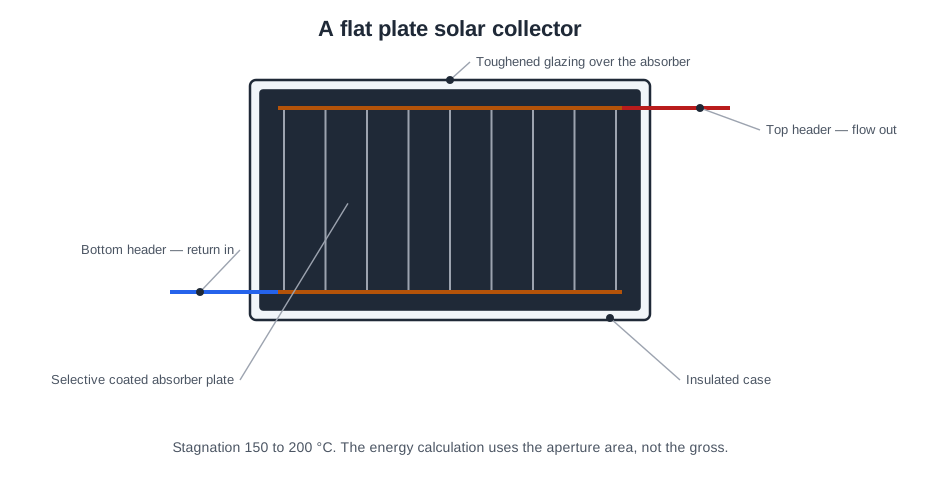
A flat plate collector is an absorber plate — copper, aluminium or stainless steel — with fluid channels bonded to it, sitting in an insulated box under glazing.
The absorber and its coating
The absorber carries a selective coating, and the word "selective" is doing real work. An ordinary black surface absorbs well but also radiates well, so much of what it gains at temperature it loses straight back out as infrared. A selective coating is chosen to absorb a high proportion of incoming solar radiation while emitting very little infrared. Absorb a lot, radiate little.
Glazing and insulation
The glazing is low-iron toughened glass: low-iron because ordinary glass has a slight green cast from its iron content and transmits measurably less, toughened because it is on a roof in hail and needs to survive being walked past. Insulation goes behind and around the sides of the absorber, cutting the losses out of the back of the box — the losses nobody sees.
Pipe configurations
Two arrangements are common. A parallel grid, sometimes called a harp, runs several risers between a top and a bottom header. A serpentine snakes a single continuous pipe back and forth across the absorber. The grid has lower resistance and drains more readily; the serpentine has no dead legs and gives a larger temperature rise at low flow.
Unglazed collectors
An unglazed collector has no glazing and no selective coating — typically a black polymer mat. It performs poorly at any useful domestic hot water temperature and very well at low temperatures, which is exactly what swimming pool heating needs. It is a legitimate product for the right job, and a wrong answer for a cylinder.
Stagnation
A flat plate reaches roughly 150–200 °C at stagnation — the state where the collector is receiving energy with the pump not running, and heats until its losses equal the energy arriving. That is normal behaviour, not a fault, and it is why every material in the circuit has to be specified for it.
Evacuated tube collectors
An evacuated tube collector uses a vacuum instead of insulation. Because conduction and convection both need a medium, removing the air removes both loss paths at once. It is insulation with almost nothing in it.
Where the advantage appears
The vacuum's benefit shows up specifically in cold conditions and at higher working temperatures — the conditions where a flat plate's losses climb fastest. On a warm day with a cool store, the two technologies are much closer than the marketing suggests. On a cold, bright February morning with a store already at 45 °C, the tubes are clearly ahead.
Tubes also stagnate hotter: over 250 °C, against a flat plate's 150–200.
Heat pipe and direct flow
Two constructions are in common use:
- A heat pipe tube contains a sealed working fluid. Solar energy evaporates it, the vapour rises to a condenser bulb seated in the manifold, gives up its heat and runs back down as liquid. The connection into the manifold is dry, so an individual tube can be replaced without draining the system — a genuine practical advantage on a roof.
- A direct flow tube carries the heat transfer fluid through the tube itself. It works at a wider range of mounting angles, but the connection is wet.
Certification
Solar heating products are certified under MCS 004 or the CEN Solar Keymark. Collectors are tested to BS EN 12975, factory-made systems to BS EN 12976, and custom-built systems to BS EN 12977. Mounting and flashing kits have their own scheme, MCS 012, with declared wind uplift resistance and weathertightness — valid only within the limitations of the certificate. And MIS 3001 is the installation standard the whole job is measured against.
Comparing collectors: the two areas
Here is where more money is lost than anywhere else in the syllabus, and it is not a difficult idea — just one that has to be got the right way round.
Every collector has two stated areas:
- Aperture area — the area that actually admits sunlight.
- Overall or gross area — the complete outside dimensions, frame included.
Use overall area in the energy calculation and you inflate the performance estimate the customer is given — the one figure they may later hold you to. Use aperture area in the wind calculation and you understate the uplift the roof has to resist, which is the error with a structural consequence rather than a commercial one. Wind pushes on the whole panel; it does not care which part admits light.
The numbers are small enough to slip past. A collector might be 1.92 m² aperture and 2.02 m² overall — about 5%. Across a four-collector array that is several hundred kilowatt hours a year of contribution that was never going to arrive.
Reading an efficiency curve
A collector's performance is described by three coefficients. η₀, the zero-loss or optical efficiency, is its efficiency with no temperature difference between it and ambient — the ceiling it works down from. a₁ and a₂ are the heat loss coefficients, describing how quickly efficiency falls as the collector runs hotter than its surroundings; a₂ is the second-order term and dominates at large temperature differences.
Flat plates typically show a higher η₀. Evacuated tubes hold their efficiency better as the difference grows. Which is better depends entirely on the temperature you intend to run at.
Output is a system property
The last point of the module is the one worth carrying furthest. What a system delivers depends on the household's hot water consumption and pattern as much as on the panel — because heat collected and not used is heat wasted, and a store already at temperature cannot accept any more.
Two identical arrays on two identical roofs will deliver different annual figures if one house baths every evening and the other showers briefly in the morning. Comparing collectors on headline efficiency alone tells you very little about what either will actually do on a given house. That is why the sizing in Module 4 starts with the occupants and works towards the roof, not the other way round.
What comes next
Module 2 takes the system apart: fully filled against drain-back, tidal volume, the primary circuit and its flow rate, pipe sizing, the pump station, differential control and the cylinder. Everything in this article decides how much heat is available; Module 2 is about getting it indoors without losing it.
📝 10-Question Mock Test
Click an option to see whether you got it right. Explanations appear instantly — no submitting at the end.
Solar thermal produces heat for hot water; solar PV produces electricity. They look similar on a roof and are entirely different technologies. Establishing which the customer means is the first minute of the conversation.
The two curves are almost perfectly out of phase. Heating demand peaks in midwinter, which is when the array produces least. Hot water demand barely changes through the year — people wash in July as much as in January.
A rate against a total. Irradiance is what the sun is doing now; insolation is what it did over a day, a month or a year. Design guides use both precisely and candidates routinely swap them.
The axial tilt. The orbit is very nearly circular — the Earth is in fact marginally closer to the sun in the northern winter. The tilt lengthens the days and makes the beam arrive more directly, and both pull the same way.
Orientation is forgiving. A west roof returns most of what a southern one would, and the honest conversation is simply that the array will produce a little less. Turning a frame away from the roof plane creates wind loading and planning problems that dwarf the gain.
Orientation and tilt are worth a few percent between them. Shading takes the resource away entirely for those hours, is worst when the sun is low in spring and autumn — which carry much of the annual yield — and gets worse every year.
Absorb a lot, radiate little. An ordinary black surface absorbs well but also radiates well, losing much of what it gains. The selective coating breaks that symmetry, which is the whole point of it.
A heat pipe's sealed working fluid gives up its heat to a condenser bulb seated in the manifold, so the connection is dry. On a roof, being able to swap one damaged tube without draining the circuit is a real advantage. Direct flow tubes are the ones more tolerant of mounting angle.
Wind acts on the whole panel, frame included, so the overall area is used — 2 × 2.02 = 4.04 m². Using aperture here understates the uplift, and that is the one of the two area errors with a structural consequence rather than a commercial one.
It is the optical efficiency, measured with no temperature difference, and it is the best the collector can ever do. The a₁ and a₂ heat loss coefficients then describe how fast it falls away as the collector runs hotter than its surroundings.
Solar thermal rewards being honest about what it does. It supplies most of a household's hot water for most of the year, it needs a store, and it is beaten by shade in a way it is not beaten by orientation. Get those three ideas across at survey and the rest of the job is arithmetic.
The one thing to carry away: aperture area for energy, overall area for wind. It is a five percent difference that decides whether the number you hand a customer is one you can defend.