Two cylinders can look identical in a cupboard and need completely different servicing. One has a sacrificial anode that will be gone in seven years; the other has none and never will. One takes up expansion in a vessel you can check with a tyre gauge; the other holds an air bubble that has to be recharged by a procedure most people have never been shown.
This article covers lesson 5 of the PlumbMate unvented hot water course: cylinder materials and what each implies, direct-fired against indirect, the two ways expansion is taken up and how to recharge an air bubble, twin-coil solar arrangements, and the insulation minimum. There is a 10-question mock test at the end.
Cylinder materials
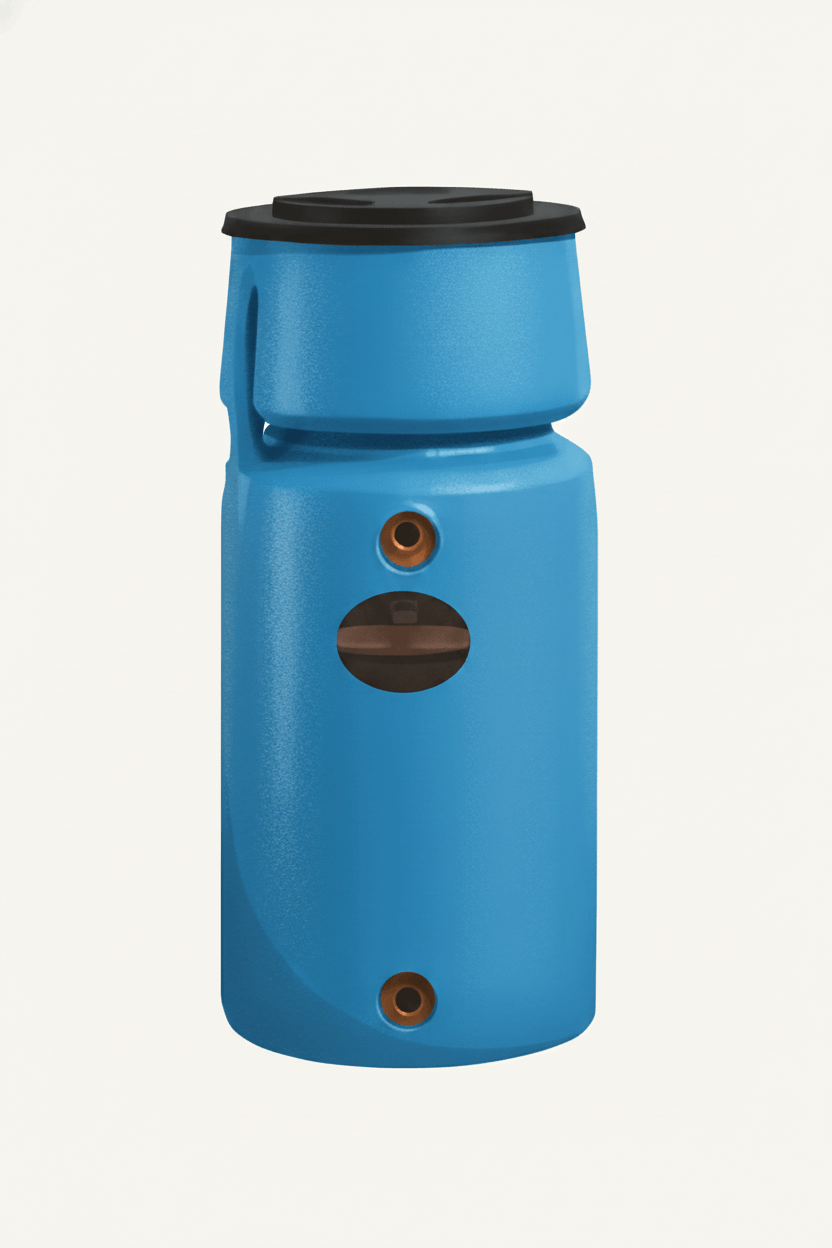
Copper
Copper cylinders run at around 1–1.5 bar and need a replaceable sacrificial anode.
The anode is a rod of a more reactive metal that corrodes instead of the cylinder. It is doing its job by being consumed, which means it has a life and needs checking — a cylinder whose anode has gone is a cylinder that has started protecting itself the hard way. “Replaceable” is part of the specification, not an incidental feature.
Copper is the weaker vessel of the common types, which is why it gets a pressure reducing valve for close pressure control rather than the coarser pressure-limiting valve a steel unit can live with.
Stainless steel
Low-carbon, high-chromium stainless resists corrosion naturally, so it needs no anode at all — and it is lighter than the alternatives.
Both of those matter commercially. No anode means one fewer consumable in the service regime and one fewer thing to be forgotten. Lighter means an easier install and less demand on the floor it stands on, which matters more than people expect once a cylinder is full.
Lined steel
Steel cylinders can be protected by a lining instead: vitreous enamel (glass), polyethylene, or cementitious. All of them protect the steel, and all of them come with a trade-off — they add weight, or fragility, or both.
Fragility is the one to keep in mind on site. A glass-lined cylinder that has been knocked about in transit or dropped on a doorstep may have a lining defect you cannot see, and the corrosion starts at exactly that point.
How the cylinder is heated
- Direct-fired — the unit has its own burner and factory-fitted controls. Mostly a commercial arrangement.
- Indirect — heated by a boiler through an internal coil. The domestic norm.
And the exclusion that follows from the safety architecture: not suitable for uncontrolled solid fuel.
The reason is the energy cut-out. Its job is to remove the heat source, and on an indirect system it does that through a motorised valve that shuts the coil off. A solid fuel appliance cannot be switched off — a fire that is burning goes on burning — so the second layer of protection has nothing to act on. It is not a preference or a manufacturer's restriction; the safety design does not work.
Expansion: two ways
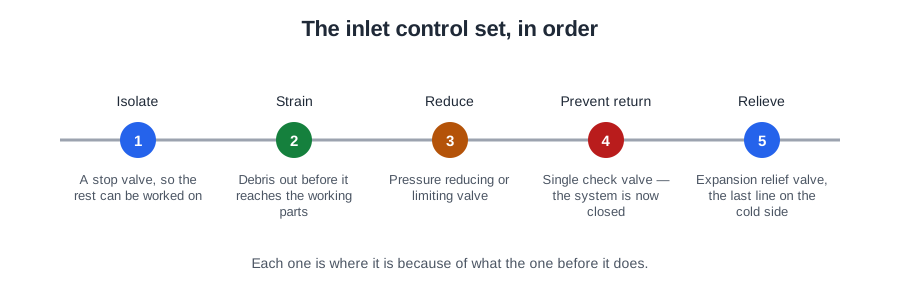
Water expands roughly two per cent going from mains temperature to storage temperature (about four per cent all the way to 100 °C), and the check valve in the inlet set has closed the only escape route. That expansion has to go somewhere.
An external expansion vessel
The common arrangement: a sealed vessel with a diaphragm and a gas charge, fitted on the cold side so the diaphragm is protected from heat and from scale. Checkable, rechargeable, replaceable.
An internal air bubble
Some cylinders instead hold an internal air bubble, retained by a floating baffle at the top of the cylinder. The bubble is compressible, so it does exactly what the vessel does, with no external component at all.
Its drawback is the one you have to plan for: the bubble needs periodic recharging. Air dissolves into water over time, so the bubble slowly shrinks, the cushion is lost, and the expansion relief valve starts discharging on every reheat.
Recharging an air bubble
A procedure worth knowing by heart, because a customer with a weeping expansion valve on an air-bubble cylinder is a very common callout and the fix takes ten minutes:
- Turn the cold supply off.
- Open the lowest hot tap in the property.
- Hold the temperature and pressure relief valve open until it stops draining.
- Close the T&P valve.
- Turn the cold supply back on.
- Close the tap.
What is happening: draining from the lowest point lets air in at the top, re-forming the bubble under the baffle. Holding the T&P valve open is what admits that air. Then refilling compresses the new bubble back to working pressure.
Two points of judgement. First, if a cylinder needs this every few months rather than every year or two, the baffle is not retaining the bubble and recharging it repeatedly is treating a symptom. Second, a weeping expansion relief valve does not automatically mean the bubble — on a cylinder with an external vessel, the identical symptom means the vessel has lost its charge. Establish which type you are looking at before doing anything.
Twin-coil cylinders
Where a cylinder is heated by two sources — typically solar thermal and a boiler — it has two coils, and their positions are not interchangeable:
Solar to the lower coil. Boiler to the upper coil.
The reasoning is stratification and the physics of a solar collector. Hot water rises, so the coolest water in the cylinder is at the bottom. A solar collector works better the colder the fluid returning to it — a bigger temperature difference means more heat collected and a better efficiency. Putting the solar coil at the bottom hands it the coldest water in the store, which is exactly what it wants.
The boiler goes at the top so that it heats only the upper portion. That way, on a day when the sun has done most of the work, the boiler only has to top up the last few degrees at the top rather than reheating the whole cylinder — which would destroy the solar contribution entirely by leaving no cold water for the collector to work on.
Swap the coils over and you have a system that will still make hot water and will never make much use of the solar.
Insulation
New unvented cylinders need a minimum of 35 mm of insulation, under Part L.
It is a Building Regulations requirement rather than a safety one, and it is easy to skate past — but it is worth remembering as a number, because it is one of the checks on a modern installation and because a cylinder in a cold garage or an unheated utility is losing heat continuously to a space nobody benefits from.
Putting the lesson together
Copper needs an anode and close pressure control. Stainless needs neither and is lighter. Lined steel protects the steel at the cost of weight or fragility. Indirect through a coil is the domestic norm, direct-fired is commercial, and uncontrolled solid fuel is excluded because the cut-out has nothing to switch off. Expansion goes into a vessel or a bubble — and knowing which one you have in front of you decides what a weeping expansion valve is telling you.
📝 10-Question Mock Test
Click an option to see whether you got it right. Explanations appear instantly — no submitting at the end.
The anode is a rod of more reactive metal that corrodes instead of the cylinder — it is doing its job by being consumed, so it has a life and needs checking. Low-carbon, high-chromium stainless resists corrosion naturally and needs none.
Copper runs at around 1–1.5 bar and needs close control. Steel units are strong enough for the coarser, cheaper device at around 5 bar. Which is also why you cannot swap one for the other during a repair.
Fragility is the one to watch on site: a glass-lined cylinder knocked about in transit may have a lining defect you cannot see, and corrosion starts at exactly that point.
Not a preference or a manufacturer's restriction — the second layer of the safety design has nothing to act on. On an indirect system the cut-out shuts a motorised valve to stop the coil; there is no equivalent for an open fire.
The bubble is compressible, so it does the same job as a vessel with no external component. Its drawback is that air dissolves into water over time, so the bubble shrinks and needs periodic recharging.
Draining from the lowest point lets air in at the top, re-forming the bubble under the baffle; holding the T&P valve open is what admits that air. Refilling then compresses the new bubble back to working pressure.
Two cylinders that look identical in a cupboard, one symptom, two different fixes. And if a bubble needs recharging every few months rather than every year or two, the baffle is not retaining it and recharging is treating a symptom.
Hot water rises, so the coldest water is at the bottom — and a solar collector works better the colder the fluid returning to it. The boiler goes on top so it only tops up the last few degrees rather than reheating the whole store.
It is a failure that produces no complaint and no symptom — just a solar array that never earns anything, on a system the customer believes is working.
A Building Regulations requirement rather than a safety one, and easy to skate past — but it is one of the checks on a modern installation, and a cylinder in a cold garage is losing heat continuously to a space nobody benefits from.
Most of this lesson is about knowing what you are standing in front of before you touch it. The same symptom means two different things on two cylinders that look alike from the cupboard door.
The one to carry away: solar to the lower coil, boiler to the upper. The collector wants the coldest water in the store, and a boiler heating the whole cylinder leaves it none.