The inlet control set is five components in a fixed order, and every one of the five is in that position for a reason that becomes obvious the moment you imagine it somewhere else. Get the order wrong and you have a system that fouls its own pressure reducing valve, or one whose expansion vessel is being cooked, or one where a thermostatic shower hunts every time somebody flushes.
This article covers lesson 3 of the PlumbMate unvented hot water course: the inlet control set in order, why the expansion vessel goes where it goes, the difference between a pressure reducing valve and a pressure-limiting valve, the vacuum relief valve, and the balanced cold feed. There is a 10-question mock test at the end.
Functional against safety
The distinction from lesson 1, because it decides how you treat each component: functional controls protect the supply and keep the system working. Safety controls protect the user.
Everything in this article is a functional control. The expansion relief valve is listed with them too, but its job is safety: it does nothing until the expansion vessel fails. That does not make any of it optional — a missing strainer will eventually cost somebody a pressure reducing valve — but it does mean these are the components whose failure produces a system that works badly rather than a system that is dangerous. The dangerous ones are the subject of the next article.
The inlet control set, in order
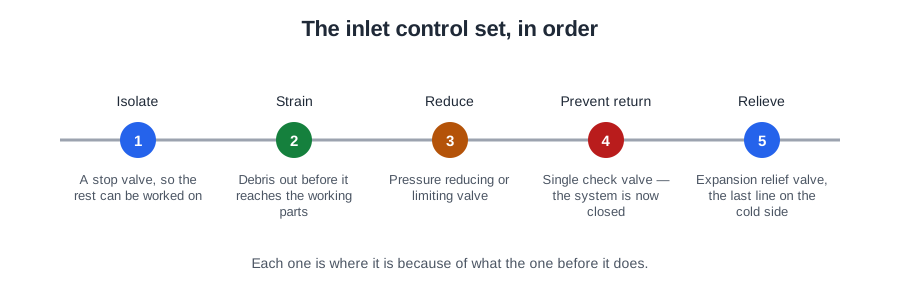
From the main, working towards the cylinder:
- Isolating valve
- Line strainer
- Pressure reducing valve
- Check valve
- Expansion relief valve
Learn it as a sequence with reasons rather than a list.
Isolating valve
First, because you cannot work on anything downstream of it otherwise. Nothing subtle here, but it earns its place at the front: every service visit for the life of the cylinder starts by closing it.
Line strainer
Second, and this is the position that matters. The strainer catches grit, scale and debris from the main before it reaches anything with a seat in it.
The component it is principally protecting is the pressure reducing valve immediately behind it. A PRV is a precision device holding a stable outlet pressure against a varying inlet, and a single piece of grit under its seat will make it pass, hunt or stick. Put the strainer after the PRV and you have protected nothing that needed protecting.
A blocked strainer has a recognisable symptom, worth knowing now because it comes back in fault finding: a burst of flow followed by weak flow. The stored volume comes out at pressure, and then the system can only refill as fast as the blocked strainer allows.
Pressure reducing valve
Third. It takes whatever the main is doing — which varies through the day and rises at night — and holds a stable, known pressure for everything downstream. Every other setting in the system is chosen relative to that pressure, so it has to be stable before anything else can be set.
Check valve
Fourth. It stops heated, expanded water travelling back up the cold main. Without it, expansion would simply push back towards the street, which is both a backflow contravention and a system that never builds the pressure its expansion vessel needs to work against.
The check valve is what turns the installation into a closed volume on the hot side — and once it is closed, expansion has nowhere to go. Which is why the next two components exist at all.
Expansion relief valve
Fifth, and a safety device rather than a functional control. This is the backup for a failed expansion vessel, and it is set above normal working pressure — typically 4 bar on a copper cylinder or 6 bar on a steel one.
In normal operation it should never open. If it is discharging, something upstream of it has already failed, and the valve is telling you so.
The expansion vessel, and where it goes
Water expands as it heats — roughly two per cent by the time it has gone from cold main temperature to storage temperature (about four per cent all the way to 100 °C). In a vented system that expansion pushes harmlessly up the vent pipe. In an unvented system the check valve has closed the only way out, so the expansion has to be absorbed.
The expansion vessel does that: a sealed vessel divided by a flexible diaphragm, with a gas charge on one side. Expanding water compresses the gas, and the system pressure rises only slightly rather than enormously.
Fit it on the cold side
The expansion vessel goes on the cold (inlet) side, to protect the diaphragm from heat and from scale.
Both halves of that matter. A diaphragm is a rubber component with a working life, and rubber at 60 °C ages considerably faster than rubber at 12 °C. And scale precipitates out of hot water, not cold — a vessel on the hot side gradually fills with deposit, losing the volume it exists to provide, in a hard water area especially.
A vessel on the hot side will work. It will simply not work for as long, and the failure is quiet: the expansion relief valve begins weeping on every reheat, months before anybody connects that symptom to a vessel fitted in the wrong place.
PRV or pressure-limiting valve
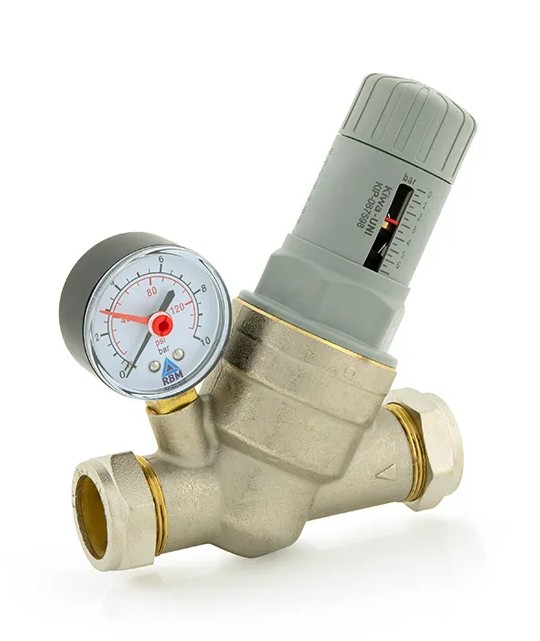
Two different components that get spoken about as one, and the choice usually follows the cylinder material.
- A pressure reducing valve gives close, stable pressure control. It is what copper cylinders get, typically holding around 1–1.5 bar.
- A pressure-limiting valve is cheaper and less precise. It appears on steel units, typically at 5 bar and above, with a minimum around 3.5 bar.
The logic is what the cylinder can take. A copper cylinder is the weaker vessel, so it needs a valve that genuinely holds a low pressure rather than one that merely caps a high one. A stainless steel unit is strong enough that a coarser device is acceptable, and the saving is real across a range.
It also explains why you cannot simply swap one for the other during a repair. A pressure-limiting valve on a copper cylinder is a cylinder running well above its intended pressure.
The vacuum relief valve
Everything so far has been about pressure being too high. This one is about pressure being too low.
A vacuum relief valve stops the cylinder imploding when the pressure inside falls below atmospheric. Two things cause that:
- Water drawn off faster than it is replaced — a large draw-off with a restricted or interrupted supply.
- The cylinder cooling, so the contents contract while the check valve prevents anything flowing back in to fill the space.
The valve simply admits air. A cylinder is built to resist pressure from the inside; it is far weaker against pressure from the outside, and a partial vacuum will collapse one.
The balanced cold feed
Take the balanced cold feed after the PRV, so thermostatic mixers see equal hot and cold pressures.
This is the detail that most often gets fitted wrong, and the symptom is one every plumber has been called back for. A thermostatic mixing valve blends hot and cold to a set temperature. It can only do that reliably if both sides arrive at the same pressure. If the hot comes through the PRV at 3 bar and the cold is taken from the main upstream at 5 bar, the valve is working against a permanent imbalance — and every time the main pressure moves, the blend moves with it.
What the customer reports is a shower that goes cold when somebody runs a tap, or hot when the washing machine fills. The valve is not faulty. It is being asked to hold a blend between two supplies that are not comparable.
Taking the cold for those outlets from downstream of the PRV puts both sides on the same regulated pressure, and the mixer behaves. It costs nothing at first fix and is expensive to correct afterwards, because the cold branch is usually buried by the time anybody notices.
Putting the lesson together
Isolate, strain, reduce, prevent return, relieve — in that order, each protecting what follows it. Expansion vessel on the cold side so the diaphragm lives. A PRV where the cylinder needs close control and a limiting valve where it does not. A vacuum relief valve because a cylinder is weak against outside pressure. And the balanced cold taken after the PRV, because a mixer can only blend two supplies that arrive on equal terms.
📝 10-Question Mock Test
Click an option to see whether you got it right. Explanations appear instantly — no submitting at the end.
Isolate, strain, reduce, prevent return, relieve — each protecting what follows it. Worth learning as a sequence with reasons rather than as a list.
Put the strainer after the PRV and you have protected nothing that needed protecting. A blocked strainer has its own signature too: a burst of flow followed by weak flow, as the stored volume comes out and the system can only refill as fast as the blockage allows.
And once the volume is closed, expansion has nowhere to go — which is exactly why the expansion vessel and the expansion relief valve exist at all.
Rubber at 60 °C ages far faster than rubber at 12 °C, and scale precipitates out of hot water rather than cold. A vessel on the hot side works — it just does not work for as long, and the failure is quiet.
In normal operation it should never open. If it is discharging, something upstream has already failed and the valve is telling you so.
The logic is what the cylinder can take. A copper cylinder is the weaker vessel, so it needs a valve that genuinely holds a low pressure. Which is also why you cannot swap one for the other during a repair.
A cylinder is built to resist pressure from the inside and is far weaker against pressure from the outside. The valve simply admits air. The check valve is what stops anything flowing back in to fill the space as the water cools.
A mixer can only hold a blend if both sides arrive on equal terms. Hot at 3 bar against cold at 5 bar means every movement in the main moves the blend with it.
The valve is not faulty; it is being asked to hold a blend between two supplies that are not comparable. It costs nothing to get right at first fix and is expensive afterwards, because the cold branch is usually buried by the time anyone notices.
Functional controls protect the supply and keep the system working; safety controls protect the user. A useful test: “the system works badly” means functional, “nothing, until the day it matters” means safety.
None of these components will hurt anybody if they fail. They will simply produce a system that weeps, hunts, scales up or never quite works — and a customer who thinks unvented hot water is a disappointment when what they actually have is a strainer in the wrong place.
The one to carry away: take the balanced cold feed after the PRV. A thermostatic mixer can only hold a blend if both sides arrive at the same pressure, and this is the mistake that gets buried in a wall before anybody notices it.