The discharge pipe is the least glamorous part of an unvented installation and the one most often got wrong. It is also the part that has to work perfectly on the one day it is ever used — while carrying water at 95 °C, at up to thirty litres a minute, to somewhere that will not scald anybody. A discharge arrangement that has been quietly undersized since the day it was fitted looks exactly like one that is correct.
This article covers lesson 6 of the PlumbMate unvented hot water course: the discharge chain end to end, D1 and its limits, what the tundish is actually for, sizing D2 by equivalent length, the material restriction people fall foul of, and terminating safely. There is a 10-question mock test at the end.
The chain
Five parts, in one order:
safety valve → D1 → tundish (air gap) → D2 → safe termination
Everything else in this article is a requirement attached to one of those five. Learn the chain first and the requirements have somewhere to live.
D1 — valve to tundish
Three requirements, all short:
- Metallic.
- At least the size of the valve outlet.
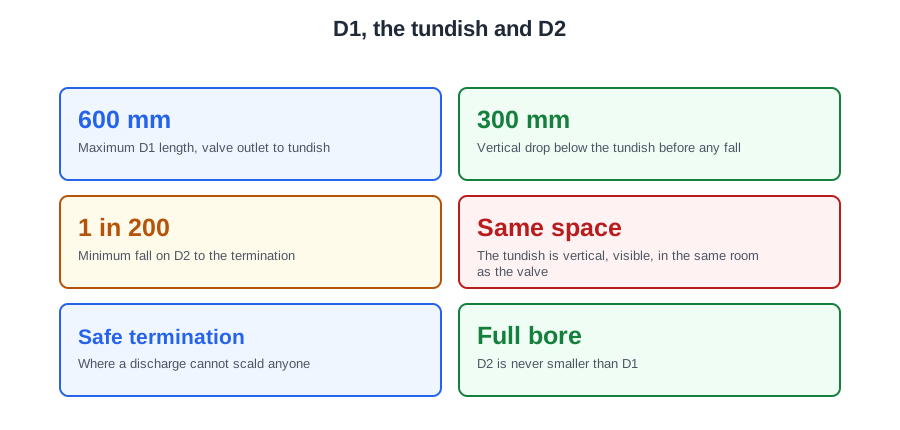
- No more than 600 mm long.
The 600 mm limit is the one that dictates where the tundish goes, and the reason is that D1 is the only part of the chain with no air gap in it. Until the water reaches the tundish, the discharge is a closed pipe connected to a pressurised vessel — so it is kept as short as practicable, in metal, so that nothing about it can fail or restrict.
The tundish
The tundish gives a visible 25 mm air gap. It must be fitted vertically and in the same space as the cylinder.
It is doing two distinct jobs, and both are worth being explicit about:
- The air gap breaks any connection between the discharge pipework and the cylinder. Whatever is happening in the drain D2 runs to, it cannot travel back up into the stored hot water.
- Visibility is the diagnostic. A discharge that happens inside a sealed pipe tells nobody anything. A discharge through a tundish is visible — and it is the first thing you look at when you arrive at a fault, because which valve discharged, when, and how hot is the whole of the diagnosis.
“In the same space as the cylinder” follows from that second job. A tundish in a different room is a tundish nobody will ever see discharge.
D2 — tundish to outside
This is where the sizing lives, and where most of the errors are.
The vertical drop
At least 300 mm of straight vertical pipe below the tundish before the first bend, then a continuous fall of at least 1 in 200.
The vertical section lets the discharge get moving and lets air separate from it. Bend it immediately below the tundish and the flow backs up into the tundish and out into the room, which is precisely the failure the whole arrangement exists to avoid.
The 1 in 200 fall is a self-draining requirement. Anything left standing in a discharge pipe can freeze, and a frozen discharge pipe means the safety valve has nowhere to discharge to.
Sizing
D2 is at least one pipe size larger than the valve outlet, and it grows from there with the resistance of the run.
The method:
- Work out the equivalent length: the straight length, plus the resistance of each elbow expressed as a length — equivalent length = straight length + (number of elbows × the per-elbow figure for that size).
- Compare that against the maximum permitted equivalent length for the pipe size you are proposing.
- If it exceeds it, go up a size and work it out again — the per-elbow resistance changes with the size, so the sum has to be redone rather than adjusted.
And the rule that catches people: if a run needs upsizing, the whole run goes up. You do not step up for the difficult section and back down afterwards. A single length of smaller pipe anywhere in the run is the capacity of the whole run.
The reason elbows count so heavily is worth understanding rather than accepting. This is not a pumped flow being pushed through the pipe; it is water falling under gravity with air in it. Every change of direction costs a disproportionate amount of that very limited driving head. A run with six elbows in it can easily need a size the same straight run would not.
Materials
Any plastic on the discharge must be high-temperature polypropylene. Standard waste pipe melts.
This is not a durability point. Ordinary solvent-weld or push-fit waste pipe is designed for water from a sink, and a temperature relief valve discharges at about 95 °C at up to thirty litres a minute. It softens, sags and can fail outright — while the cylinder is doing the one thing all of this exists to protect against.
It is a common find on inspection, because the pipe looks entirely reasonable and the fault only appears on the day it matters.
Terminating safely
The requirement is a pair of words that pull against each other: visible, but safe. Visible, because a discharge nobody notices is a fault nobody fixes. Safe, because what is coming out is near-boiling water.
Three specifics:
- Keep 300 mm clear of plastic guttering. Water at 95 °C will distort a PVC gutter or downpipe, and a discharge terminating into one destroys the thing it discharges into.
- A soil-stack HepvO must be vertical. Where the discharge goes to a stack through a waterless valve, that valve only works in the orientation it was designed for.
- Never terminate where people could be scalded — the course's example is a playground, and the principle extends to a doorway, a path, a patio, a seating area, or anywhere a child might be.
The tension between visible and safe is real and it is a judgement you have to make on site. A discharge one metre above a lawn at the back of the house is visible from the kitchen window and reaches nobody. A discharge at head height over a footpath is visible and dangerous. When the two pull apart, safety wins and you find another way to make the discharge noticeable — which is exactly what the tundish inside is for.
Why this is the part that gets got wrong
Worth naming the pattern. Every other component in an unvented system announces a fault: a failed expansion vessel weeps, a tripped cut-out leaves no hot water, a blocked strainer gives poor flow. The discharge arrangement announces nothing at all. An undersized D2, a bend too close to the tundish, standard waste pipe, a termination into a gutter — none of them produce a symptom, a complaint or a callout.
They produce one thing, once: a safety valve that cannot discharge properly on the day the cylinder is overheating.
Which is why it is worth checking every one of them on every service visit, on installations you did not fit, even when nothing has been reported. It is the only part of the system where the absence of a symptom is not evidence of anything.
Putting the lesson together
Valve, D1, tundish, D2, termination. D1 metallic, full size, under 600 mm. Tundish vertical, in the same room, giving a visible 25 mm air gap. D2 with 300 mm straight down before any bend, falling at least 1 in 200, one size up from the valve outlet and sized on equivalent length with the elbows counted — and if it goes up, all of it goes up. High-temperature polypropylene if any of it is plastic. And a termination somebody will see and nobody can be hurt by.
📝 10-Question Mock Test
Click an option to see whether you got it right. Explanations appear instantly — no submitting at the end.
Five parts in one order, and every requirement in this lesson attaches to one of them. D1 runs from the valve to the tundish; D2 runs from the tundish to the outside.
D1 is the only part of the chain with no air gap in it — until the water reaches the tundish it is a closed pipe on a pressurised vessel. So it is kept short, in metal, with nothing about it that can restrict or fail.
Both matter. The air gap means nothing in the drain can travel back into the stored hot water; the visibility is the diagnostic — which valve discharged, when, and how hot is the whole of the diagnosis. Which is why it must be in the same space as the cylinder.
The vertical section lets the discharge get moving and lets air separate from it. Bend it immediately below the tundish and the flow backs up into the tundish and out into the room — exactly the failure the arrangement exists to avoid. The 1 in 200 fall is so the pipe self-drains and cannot freeze.
One size larger than the valve outlet is where you start, not where you finish. And the per-elbow resistance changes with pipe size, so if you go up a size the sum has to be redone rather than adjusted.
Stepping up for the difficult section and back down afterwards achieves nothing. The run is only as good as its smallest part.
A run with six elbows can easily need a size that the same straight run would not.
Not a durability point. Ordinary waste pipe is designed for water from a sink; a temperature relief valve discharges at about 95 °C at up to thirty litres a minute. A common find on inspection, because the pipe looks entirely reasonable and only fails on the day it matters.
A discharge terminating into a gutter destroys the thing it discharges into. Where a discharge goes to a soil stack through a HepvO, that valve must be vertical — it only works in the orientation it was designed for.
Visible and safe pull against each other, and when they do, safety wins. Making the discharge noticeable is exactly what the tundish inside the property is for.
None of this is difficult. It is simply the part of the job where nothing checks your work — no commissioning test proves a D2 is the right size, and no customer ever rings up about it.
The one to carry away: if a run needs upsizing, the whole run goes up. A single length of smaller pipe anywhere is the capacity of the entire run, and stepping up for the difficult section and back down afterwards achieves nothing at all.