Unvented hot water is one of the few areas of domestic plumbing where the paperwork is part of the safety case. The unit is a proprietary package approved as a whole, the installer has to hold a specific competence, and the work is notifiable unless you are registered to certify it yourself. None of that is bureaucracy for its own sake — it exists because the thing being installed can fail catastrophically and the failure is invisible until it happens.
This article covers lesson 7 of the PlumbMate unvented hot water course: which documents carry legal force, what Approved Document G3 actually covers, what makes a unit an approved package, the two routes to compliant certification, what a viable site looks like, and diagnosing a fault from the discharge. There is a 10-question mock test at the end.
Which documents carry legal force
Two, and only two: the Water Supply (Water Fittings) Regulations, and the Building Regulations.
Everything else — British Standards, BBA certificates, manufacturer instructions, scheme technical guides — is authoritative and useful and, in some cases, effectively obligatory in practice. But it is not the law, and the distinction matters when you are deciding what you can and cannot depart from.
Approved Document G3
G3 covers hot water safety. Its scope is wider than people assume, and worth stating precisely. It applies to:
- all unvented storage;
- vented storage as well;
- combination boilers with a storage vessel.
The common misreading is that G3 is the unvented document. It is the hot water safety document, and a vented cylinder is inside it. What differs is what compliance requires, not whether the document applies.
And the requirement that everything else serves: stored water must never exceed 100 °C.
Approved packages
Unvented units are proprietary packages approved by the BBA, designed to BS 8558 and BS EN 12897.
“Package” is the operative word. The cylinder and its controls are approved together, as an assembly that has been tested as a whole. That has a direct consequence on site: you cannot substitute a component for something that looks equivalent. A temperature relief valve from another manufacturer, with the right thread and a similar rating, is not the valve the package was approved with, and fitting it takes the installation outside its approval.
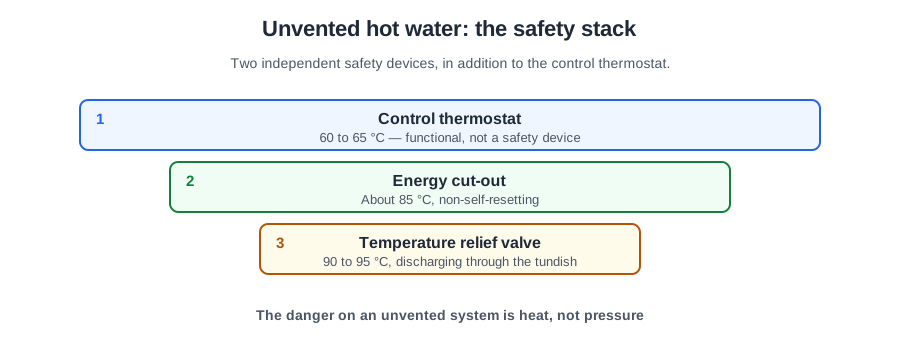
Which gives the rule that closes lesson 7, and it is worth stating as a rule rather than as advice: if a safety valve fails and you do not have the correct spare, isolate the system and take it out of service. Never plug it, and never fit the wrong part.
That is an unpopular conversation to have with a customer who wants a bath tonight. It is also the only defensible answer. A plugged safety valve is a cylinder with one of its three protection layers deliberately removed, by you, in writing, on your job sheet.
Certifying the work
Two routes.
Self-certification
To self-certify you need both:
- competence and an ID card — a recognised unvented qualification, BPEC being the usual one; and
- active membership of a Competent Person Scheme.
Both halves are required, and it is the second that lapses quietly. A qualification does not expire the way scheme membership does, and an engineer holding a valid card but no current registration cannot self-certify — they are competent and unregistered, which is not the same thing as compliant.
Notifying Building Control
Where you cannot self-certify, the work must be notified to Building Control — by a Building Notice, or through CPS registration where someone else on the job holds it.
The point is that there is no third option. Unvented work is either self-certified by a registered competent person or notified. It is never simply done.
Siting
Three things decide whether a proposed position is actually usable, and all three are survey questions rather than installation questions:
- The floor must carry the full weight of the cylinder when full. Reckon roughly a kilogram per litre — a 210 litre cylinder is over 200 kg standing on one small footprint, which is a different proposition from a cistern's load spread over a loft.
- Servicing clearance. The expansion vessel has to be reachable and rechargeable, both relief valves have to be operable, the strainer has to come out, and the anode has to be replaceable where there is one. A cylinder wedged into a cupboard that just fits it is a cylinder that cannot be serviced, and it will need servicing every year for twenty years.
- A viable safe-discharge route. From lesson 6 — and this is the one that most often rules a position out. A cylinder in the middle of a house, with no reasonable path for a correctly sized D2 to an outside termination, is in the wrong place however well it fits.
And the supply condition: about 1 bar and 20 litres per minute or better. Below that the system will disappoint whatever you do, because unvented hot water is only as good as the main feeding it. This is a survey measurement, taken before quoting, not an assumption — and it is the single most common reason an unvented installation ends in an unhappy customer.
Diagnosing from the discharge
Lesson 8 goes into this properly, but the shape of it belongs here because it is what siting for visibility is for. Three signatures:
- A dribble that stops when the system is cold — the expansion vessel or air gap. Expansion has nowhere to go on reheat, so the expansion relief valve opens; when the system cools, the pressure drops and it stops.
- Scalding water and steam — a temperature control failure: the thermostat and the energy cut-out have both let go, and the T&P valve is doing its job as the last layer.
- A burst of flow followed by weak flow — a blocked strainer. The stored volume comes out at pressure and then the system can only refill as fast as the blockage allows.
The organising principle: pressure faults discharge cold; temperature faults discharge hot. Feel the discharge, or feel the pipe, before doing anything else. It halves the diagnosis in one step.
Putting the lesson together
Two documents carry legal force. G3 is about hot water safety generally, not only unvented, and it caps stored water at 100 °C. The unit is an approved package, so components are not interchangeable — and where the right part is not available, the system comes out of service rather than being made to look complete. Self-certification needs competence and current scheme membership together; without both, it is a Building Notice. And a site needs the floor, the clearance, the discharge route and about 1 bar at 20 litres a minute before any of the rest is worth discussing.
📝 10-Question Mock Test
Click an option to see whether you got it right. Explanations appear instantly — no submitting at the end.
Everything else — British Standards, BBA certificates, manufacturer instructions, scheme guides — is authoritative and often obligatory in practice, but it is not the law. The distinction matters when deciding what you can and cannot depart from.
The common misreading is that G3 is the unvented document. It is the hot water safety document, and a vented cylinder is inside it — what differs is what compliance requires, not whether it applies. Its central requirement is that stored water must never exceed 100 °C.
A temperature relief valve from another manufacturer with the right thread and a similar rating is not the valve the package was approved with, and fitting it takes the installation outside its approval. Units are designed to BS 8558 and BS EN 12897 and approved by the BBA.
An unpopular conversation with a customer who wants a bath tonight, and the only defensible answer. A plugged safety valve is a cylinder with one of its three protection layers deliberately removed, by you, in writing, on your job sheet.
Both halves, and it is scheme membership that lapses quietly — a qualification does not expire the way registration does. An engineer with a valid card but no current registration is competent and unregistered, which is not the same as compliant.
There is no third option. Unvented work is either self-certified by a registered competent person or notified. It is never simply done.
All three are survey questions rather than installation questions. The discharge route is the one that most often rules a position out — a cylinder in the middle of a house with no reasonable path for a correctly sized D2 is in the wrong place however well it fits.
Unvented hot water is only as good as the main feeding it. This is a survey measurement taken before quoting, not an assumption — and inadequate supply is the single most common reason an unvented installation ends in an unhappy customer.
A pressure fault, and it discharges cold. Scalding water and steam means a temperature control failure; a burst of flow then weak flow means a blocked strainer.
Feel the discharge, or feel the pipe, before doing anything else. It is also what siting the tundish for visibility is for — a discharge nobody can see tells nobody anything.
The paperwork side of unvented work is genuinely part of the safety case rather than an administrative layer on top of it. An approved package installed by a registered person and notified or certified is a system somebody can be held to; the same cylinder with a substituted valve and no certificate is a system nobody owns.
The one to carry away: if a safety valve fails and the correct spare is not available, isolate and take the system out of service. Never plug it, never fit the wrong part — an unpopular conversation, and the only defensible answer.