An excavation does not have to be deep to kill you. A cubic metre of soil weighs about a tonne, and it arrives without warning — there is no creak, no sag, no second chance to climb out. People have died in trenches shallower than the one you would dig to reach a water service. Confined spaces kill fewer people each year but kill them faster: an atmosphere with no oxygen in it takes someone down in seconds, and it takes the person who climbs in after them just as quickly.
These two topics sit together in Learning Outcome 6 of your Level 2 health and safety unit, and they share a logic: both are places where the environment itself is the hazard, and both are governed by rules that say plan it before you go in. This post covers the law, the figures your exam will ask for, and — where the two differ — the difference between what is commonly taught and what the regulations actually require.
This is part of the Level 2 Health and Safety cluster. See also working at height and access equipment, safety legislation, risk assessment and first aid, PPE and signs, hazardous substances and gases and hot work.
Why excavations kill
Most ground is self-supporting to some degree. That is exactly what makes it dangerous — a trench that has stood open all morning feels solid, right up until it isn't. Ground that has been dug is disturbed ground: it has lost the friction that was holding it in place, and rain, vibration from passing plant, frost, or simply time will finish the job.
The reason a collapse is so lethal is weight. One cubic metre of earth weighs roughly a tonne. A fall of material that only reaches your knees is enough to pin you where you stand; one that reaches your chest will stop you breathing. You do not need to be buried to be killed — compression of the chest and abdomen prevents the lungs and diaphragm working, which is why crush injuries in trenches are so often fatal even when the casualty's head is clear.
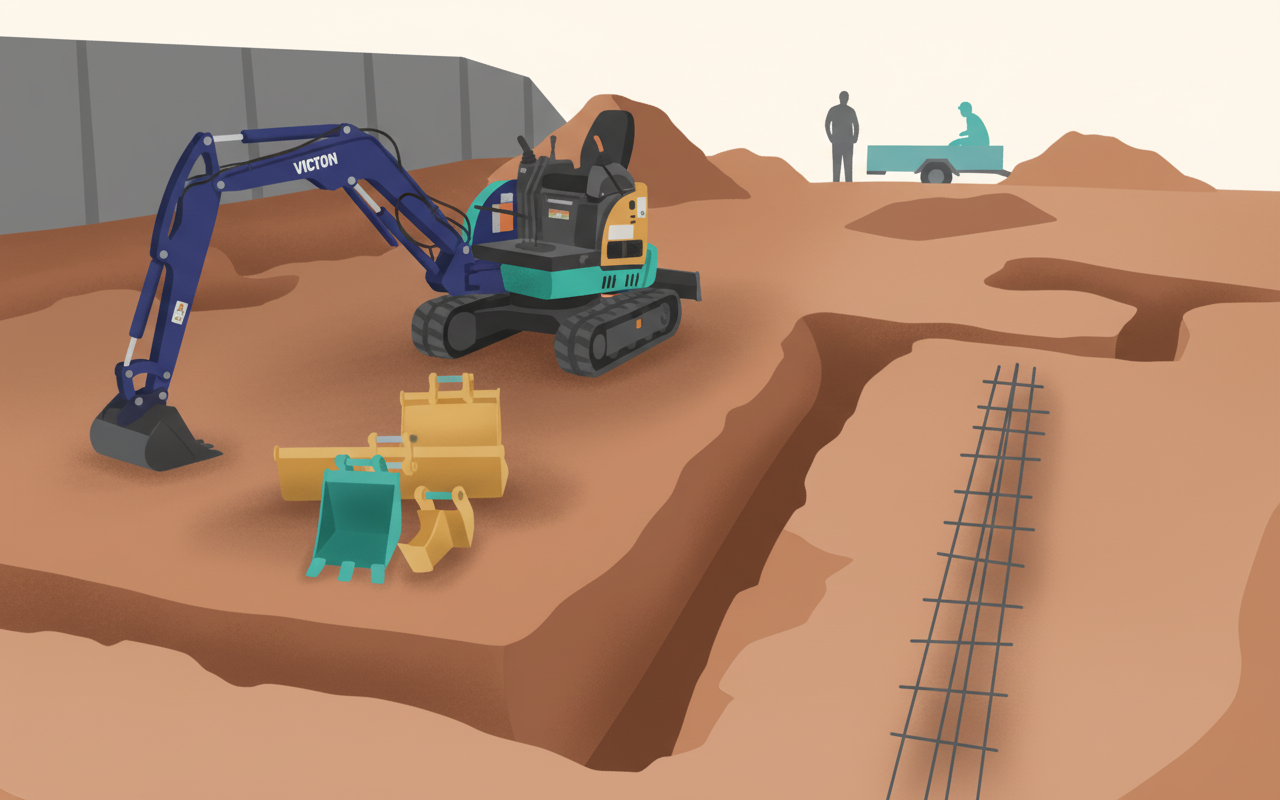
Plumbers are fortunate here: most below-ground work is done by groundworkers or the utilities. But you will still find yourself in a trench connecting an incoming water or gas service, or repairing a buried main — and the syllabus expects you to know how one is made safe.
The law: CDM 2015 regulation 22
The rules for excavations come from regulation 22 of the Construction (Design and Management) Regulations 2015. It is worth reading what it actually says, because it is shorter and blunter than most people expect:
- 22(1) — all practicable steps must be taken to prevent danger, including, where necessary, the provision of supports or battering, so that no excavation collapses, no material forming its walls is dislodged or falls, and no person is buried or trapped.
- 22(2) — suitable and sufficient steps to stop any person, work equipment or accumulation of material falling into the excavation.
- 22(3) — suitable and sufficient steps to stop the excavation or the ground next to it being overloaded by equipment or material.
- 22(4) — where supports or battering have been provided, no work may be carried out until a competent person has inspected it and is satisfied it is safe.
- 22(5) — if the inspector raises something they are not satisfied with, work stops until it is remedied.
Note what is not in there: a depth. Regulation 22 contains no measurement anywhere. It is written in terms of risk — "where necessary", "suitable and sufficient" — because the safe depth of an unsupported trench depends entirely on the ground you are standing in. That matters for the next section.
1.2 metres — the number to remember
1.2m is the depth at which a trench must be supported, and it is the figure your exam will ask for. On an average person it is about waist height, and the reasoning usually given is that your chest stays above ground level, so your breathing would not be restricted if the sides came in.
But do not read 1.2m as "anything shallower is safe", because it is not a legal limit. As above, regulation 22 has no depth figure in it at all. 1.2m is a rule of thumb that has been taught for decades and it is a reasonable one — but it is often stated as though it were law, usually alongside the warning that deaths have occurred in both shallow and deep excavations. Both statements cannot be doing the work people think they are.
The honest version: 1.2m is the answer in the exam; risk assessment is the answer on site. If the ground is sandy, waterlogged, previously dug, next to a road, or carrying a surcharge from spoil or plant, it can need support well before 1.2m.
Battered, benched or supported
Beyond 1.2m the sides have to be dealt with in one of three ways. All three appear in regulation 22(1)'s phrase "supports or battering":
- Battered — the sides are sloped back away from the bottom of the trench, so the material cannot stand steeply enough to fall in. The angle depends on the ground; 45° is usually taken as adequate. Cheap and effective, but it needs a lot of room, which you rarely have in a garden or a footpath.
- Benched — the sides are cut into steps going away from the trench. Same principle as battering, done in stages.
- Supported — a proprietary trench support system. A trench box or trench shield is set down inside a preliminary trench and braced against both walls, with piles driven into the soil below it as the dig goes deeper. This is what you will actually see on a service connection in a street.
Making the excavation safe
The general requirements, in the order you would meet them on site:
- A secured ladder for access, tied to the trench supports — and on a long trench, ladders at regular intervals. Treat them as the emergency escape route rather than the way in, because that is what determines how many you need and where they go.
- Spoil at least 1 metre back from the edge. This is regulation 22(3) in practice: a tonne per cubic metre piled against a freshly cut edge is one of the commonest causes of collapse. Set it back, and never let it build into a heap that can roll.
- Edge protection to stop anyone falling in — guard rails plus a toe board, so tools and materials cannot be kicked over onto whoever is below. The figures come from Schedule 2 of the Work at Height Regulations 2005: the top guard rail at least 950mm above the edge, with no gap greater than 470mm between rails. HSE puts this protection at the edge of a supported excavation, not set back from it.
- Vehicle stops, to keep plant and vehicles away from the edge. An excavator tracking too close surcharges the ground next to the trench, which is exactly what 22(3) is aimed at. Keeping engines back also keeps their exhaust — carbon monoxide — out of the trench.
- Warning notices and signs at regular intervals along the length of the trench.
- No propane in a trench. It is heavier than air, so any leak sinks to the trench floor and stays there, exactly where you are working. Same reasoning as LPG in a cellar.
Two figures to watch here. Some sources ask for a 2 metre high barrier set 1 metre back from the edge. That is not the trench edge-protection standard — 2m is the height of the hoarding round a site perimeter that keeps the public out, which is a different control for a different risk. Guard rails at an excavation are the 950mm figure above. And on propane: nothing in law names it and bans it outright — the duty comes from DSEAR 2002, which requires dangerous substances to be eliminated or controlled — but treat it as a flat prohibition, because that is how virtually every set of site rules writes it. Learn those answers if you are asked for them, but know which one is the actual standard.
The inspection nobody remembers
This is the single most important duty in regulation 22, and it is routinely left out of course material altogether. Once supports or battering have been put in, regulation 22(4) says work must not be carried out in the excavation at all until a competent person has inspected it and is satisfied the work can be done safely. There are three separate triggers, and most people only ever learn the first:
- At the start of every shift in which work is to be carried out — not once when the trench is dug, and not once a week.
- After any event likely to have affected its strength or stability — a night of heavy rain, a frost, plant tracking past, a nearby dig, a burst main.
- After any material accidentally falls or is dislodged, however minor it looked at the time. A small fall is the trench telling you what it is about to do.
If the inspector is not satisfied, regulation 24 requires them to say so before the end of that shift, put it in a written report within 24 hours, and no work may go on in the excavation until it is put right. Being buried by an earthfall is also one of the categories of high-risk work listed in Schedule 3 to CDM 2015, which is why excavation work has to be planned for specifically in the construction phase plan rather than just turned up to.
Before the first spade goes in: underground services
For a plumber this is the likeliest way an excavation hurts you, and it happens before there is any trench to fall into. Striking a live cable causes an arc flash — a short, extremely hot explosion that causes severe burns to the hands and face. Striking a gas main can kill everyone on the plot and level the building.
CDM 2015 regulation 34 requires that where there is a risk from a service, it is located, checked and clearly indicated before work starts. The method is set out in HSE guidance HSG47, Avoiding danger from underground services, and it is four steps in a fixed order:
- Plans. Get the service drawings from the utilities and read them before you dig. They tell you what should be there — never exactly where. Treat them as a warning of what to expect, not a map.
- Locate. Sweep the ground with a cable avoidance tool (a CAT and genny) and mark what it finds on the surface. Re-sweep as you go deeper; one scan at the start is not enough, because the tool only reaches so far and new services appear as you descend.
- Dig safely. Hand-dig trial holes to expose anything near your route before a machine goes anywhere near it. Dig alongside a service rather than straight down onto it, and use insulated tools with the spade turned to slice rather than stab.
- Assume it is live. Every service stays live until whoever owns it has confirmed in writing that it is not.
Remember what you are digging towards. A water service pipe is normally laid at a minimum of 750mm and a maximum of 1350mm; gas services run shallower still; electricity and telecoms shallower again. On a domestic job you are working in exactly the band where every service sits.
Trench safety — your own conduct
Once the excavation itself is right, four things are down to you:
- Correct PPE. On this job the hi-vis vest matters most — it is what stops a machine driver reversing into you — followed by the hard hat.
- Never work in an unsupported trench deeper than 1.2m, and never work ahead of the trench supports. Working ahead of the supports is how experienced people die: the supported section behind you gives the impression the whole trench is safe.
- Know where the access points and ladders are before you go down. In an emergency you will not have time to look.
- Be aware of plant and vehicles approaching. You cannot hear much from inside a trench and the driver cannot see you at all.
What counts as a confined space
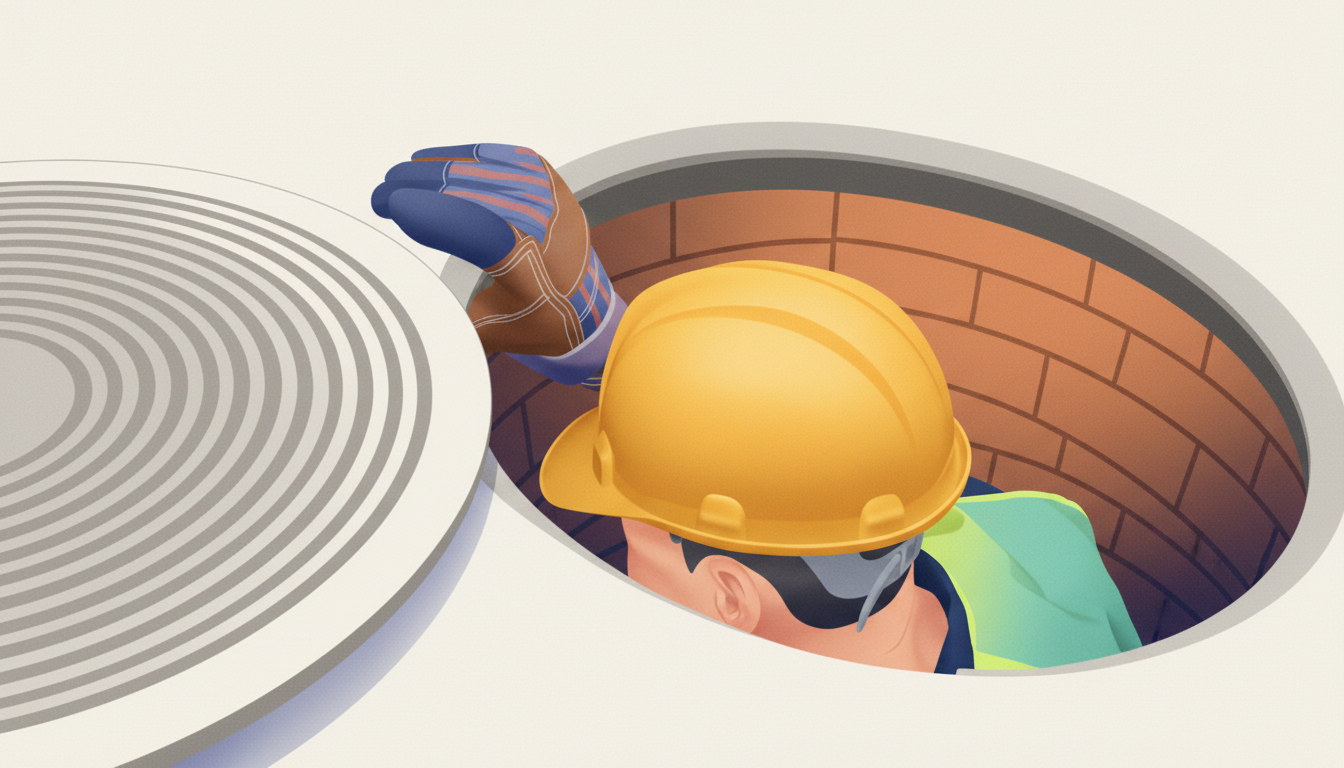
The Confined Spaces Regulations 1997 define a confined space as any place — the regulations list "any chamber, tank, vat, silo, pit, trench, pipe, sewer, flue, well or other similar space" — in which, by virtue of its enclosed nature, there arises a reasonably foreseeable specified risk.
Both halves of that matter. It has to be enclosed, and that enclosure has to create one of a defined list of risks. A space is not confined just because it is small, awkward or unpleasant to work in.
The specified risks
There are five, and they are the whole test:
- Serious injury from fire or explosion — a build-up of gas or vapour in an enclosed space.
- Loss of consciousness from an increase in body temperature — heat with nowhere to go.
- Loss of consciousness or asphyxiation from gas, fume, vapour or lack of oxygen — the classic, and the one that kills most often.
- Drowning from a rise in the level of a liquid — a sewer or a chamber that can fill.
- Asphyxiation from a free-flowing solid, or being unable to reach breathable air because a free-flowing solid has trapped you — grain, sand, or similar.
Where plumbers meet them
- Manholes, inspection chambers and sewers — drainage work below ground
- Under a suspended floor — subfloor work through access panels
- Service ducts and risers in flats and commercial buildings
- Large tanks and cisterns entered for internal cleaning or repair
- Enclosed or poorly ventilated plant rooms
- Some parts of a loft, particularly enclosed areas with no through-ventilation
- Deep excavations and trenches — see below
Is a trench a confined space?
Sometimes. The regulations do name "trench" in their list, which is why some sources treat every trench as a confined space — but the qualifier still applies. An open, well-ventilated trench in clean ground, a metre deep, with no services leaking into it, has no reasonably foreseeable specified risk and is not a confined space.
A deep trench is a different matter. Heavier-than-air gases — propane, LPG, and natural gas from a damaged main — sink and collect at the bottom and will not blow away. Carbon monoxide from plant idling at the edge does the same. Sewer gas can enter through a broken drain. Once any of that is foreseeable, the trench is a confined space and everything in the rest of this section applies on top of the excavation rules.
Treat that as "may well be", not "always is".
What the Confined Spaces Regulations require
Three duties, in a strict order. The order is the point — you are not allowed to skip to step two because step one is inconvenient.
- Avoid entry if you reasonably can. Regulation 4 is blunt: no person shall enter a confined space to carry out work unless it is not reasonably practicable to achieve that purpose without such entry. Can you do it from outside — with a camera, a rod, a long-reach tool, by isolating and draining, by removing a panel? Then you must.
- If entry is unavoidable, follow a safe system of work that renders the work safe in relation to the specified risks. In practice: a permit to work, trained operatives, isolation of anything that could fill or start, ventilation, atmospheric testing, appropriate RPE, lighting and communications.
- Put emergency arrangements in place before anyone enters. Regulation 5 requires suitable and sufficient rescue arrangements before the work starts — and requires that those arrangements do not simply transfer the risk to whoever carries them out. Where resuscitation may be needed, the equipment for it has to be there too.
The permit to work
A permit to work is the document that ties the safe system together. It is not paperwork for its own sake: it is a formal handover stating that specific checks have been done, by a named person, at a stated time, and that entry is authorised for a limited period only. It records the isolation, the test results, who is inside, who is outside, and when the permit expires — and it has to be signed back in when the job is finished, so that nobody is left unaccounted for.
Testing the atmosphere
You test before entry and you keep testing while people are inside, because a space that was safe an hour ago may not be now. The conventional order is oxygen first, then flammable gases, then toxic gases — oxygen first because the reading affects how the other sensors behave, and because oxygen deficiency is the risk most likely to kill without warning.
Normal air is 20.9% oxygen. Below roughly 19.5% an atmosphere is treated as oxygen-deficient and unsafe to enter without breathing apparatus. Enriched atmospheres are dangerous too — extra oxygen dramatically increases fire risk, which is why a leaking oxygen hose must never be left in an enclosed space.
The two things that make this hazard so treacherous: you cannot smell a lack of oxygen, and carbon monoxide is colourless and odourless as well. By the time you notice symptoms your judgement is already impaired, which is precisely why the decision to enter is made outside, on the basis of an instrument, not on how the space feels once you are in it.
The person outside
Someone must be stationed immediately outside the confined space for the whole time work is going on inside. Their main role is to start the rescue plan in an emergency.
Not to supervise the work — that is the supervisor's job, separately. Not to check compliance with the method statement. Not to carry out a risk assessment; that was done before anyone arrived. The person outside is there to maintain contact with whoever is inside, to raise the alarm, and to set the rescue arrangements in motion. That is a full-time job and they must not be given anything else to do.
Why you never go in after them
This is the hardest rule in the whole topic and the one worth carrying off the course. A large proportion of confined space deaths are would-be rescuers — people who saw a colleague collapse and climbed in to help. The atmosphere that took the first casualty down takes the second down just as fast, and now there are two casualties and nobody outside.
The rescue arrangements exist so that rescue can be carried out without anyone entering unprotected: winch and harness from outside, breathing apparatus, and the emergency services. This is exactly what regulation 5 means when it says the arrangements must reduce the risks to the person carrying out the rescue. If you take one thing from this section: raise the alarm, start the plan, stay out.
Blowtorches: two questions, two different answers
This pair comes up repeatedly and catches people out because the answers look interchangeable. They are not — read the location in the question.
Blowtorch in a confined space → the greatest risk is fume inhalation. A naked flame in an enclosed space consumes oxygen and produces combustion products — carbon monoxide, carbon dioxide, nitrogen oxides — which build up fast where ventilation is restricted. You are attacked from both directions at once: the oxygen goes down as the toxic gas goes up.
Blowtorch in a cramped loft → the greatest risk is fire damage. A loft is full of flammable insulation, dry timber and stored belongings, it is usually unventilated in the fire-safety sense, and a fire that starts up there is well established before anyone below notices.
Same tool, same flame, different surroundings, different answer.
Common exam traps
Trap 1: 1.2m is the depth at which support is required. Learn it as the answer — but know it is a rule of thumb, not a figure in regulation 22.
Trap 2: Battered, benched or supported are the three options beyond 1.2m. Battered is sloped; benched is stepped.
Trap 3: Spoil at least 1m back from the edge. One cubic metre of earth ≈ one tonne.
Trap 4: A trench is work at height — the Work at Height Regulations say any distance above or below ground level. This is why excavations sit in the same unit.
Trap 5: Guard rail 950mm, gap 470mm (Work at Height Regs Schedule 2). The 2m barrier some sources give is site perimeter hoarding, not trench edge protection.
Trap 6: Excavations are inspected by a competent person at the start of every shift — plus after any event affecting stability, and after any fall of material.
Trap 7: Propane is banned in a trench because it is heavier than air and collects at the bottom.
Trap 8: Never work ahead of the trench supports.
Trap 9: A confined space needs a reasonably foreseeable specified risk — enclosure alone is not enough.
Trap 10: The order is avoid entry → safe system of work → emergency arrangements, and the emergency arrangements must be ready before entry.
Trap 11: The person outside initiates the rescue plan. Not supervision, not risk assessment.
Trap 12: Never enter to rescue someone. Most confined space fatalities include rescuers.
Trap 13: Test oxygen first, then flammable, then toxic. Below 19.5% oxygen is unsafe.
Trap 14: Confined space + blowtorch = fume inhalation. Cramped loft + blowtorch = fire damage.
Trap 15: Assume every underground service is live until the owner confirms otherwise in writing.
Quick revision summary
Before the mock test, ten things you should be able to produce from memory:
- Support required at 1.2m — exam answer; regulation 22 itself has no depth figure
- Three ways to treat the sides: battered (45°), benched (stepped), supported (trench box/shield)
- Spoil 1m back; 1m³ of earth ≈ 1 tonne
- Edge protection: guard rail min 950mm, max gap 470mm, plus toe board
- Inspection by a competent person: start of every shift, after any destabilising event, after any fall of material — report within 24 hours
- Services: plans → CAT and genny → hand-dig trial holes → assume live. Water service min 750mm deep
- Confined space = enclosed and a reasonably foreseeable specified risk (five of them)
- Confined Spaces Regs order: avoid entry → safe system of work → emergency arrangements in place first
- Person outside = initiates the rescue plan; never enter to rescue
- Atmosphere: oxygen first, then flammable, then toxic; normal 20.9%, unsafe below 19.5%
📝 10-Question Mock Test
Click an option to see whether you got it right. Explanations appear instantly — no submitting at the end.
1.2m — roughly waist height on an average person. Worth knowing that this is a long-standing rule of thumb rather than a figure written into CDM 2015 regulation 22, which is expressed in terms of risk rather than depth. Shallower trenches have killed people, so 1.2m is a trigger for support, not a guarantee of safety below it.
About a tonne. That is why spoil must be kept at least 1 metre back from the edge, and why even a shallow fall of material can pin someone or stop them breathing. It is the single figure that explains most of the excavation rules.
The three options are battered (sides sloped back, usually 45°), benched (sides cut into steps) and supported (a proprietary trench box or shield). Compacting the sides does nothing to prevent a collapse — vibration next to an open trench makes one more likely, not less.
CDM 2015 regulation 22(4) requires inspection by a competent person at the start of every shift, after any event likely to have affected the strength or stability of the excavation, and after any accidental fall of material. Heavy rain triggers the second of those, and the new shift triggers the first — so this trench needs inspecting on both counts before anyone goes back in.
Propane and LPG are heavier than air, so a leak sinks to the lowest point and stays there — exactly where you are working, and it will not blow away. It is the same reasoning that bans LPG cylinders from cellars. Natural gas, by contrast, is lighter than air and rises.
HSG47 sets the order: plans, then locate, then dig safely. Drawings tell you what to expect but never exactly where; the CAT and genny locate it on the ground; hand-dug trial holes expose it before any machine goes near. Every service is treated as live until its owner confirms otherwise in writing.
Both halves are needed. The space must be enclosed, and by virtue of that enclosure there must be a reasonably foreseeable specified risk — fire or explosion, loss of consciousness from heat, loss of consciousness or asphyxiation from gas/fume/vapour/lack of oxygen, drowning, or asphyxiation from a free-flowing solid. Small and awkward is not the same as confined.
Regulation 4 says nobody shall enter a confined space unless it is not reasonably practicable to achieve the purpose without entering. Avoidance comes first; the safe system of work (permits, testing, the person outside) and the emergency arrangements only come into play once entry has been shown to be unavoidable.
A large share of confined space deaths are would-be rescuers. Whatever took the first casualty down will take you down just as fast, and then there are two casualties and nobody outside. Regulation 5 requires rescue arrangements that do not depend on someone entering unprotected — winch and harness from outside, breathing apparatus, emergency services. Raise the alarm, start the plan, stay out.
A naked flame in an enclosed space consumes oxygen and produces carbon monoxide and other combustion products, which build up fast where ventilation is restricted — you are attacked from both directions at once. Fire damage (C) is the right answer for the same blowtorch in a cramped loft, where flammable insulation and timber are the dominant hazard. Read the location in the question.
How PlumbMate puts this into practice
Excavations and confined spaces are heavy on specific figures, fixed sequences and "which risk is greatest here" judgements — exactly the material that rewards spaced retrieval rather than re-reading.
- Flashcards, not essays. One prompt, one answer — the format that research has consistently shown works best for active recall.
- Wrong answers are logged. Every question you get wrong goes into a dedicated collection that resurfaces more frequently in future sessions.
- The 3× rule. You need to get a question right three times before it clears — one lucky guess isn't enough.
- A sort task for this exact topic. Unit 201 has an interactive board that makes you decide, statement by statement, whether something is true of a confined space, an excavation, or both — which is where most people find out their mental model is fuzzier than they thought.