At Level 1 you need to know what each renewable does, not how to design one. The one that catches everybody out is the pair that share a name: solar thermal and solar PV.
The short answer
Heat pumps work on the principle that heat is provided from the ground or the air. The one that provides heat from wood pellets is biomass. Solar thermal makes hot water, solar photovoltaic makes electricity, and wind, tidal and hydro all turn a turbine.
The two organisations giving advice and guidance on energy saving and conservation are the Energy Saving Trust and the Carbon Trust.
Why a heat pump gives back more than you put in
This is the part worth understanding rather than memorising, because it sounds like something for nothing and is not.
Put one unit of electricity into the compressor and you get three or four units of heat into the house. The extra did not come from the electricity; it came from outside, for nothing, and the machine only paid to move it. The ratio has a name — the coefficient of performance — and across a whole year a well installed air source machine typically manages around three.
The cycle itself is a fridge running backwards. A refrigerant that boils at a very low temperature is fed to the evaporator outside, where even cold air is warm enough to boil it. The compressor squeezes that gas, which raises its temperature sharply. The condenser indoors hands that heat to the heating water, and an expansion valve drops the pressure so it can start again.
People stumble on the idea that cold air contains heat. It does: 0 °C is nearly 273 degrees above absolute zero, so there is a great deal of heat in it. It is simply at too low a temperature to be useful until something raises it. A ground source machine uses the same cycle with the collector buried, where the ground temperature barely moves between January and July.
Wood pellets are the exam’s giveaway word
Pellets exist to make wood behave like oil. They are a uniform size with the moisture driven out of them, so they pour, they flow down an auger, and a boiler can feed itself and turn down. Logs can do none of that, which is why a log boiler needs a large store of heated water and somebody to load it by hand every day.
What the customer needs to be told before they buy is the part that never appears in the sales material: a pellet store big enough for a delivery, a lorry that can reach it, and ash to empty. It is a heating system with a fuel supply chain attached.
Solar thermal in December
A collector will cover most of a household’s hot water from May to September and very little in midwinter. That is not a fault, it is the nature of the thing, and it is why the cylinder keeps a second heat source.
Hence the twin coil cylinder: the solar coil sits low down where the stored water is coolest, so the panel has the best chance of adding something useful, and the boiler coil sits above it to top up the rest. Get those the wrong way round and the boiler heats the whole cylinder, leaving the panel nothing to do.
The two organisations, and who each is for
The exam wants both names, and they are easy to muddle because they are the same shape.
- The Energy Saving Trust — set up in the early 1990s and aimed at households and the people who work in them. Advice on what a measure is actually worth, what grants and schemes exist, and certification for products and installers.
- The Carbon Trust — set up in 2001 and aimed at businesses and public bodies. Measuring an organisation’s carbon footprint, certifying it, and finding the reductions at that scale.
Homes to the Energy Saving Trust, organisations to the Carbon Trust. If nothing else sticks, remember there are two of them and both are called Trust.
What comes next
Level 2 and the renewables courses take these apart properly: sizing a heat pump against a calculated heat loss, choosing emitters for a low flow temperature, and the certification an installer needs before any of it can be signed off.
🔢 The numbers worth memorising
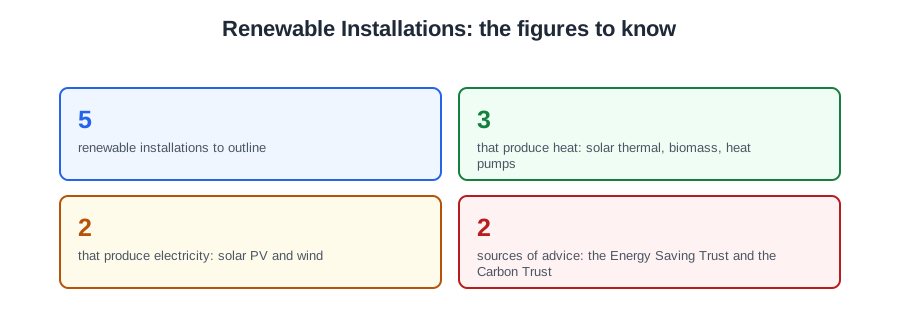
- 5
- renewable installations to outline
- 3
- that produce heat: solar thermal, biomass, heat pumps
- 2
- that produce electricity: solar PV and wind
- 2
- sources of advice: the Energy Saving Trust and the Carbon Trust
⚠️ Where people go wrong
- Confusing solar thermal with solar PV. Thermal makes heat; photovoltaic makes electricity.
- Saying solar thermal heats the house. It heats the water in the cylinder.
- Describing a heat pump as making heat. It moves heat, which is why it delivers more than it uses.
- Forgetting that heat pumps want low flow temperatures, and therefore bigger emitters.
- Naming only one advice body. Both the Energy Saving Trust and the Carbon Trust are on the list.
📝 8-Question Self-Test
Straight from the Level 1 course question bank. Click an option to see whether you got it right — the explanation appears instantly, and there is nothing to submit.
Solar thermal absorbs heat and passes it to a coil in a hot water cylinder. Photovoltaic makes electricity.
The Energy Saving Trust and the Carbon Trust both give advice on energy saving.
Solar thermal absorbs heat from the sun and passes it to a cylinder coil. Photovoltaic turns daylight directly into electricity.
A heat pump takes low grade heat from the air or ground and raises it to a useful temperature — it moves heat rather than creating it.
The Energy Saving Trust and the Carbon Trust.
The Energy Saving Trust, or the Carbon Trust — the two named sources of energy saving guidance.
A heat pump moves heat that is already there rather than making it. Ground source takes it from buried pipework, air source from outdoor air — which works in winter because cold air still holds usable heat.
Biomass burns wood. The exam question asks which one provides heat from wood pellets, and offers air source, solar photovoltaic and ground source alongside it — the word pellets is the giveaway.
Going deeper: the same ground at Level 2
Level 1 gives you the shape of this. The Level 2 guides below take it considerably further — the regulations, the calculations and the detail you will need next. Free to read, same as these.
- Start here: Environment and Sustainability for Level 1 Plumbers — the whole unit in one piece
- All 72 Level 1 guides — one per lesson, across all ten units
- The Level 1 glossary — 620 terms in plain English