Three bands, four examples each. The marks are not really in the list — they are in being able to say why something sits in one band and not the next one along.
The short answer
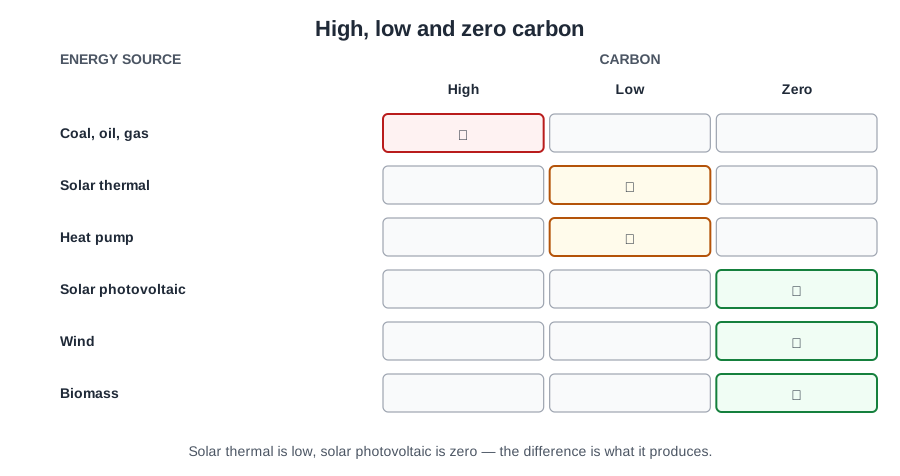
Three bands, four examples in each. High carbon: natural gas and LPG, fuel oils, coal and peat, and electricity from non-renewable sources. Low carbon: solar thermal, biomass, heat pumps, and combined heat and power. Zero carbon: wind, tidal, hydroelectricity, and solar photovoltaic.
The paper shows you pictures rather than words. A hydroelectric dam is zero carbon, a coal fired power station is high carbon, and a solar thermal panel is low carbon.
You have to recognise them, not only name them
A picture question is a different skill from a list, so it is worth knowing what each one looks like.
- A coal or gas fired station is the wide cooling towers and the tall thin chimney. Worth knowing which is which: what pours out of the fat towers is water vapour, and the carbon dioxide leaves quietly from the thin one.
- A hydroelectric plant is a dam and a reservoir, or a small turbine house on a river.
- A solar thermal collector has pipework at the top edge, or is a rack of glass evacuated tubes. A photovoltaic panel is a grid of dark cells crossed by fine silver lines, and has no pipes at all.
If you can tell those two panels apart in a photograph you have the mark that catches most people.
Why solar thermal is low and solar photovoltaic is zero
Both sit on a roof and both are driven by the sun, so the split feels arbitrary until you look at what each installation actually does while it is running.
Solar thermal has a pump and a controller, and often a motorised valve, so it draws a small amount of electricity to move the heat it has collected. Photovoltaic has no moving parts and produces electricity rather than consuming any. That is the whole of the difference as far as the bands are concerned.
Being honest about it: on a full life-cycle view nothing is truly zero, because panels, turbines and dams all take energy to build. The bands describe what is released while the thing is in use, which is the only way a classification like this can work.
Electricity sits in two bands, and that is the point
Electricity is not a fuel. It is a way of moving energy from one place to another, and its carbon is decided at the power station rather than at the socket. That is why the answer list splits it: non-renewable generation is high carbon, and wind, tidal, hydro and photovoltaic are zero.
The practical version is that the same heat pump is a different machine at different hours. On a windy afternoon it is running on almost nothing; on a still, cold evening when gas plant is filling the gap, it is not. The grid has changed enormously — coal has gone, wind now supplies more across a year than anything else — but it has not finished changing.
Why low carbon is not a consolation prize
Biomass burns, and you can see it burning. The argument for putting it in the low band is that the carbon coming out is carbon the tree took from the air over the last few decades, so it is a short loop rather than releasing something that has been underground since before there were trees. That argument only holds while the wood is replaced.
Combined heat and power is the one worth understanding properly. An ordinary power station throws away roughly half the energy in its fuel as warm water and steam, because there is nobody near enough to want it. CHP puts the generator where the heat is wanted — a hospital, a block of flats, a district scheme — and uses both outputs. The same fuel does far more work, which is why it earns a band above the fuel it burns.
What comes next
Level 2 takes the high carbon column apart properly: what a fuel actually is, calorific values, what complete combustion produces, and what incomplete combustion produces instead. Carbon monoxide is the point at which this stops being an environmental subject and becomes a safety one.
🔢 The numbers worth memorising
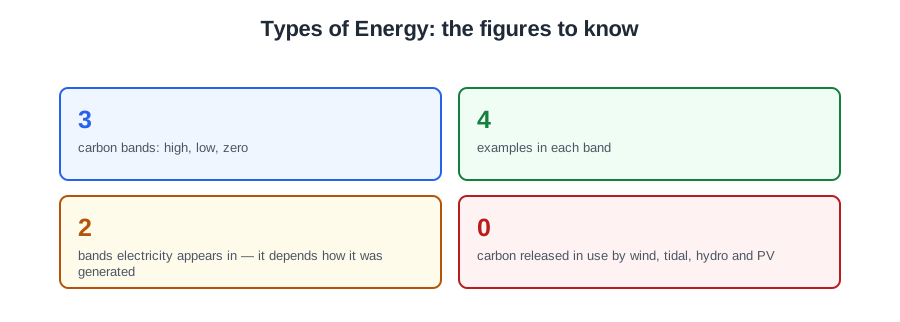
- 3
- carbon bands: high, low, zero
- 4
- examples in each band
- 2
- bands electricity appears in — it depends how it was generated
- 0
- carbon released in use by wind, tidal, hydro and PV
⚠️ Where people go wrong
- Putting all electricity in one band. Non-renewable electricity is high carbon; wind, tidal, hydro and PV are zero.
- Calling biomass zero carbon. It burns and releases carbon — just carbon the tree recently absorbed.
- Calling a heat pump zero carbon. It uses electricity, so its carbon depends on how that was made.
- Confusing solar thermal with solar PV. Thermal is low carbon and makes heat; PV is zero carbon and makes electricity.
📝 8-Question Self-Test
Straight from the Level 1 course question bank. Click an option to see whether you got it right — the explanation appears instantly, and there is nothing to submit.
Zero carbon sources release none in use: wind, tidal, hydroelectricity and solar photovoltaic.
A heat pump uses electricity, so how clean it is depends on where that electricity comes from.
Electricity is only as clean as whatever made it. From a non-renewable source it is high carbon; from wind, tide, hydro or solar PV it is zero carbon.
The paper shows pictures and asks you to classify them. It uses a hydroelectric dam for zero carbon, a coal fired power station for high carbon, and a solar thermal panel for low carbon — one from each group.
High carbon means burning fossil fuel: natural gas and LPG, fuel oils, solid fuels such as coal and peat, and electricity from non-renewable sources. Solar photovoltaic is zero carbon.
Electricity is only as clean as whatever made it. The carbon comes out at the coal fired power station rather than in the house, which is why the Range lists electricity from non-renewable sources as high carbon.
Low carbon is not zero. Biomass burns, but the wood took that carbon from the air while growing. CHP burns fuel but wastes almost none of it. A heat pump carries whatever carbon its electricity came with. Hydroelectricity is zero carbon.
CHP generates electricity on site and uses the heat that would otherwise be thrown away for heating. Almost all the energy in the fuel gets used, which is why it sits in the low carbon group with solar thermal, biomass and heat pumps.
Going deeper: the same ground at Level 2
Level 1 gives you the shape of this. The Level 2 guides below take it considerably further — the regulations, the calculations and the detail you will need next. Free to read, same as these.
- Start here: Environment and Sustainability for Level 1 Plumbers — the whole unit in one piece
- All 72 Level 1 guides — one per lesson, across all ten units
- The Level 1 glossary — 620 terms in plain English