Waste from a job is your responsibility until it reaches somewhere licensed to take it. If you hand it to the wrong person and it ends up in a lay-by, it is still your offence.
The short answer
For a company vehicle to carry waste legally the operator needs a licence — registration as a waste carrier.
Metals that can be recycled, beyond the galvanised trunking and lead the question hands you: copper pipe, copper cable, low carbon steel, metal conduit and brass.
The piece of legislation the answer guide names is the Site Waste Management Plans Regulations.
About that piece of legislation
Give the guide’s answer, and know the real position underneath it.
The Site Waste Management Plans Regulations applied in England from 2008 and required larger construction projects to plan their waste before work began rather than deal with it once it existed. They were revoked in 2013. The duty that actually governs your working life is the duty of care in the Environmental Protection Act, which falls on anyone who produces, carries, treats or disposes of waste, and it has never gone anywhere.
So: write what the paper wants, and know which one is still in force. The idea behind the plans was a good one regardless — the cheapest time to deal with waste is before the material has been ordered.
The duty of care follows the waste, and it follows the householder
Handing waste to somebody does not hand the responsibility over with it. Pay a man with a van £40 to take a bath and some old pipework away, and if it appears in a lay-by the trail leads back to whoever produced it — usually because something in the pile has an address on it.
Householders are caught by the same principle, which is the part worth passing on to a customer. Somebody who pays a stranger to clear their old bathroom and does not check that they are registered can be issued a fixed penalty of up to £600 in England, or prosecuted. “I paid a man” is not a defence for them any more than it is for you.
Checking a carrier takes about a minute
The register is public and free to search — the Environment Agency in England, SEPA in Scotland, Natural Resources Wales, and the NIEA in Northern Ireland. You need the firm’s name or its registration number, and registration is renewed every few years, so an old certificate on a windscreen proves nothing on its own.
Then record the handover on a waste transfer note: what the waste was, roughly how much, who handed it over, who took it, their carrier registration, and where it was going. Keep it for two years. Hazardous waste travels on its own paperwork, a consignment note, kept for three.
What a strip-out is worth
Scrap metal is the reason nobody has to be talked into separating copper. Clean copper tube is worth a few pounds a kilo, brass rather less, and low carbon steel radiators and pipe are worth a bin rather than a fortune — but between them, the cylinder, the pipework and the rads off a full heating strip-out will often cover the skip and the diesel.
One rule surprises people every time: you cannot be paid in cash. Since the Scrap Metal Dealers Act 2013 a yard has to pay by cheque or bank transfer and has to see photographic identification, which was brought in to make stolen lead and cable harder to sell. Take your driving licence, and expect the yard to write down the vehicle.
Lead is the one to be careful with in an answer. It is valuable and recyclable, and it is hazardous to work with, but clean scrap lead is not hazardous waste: it is kept apart from the copper because it is priced separately. In an exam, note that the qualification’s list puts lead under hazardous waste, so an assessment question may expect that answer.
What comes next
Level 2 goes into the substances themselves: what makes a waste hazardous, how asbestos is identified and who is allowed to touch it, and the assessments that have to happen before you open a container rather than after.
🔢 The numbers worth memorising
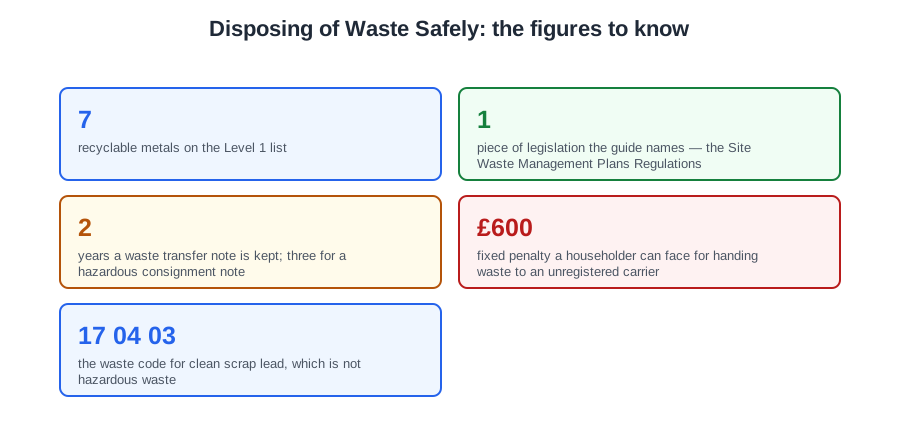
- 7
- recyclable metals on the Level 1 list
- 1
- piece of legislation the guide names — the Site Waste Management Plans Regulations
- 2
- years a waste transfer note is kept; three for a hazardous consignment note
- £600
- fixed penalty a householder can face for handing waste to an unregistered carrier
- 17 04 03
- the waste code for clean scrap lead, which is not hazardous waste
⚠️ Where people go wrong
- Thinking your responsibility ends when someone takes the waste away. The duty of care follows the waste.
- Not checking a waste carriers licence. That check is what protects you if the waste is tipped.
- Putting lead in with the general scrap. It is priced separately, so it is kept apart.
- Forgetting the waste transfer note. It is the evidence that the transfer was legal.
- Answering the legislation question vaguely. The guide wants the Site Waste Management Plans Regulations by name.
📝 8-Question Self-Test
Straight from the Level 1 course question bank. Click an option to see whether you got it right — the explanation appears instantly, and there is nothing to submit.
Recyclable metals include copper tube, brass, lead, low carbon steel, copper cable, conduit and galvanised steel trunking.
Anyone carrying waste as part of a business must be a registered waste carrier — and the waste stays your responsibility until it reaches a licensed site.
A registered waste carriers licence. If you pay someone to take waste away, check they have one — fly tipping stays your offence even if someone else tipped it.
Licensed waste disposal: waste goes to a site licensed to receive that type of waste, and it is your responsibility until it gets there.
Lead is hazardous to work with, but clean scrap lead is not hazardous waste: it is recycled, and kept apart from the other scrap because it is priced separately. Exam note: the qualification’s list puts lead under hazardous waste, so an assessment question may expect that answer.
The metals named are copper tube, brass, lead, low carbon steel, copper cable, conduit and galvanised steel trunking.
The Environmental Protection Act and its duty of care, documented on a waste transfer note.
A waste transfer note, required under the duty of care in the Environmental Protection Act.
Going deeper: the same ground at Level 2
Level 1 gives you the shape of this. The Level 2 guides below take it considerably further — the regulations, the calculations and the detail you will need next. Free to read, same as these.
- Start here: Environment and Sustainability for Level 1 Plumbers — the whole unit in one piece
- All 72 Level 1 guides — one per lesson, across all ten units
- The Level 1 glossary — 620 terms in plain English