Unit 103 looks like the soft one and is full of things that are simply facts you either know or do not: which band a fuel sits in, and which skip a material goes in. Both are quick to learn and both come up.
Three bands of energy
Energy used in homes is grouped by how much carbon dioxide it releases. Four examples in each band is what gets asked.
- High carbon — natural gas and LPG, fuel oils, solid fuels (coal and peat), and electricity from non-renewable sources.
- Low carbon — solar thermal, biomass (wood pellets and logs), heat pumps, and combined heat and power (CHP).
- Zero carbon — electricity from wind, from the tide, hydroelectricity, and solar photovoltaic.
The middle band is where people go wrong, and there is a reason for it in each case. Biomass does release carbon when it burns — but only the carbon the tree took in while it was growing, so it counts as low rather than high. A heat pump runs on electricity, so how clean it is depends on where that electricity came from. That is why neither is zero.
Note the same logic on electricity itself: it is only as clean as whatever made it. From a wind turbine it is zero carbon. From a gas station it is high.
Saving water and electricity in a home
Small things, and they add up across a country.
On water: fix dripping taps and running overflows (a drip runs day and night), fit a dual flush or a cistern displacement device, showers rather than baths, spray taps, and water butts for the garden. On electricity: efficient appliances, good controls so heating runs when it is needed and not when it is not, insulation, and LED lighting.
The plumbing angle is worth stating: a leak is not just a repair job, it is water wasted continuously until somebody fixes it. That is one of the arguments for planned maintenance rather than waiting for a breakdown.
Three classes of waste
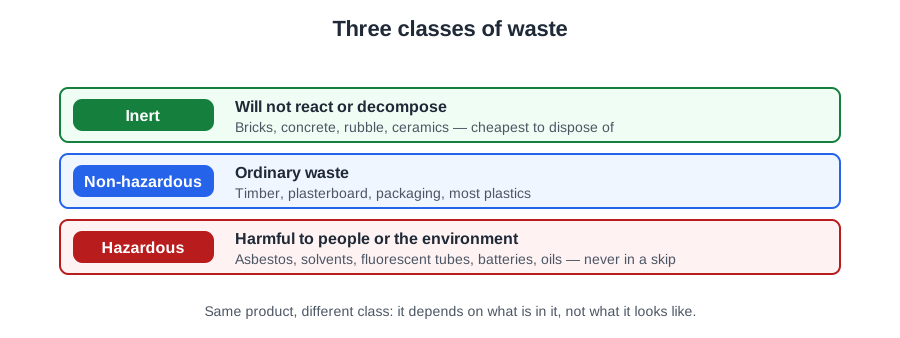
Waste goes into three classes, and they go to different places. Putting hazardous waste into a general skip is an offence.
- Hazardous — harmful to people or the environment. Needs special handling, separate containers and its own paperwork (a consignment note). Asbestos, waste electrical equipment, solvents.
- Non-hazardous — ordinary waste that will break down or can be recycled. Timber, paper and cardboard, water based glues and paints, scrap metal.
- Inert — will not rot, burn or react. Chemically inactive, so it can often be used as fill. Bricks, glass, ceramics and tiles, sand and gravel.
Two catch people out every time. Clean scrap lead is not hazardous waste (List of Wastes code 17 04 03): it goes to a metal recycler on a normal transfer note, though lead is hazardous to work with. Lead paint debris, lead-contaminated waste and lead-acid batteries are hazardous waste. In an exam, note that the qualification’s list puts lead under hazardous waste, so an assessment question may expect that answer. Working with lead is covered separately, by the Control of Lead at Work Regulations. And water based glues and paints are non-hazardous — solvent based ones are hazardous. The base is what decides, not the fact that it is paint.
WEEE
The WEEE regulations — waste electrical and electronic equipment — keep electrical goods out of landfill, because they contain both valuable materials and harmful ones.
Things you will actually be carrying out of a house under WEEE: motors (pumps and fans), control equipment (programmers, thermostats, control boxes), lamps, printed circuit boards from boilers and controls, and power tools.
Which leads to the point worth taking away from this whole unit: an old boiler is not one kind of waste. The casing is scrap metal. The pump and the circuit board are WEEE. And if it is old enough, the gaskets and rope seals may contain asbestos.
🔢 The numbers worth memorising
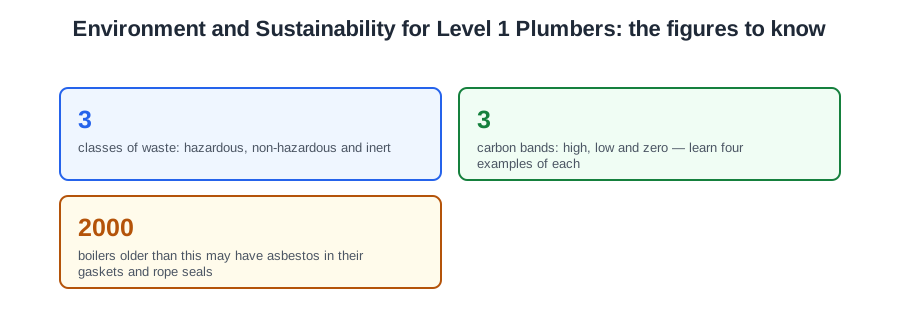
- 3
- classes of waste: hazardous, non-hazardous and inert
- 3
- carbon bands: high, low and zero — learn four examples of each
- 2000
- boilers older than this may have asbestos in their gaskets and rope seals
⚠️ Where people go wrong
- Clean scrap lead is not hazardous waste, though lead is hazardous to work with — and the qualification’s list puts lead under hazardous waste, so an assessment question may expect that answer.
- Water based paint is non-hazardous; solvent based is hazardous. The base decides, not the fact that it is paint.
- Biomass is low carbon, not zero. Burning it does release carbon — just only what the tree took in while growing.
- A heat pump is low carbon, not zero. It runs on electricity, so it is only as clean as the electricity is.
- A pump is WEEE, not scrap metal. Motors are named in the regulations.
📝 8-Question Self-Test
Straight from the Level 1 course question bank. Click an option to see whether you got it right — the explanation appears instantly, and there is nothing to submit.
A flow reducing valve limits the flow so an outlet cannot run faster than it needs to.
Standby draws power all day for nothing. Switching off, energy efficient lighting and A rated appliances all reduce waste.
About a fifth of a home's energy bill goes on hot water, so wasting it wastes fuel as well as water.
Roughly a fifth of a home's energy bill goes on hot water, which is why wasting hot water wastes fuel as well as water.
A metered household pays once to buy the water and again to have it taken away and treated as waste.
A spray tap breaks the flow into a spray, so hands can be washed using far less water.
Modern dual flush cisterns use around 4 to 6 litres; an older cistern uses 9 litres or more.
Standby draws power all day for nothing. The other three are water-saving measures.
Going deeper: the same ground at Level 2
Level 1 gives you the shape of this. The Level 2 guides below take it considerably further — the regulations, the calculations and the detail you will need next. Free to read, same as these.
- Heat Loss for Low Temperature Heating: Fabric, Ventilation and U-Values
- How Heat Pumps Work: Principles, the Refrigerant Cycle and Real Efficiency
- How Solar Thermal Works: The Resource, Orientation and Collectors
- Workplace Documents, Drawings and Information
- Hazardous Substances: COSHH, Asbestos and Lead
- Hand Tools for Plumbers: Identification, Use and Safety
- All 72 Level 1 guides — one per lesson, across all ten units
- The Level 1 glossary — 620 terms in plain English