A plumber has more effect on what a house uses than almost anyone else. The fittings you choose and the leaks you fix decide that household’s bills for the next twenty years.
The short answer
Why it matters, and any two of these will do: it is less harmful to the environment; the release of CO2 into the atmosphere during the production of electricity; to prevent water shortages; the conservation of energy sources; and it saves money.
Conserving water: flow reducing valves, spray taps, low volume WC flush, regular maintenance of terminal fittings and float valves, and promoting user awareness. Conserving electricity: energy efficient lighting, switching equipment from standby to off, energy efficient equipment, and A rated cookers and washing machines.
That is the paper. The rest of this is why the lists look the way they do.
Whether the house is metered decides who pays for a leak
More than half of households in England are now on a water meter, and the two arrangements behave completely differently.
An unmetered house pays a fixed charge worked out from the old rateable value of the property. The bill is identical whether the family uses fifty litres a day or five hundred. A dripping tap therefore costs that customer nothing, which is exactly why it never gets reported.
A metered house pays for what the meter records, and then pays a sewerage charge worked out as a percentage of that same reading. Every litre is charged for twice. That is why the money argument is the one that moves people: it is a line on a bill rather than a moral point.
Why the WC is the fitting that matters most
Around a third of the water used in an average home goes down the WC — more than baths, more than showers, more than everything in the kitchen put together. A person in this country uses roughly 140 litres a day, and a good deal of it is flushed away.
An old single flush cistern uses nine litres, and some older ones a good deal more. A modern dual flush uses about four or six. Change one fitting and the biggest single use in the house halves, which is why low volume flush sits on the list and why the exam keeps it there.
It also explains why promoting user awareness earns a mark rather than being filler. A dual flush plate with two unmarked buttons is a coin toss, and plenty of households press the larger one every time for years.
Terminal fittings, and the leak nobody hears
Terminal fittings is exam language for the taps and outlets at the ends of the pipework — the last thing water passes through before it leaves the system. They are on the maintenance list alongside float operated valves for a reason.
A float valve that has stopped shutting off floods nothing. The cistern keeps filling and the surplus runs quietly out of the warning pipe and down the outside wall, day and night, where nobody indoors hears it. A passing valve can lose hundreds of litres a day and run for months before anybody notices the green stain on the brickwork.
That is the one thing worth telling a customer at handover: water dripping from a small pipe on an outside wall is never normal.
The electricity list is aimed at a moving target
The guide names CO2 released during the production of electricity because the carbon comes out at the power station rather than in the kitchen. What is worth knowing is how much that number has moved. The last coal fired power station in the country closed in 2024, wind now produces more of Britain’s electricity across a year than gas does, and the carbon released per unit has more than halved in a decade.
It has not reached zero, and gas still fills the gaps on a cold, still evening. So the exam answer holds: using less electricity means burning less fuel somewhere. It is simply a smaller somewhere than it used to be.
What comes next
At Level 2 this stops being a list and becomes a calculation. New dwellings in England have to meet a water efficiency target of 125 litres per person per day, worked out from the fittings specified, and the Water Regulations limit what a WC or a tap may deliver. The fittings on this list are what make that sum come out.
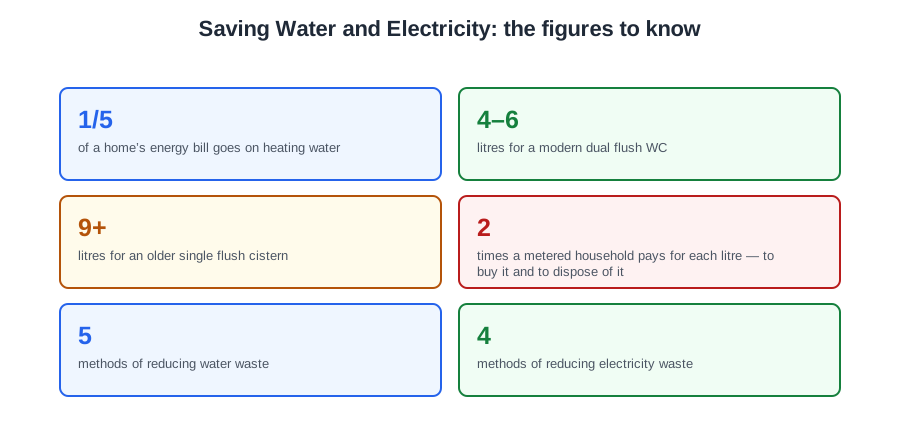
🔢 The numbers worth memorising
- 1/5
- of a home’s energy bill goes on heating water
- 4–6
- litres for a modern dual flush WC
- 9+
- litres for an older single flush cistern
- 2
- times a metered household pays for each litre — to buy it and to dispose of it
- 5
- methods of reducing water waste
- 4
- methods of reducing electricity waste
- 1/3
- of the water used in a home goes down the WC
⚠️ Where people go wrong
- Forgetting that terminal fittings means the taps and outlets at the ends of the pipework.
- Leaving user awareness off the list. Telling the customer how a fitting works is one of the named methods.
- Mixing up the water list and the electricity list. Spray taps and flow reducers are water; LEDs and standby are electricity.
- Giving only the environmental argument. The cost-to-the-customer one is on the list too, and it is the one that persuades people.
📝 8-Question Self-Test
Straight from the Level 1 course question bank. Click an option to see whether you got it right — the explanation appears instantly, and there is nothing to submit.
A flow reducing valve limits the flow so an outlet cannot run faster than it needs to.
Standby draws power all day for nothing. Switching off, energy efficient lighting and A rated appliances all reduce waste.
About a fifth of a home's energy bill goes on hot water, so wasting it wastes fuel as well as water.
Roughly a fifth of a home's energy bill goes on hot water, which is why wasting hot water wastes fuel as well as water.
A metered household pays once to buy the water and again to have it taken away and treated as waste.
A spray tap breaks the flow into a spray, so hands can be washed using far less water.
Modern dual flush cisterns use around 4 to 6 litres; an older cistern uses 9 litres or more.
Standby draws power all day for nothing. The other three are water-saving measures.
Going deeper: the same ground at Level 2
Level 1 gives you the shape of this. The Level 2 guides below take it considerably further — the regulations, the calculations and the detail you will need next. Free to read, same as these.
- Start here: Environment and Sustainability for Level 1 Plumbers — the whole unit in one piece
- All 72 Level 1 guides — one per lesson, across all ten units
- The Level 1 glossary — 620 terms in plain English