Four valves that all do the same job in different ways. The differences are the whole lesson — and they explain why the old ones stick and the new ones do not.
What a float operated valve does
A float operated valve — an FOV — fills a cistern and shuts off at the right level. A float on an arm rises with the water and closes the valve.
You will hear it called a ballvalve or a ball cock on site, and all three names mean the same thing.
Where they are found
- WC cisterns
- Storage cisterns — the cold water cistern in the loft
The four types
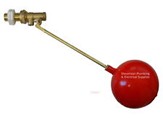
Portsmouth pattern FOV
The older type. A piston moves sideways in the body, pressing a washer against the seat.
- The arm is bent to adjust the water level. Literally — you bend the brass arm.
- Noisier, and the piston can stick.
It sticks because the piston slides in a bore that is full of water, so limescale and grit build up around it. That is the fault this design is known for.
Diaphragm pattern FOV (brass)
A large rubber diaphragm closes against the seat instead of a piston.
The important consequence: the moving parts are kept out of the water, so it does not seize up. That is the whole reason the diaphragm design replaced the Portsmouth one. It is also quieter.
Diaphragm pattern FOV (plastic)
The same principle in a plastic body. The common modern valve.
The level is usually adjusted by a screw rather than by bending the arm — which is both easier and repeatable.
Diaphragm pattern equilibrium FOV
This one takes a moment to understand, and it is worth it.
Water is allowed through a small passage to the back of the diaphragm, so there is equal pressure on both sides. That is what “equilibrium” means — balanced.
With the pressure balanced, the float only has to overcome friction, not the water pressure. It is doing far less work, so it closes cleanly and positively.
Used on high pressure or fluctuating mains, where an ordinary valve would judder or fail to shut. A juddering ballvalve on a high pressure main is a noise complaint, and an equilibrium valve is the fix.
The warning pipe
Every cistern has a warning pipe — an overflow — that discharges outside where it will be noticed.
“Where it will be noticed” is the design intent, not an accident. The pipe comes out through the wall and drips onto the path so that somebody sees it, because the alternative is a cistern quietly overflowing into a loft.
Water running from a warning pipe is the sign that a float valve has failed — usually a worn washer or diaphragm. So a customer ringing to say water is dripping from a pipe outside has told you the diagnosis before you arrive.
Learning the four
- Portsmouth = piston, moving sideways. Older, noisier, can stick.
- Diaphragm = rubber diaphragm, and the working parts stay dry. Brass or plastic body.
- Equilibrium = pressure balanced on both sides, for difficult mains.
Three ideas, four valves. The plastic and brass diaphragm valves work identically; only the body differs.
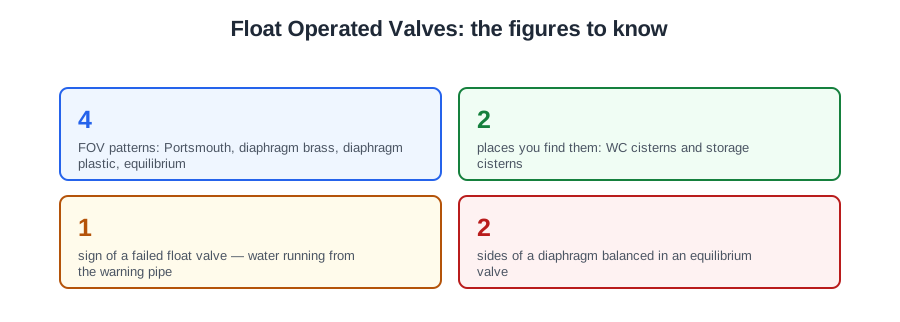
🔢 The numbers worth memorising
- 4
- FOV patterns: Portsmouth, diaphragm brass, diaphragm plastic, equilibrium
- 2
- places you find them: WC cisterns and storage cisterns
- 1
- sign of a failed float valve — water running from the warning pipe
- 2
- sides of a diaphragm balanced in an equilibrium valve
⚠️ Where people go wrong
- Confusing Portsmouth with diaphragm. Portsmouth is a sideways piston; diaphragm uses a rubber diaphragm.
- Not knowing what equilibrium means. Equal pressure both sides of the diaphragm, so the float does less work.
- Thinking the warning pipe is a fault in itself. It is the warning; the fault is the valve.
- Adjusting a plastic diaphragm valve by bending the arm. It has an adjusting screw.
- Forgetting why the diaphragm design replaced the piston one — the moving parts stay out of the water.
📝 8-Question Self-Test
Straight from the Level 1 course question bank. Click an option to see whether you got it right — the explanation appears instantly, and there is nothing to submit.
The Portsmouth pattern uses a piston moving sideways. The diaphragm types use a rubber diaphragm and keep the working parts out of the water.
B is the only one with a piston moving sideways rather than a diaphragm. That is the Portsmouth pattern, BS 1212 part 1.
Water fed to both sides of the diaphragm balances the pressure, so the float only has to overcome the spring. That is the equilibrium pattern, BS 1212 part 4.
The Portsmouth pattern is the older type: a piston moves sideways in the body, pressing a washer against the seat. The arm is bent to adjust the level.
Float operated valves are found on WC cisterns and on storage cisterns — the cold water cistern in the loft.
The portsmouth float valve is part 1. It is no longer fitted new, so it goes in for replacement only of an existing part 1 valve.
The diaphragm float valve is part 2 in brass and part 3 in plastic. Part 3 is the one in most modern WC cisterns.
Water reaches both sides of the diaphragm, so the pressure balances and the float only has to overcome the spring.
- Start here: Installation, Repair and Maintenance for Level 1 — the whole unit in one piece
- All 72 Level 1 guides — one per lesson, across all ten units
- The Level 1 glossary — 620 terms in plain English