This is the unit where Level 1 turns into actual work. Most of it comes down to one skill: looking at what a fault is doing and knowing from that alone which repair it needs. Get that right and the job is half done before you touch a spanner.
Where the water comes from
All water on earth is recycled through the water cycle. The sun evaporates it from the sea, it condenses into cloud, falls as rain, runs into rivers or soaks into the ground, and returns to the sea. The water coming out of a tap today has been going round for millions of years.
It is collected from five sources, and they differ in how clean they start out:
- River — surface water. Plentiful, and the dirtiest: it has run over land and through towns.
- Spring — emerging naturally from the ground, already filtered by the rock.
- Upland surface — rainwater collected off high ground into a reservoir. Little contamination, because few people live there.
- Deep well — a borehole into deep rock. Very clean.
- Shallow well — into the water table near the surface. More easily contaminated from above.
The pattern: the deeper and the higher, the cleaner.
Then six stages between the source and the tap: reservoir storage (which also lets heavy particles settle out on their own), treatment, sedimentation (solids sink), filtration (through sand and gravel), sterilisation (chlorine, and this is the stage that makes it safe to drink), and distribution.
Water that has been through all of that is described as wholesome — fit to drink. Keeping it that way once it is inside a building is what the water regulations are for.
Which valve, and where
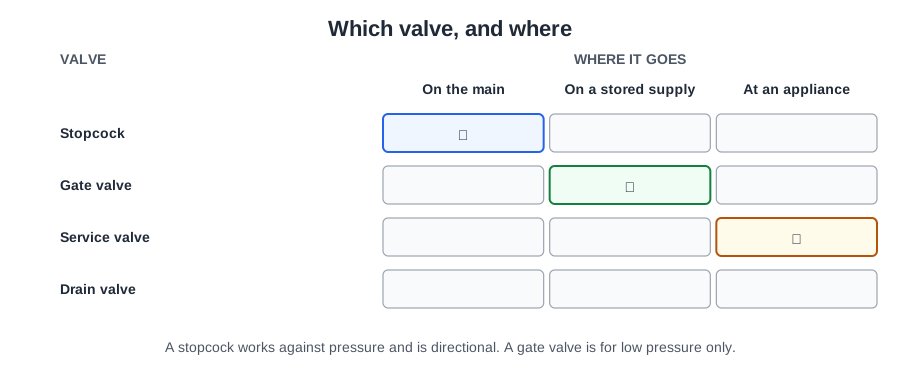
Three ideas explain where each type belongs.
Low pressure. A valve on a gravity-fed pipe from a cistern has very little pressure behind it, so it must not restrict the flow. That is why gate valves are used there — a gate lifts clear of the bore so the full pipe is open. You recognise one by its round wheel head.
Pressure from height. Pressure in a stored system comes from the height of the water above the outlet. Roughly 10 metres of height gives 1 bar.
Appliance isolation. Small service valves let one appliance be shut off for repair without draining the whole house — behind a WC, under a basin, usually a slotted head turned with a screwdriver.
The two stop valves are worth keeping straight:
- External stop valve — in the footpath or at the boundary, in a covered box. It belongs to the water supplier and shuts off the whole property. Turned with a stopcock key.
- Internal stop valve — where the supply enters the building, usually under the kitchen sink. This is the one you use.
And drain valves sit at the lowest points, to drain the system down before a repair.
Stopcock or gate valve? A stopcock has a crutch or lever head and goes on mains pressure, restricting the flow slightly. A gate valve has a round wheel and goes on low pressure gravity pipework, where that restriction could not be afforded.
Reading the fault
This is the part worth learning properly, because the symptom tells you the repair.
- Dripping from the spout → the washer. The rubber washer sealing against the seating has hardened or worn. If it still drips with a new washer, the seating is scored and needs re-cutting or a nylon seat.
- Weeping up the spindle, around the handle, when the tap is open → the gland. Tighten the gland nut a little first; if that does not do it, re-pack the gland.
- Stiff to turn → re-grease the spindle with silicone grease, which is safe with drinking water and does not attack rubber. Never oil or ordinary grease on a water fitting.
- Water escaping around the head or spout of a mixer → the O ring. Replace like for like with a smear of silicone grease.
- Grits when turned, or drips, on a ceramic disc tap → the cartridge. A ceramic disc tap has no washer at all, so it is never re-washered — the whole cartridge is replaced. Note whether it is the hot or the cold side, as they are handed.
- Cistern overflowing → the float operated valve. Either its washer (or diaphragm), or a waterlogged float sitting low in the water so the valve never fully closes.
- Gate valve turns but does not shut the water off → the gate has come off the spindle inside. On an old valve it is often quicker to replace the whole thing.
Whatever the repair, the first step never changes: isolate. Turn off the supply — a service valve if there is one, otherwise the internal stop valve — open the tap to drain the pipe and prove the water is off, and put the plug in so nothing small disappears down the waste.
After working on a float valve, check the level: it should sit about 25 mm below the warning pipe.
Planned and unplanned maintenance
Planned preventive maintenance means checking things before they fail, at regular intervals. It is usually found on larger installations, and it covers float operated valves, appliance taps, stop valves, gate valves and isolation valves. Part of it is simply turning valves off and on again, because valves that are never operated seize — and then do not work on the day they are needed.
Unplanned maintenance is what happens when something has already gone wrong: burst pipes, running overflows, dripping taps, blockages.
Why speed matters, and this is a list the exam likes:
- Wasted water — a drip or a running overflow wastes it continuously, day and night.
- Contamination of water — a fault can let contaminated water back into the supply.
- Damage to the owner’s property — a leak destroys ceilings, floors and electrics.
- Damage to other property — in flats and apartments, a leak on one floor damages the homes below.
- The inconvenience of no services — and for someone elderly or ill, no heating and no hot water is a good deal more than an inconvenience.
The whole argument in one line: planned costs a little, regularly, at a time you choose. Unplanned costs a lot, at the worst possible moment.
🔢 The numbers worth memorising
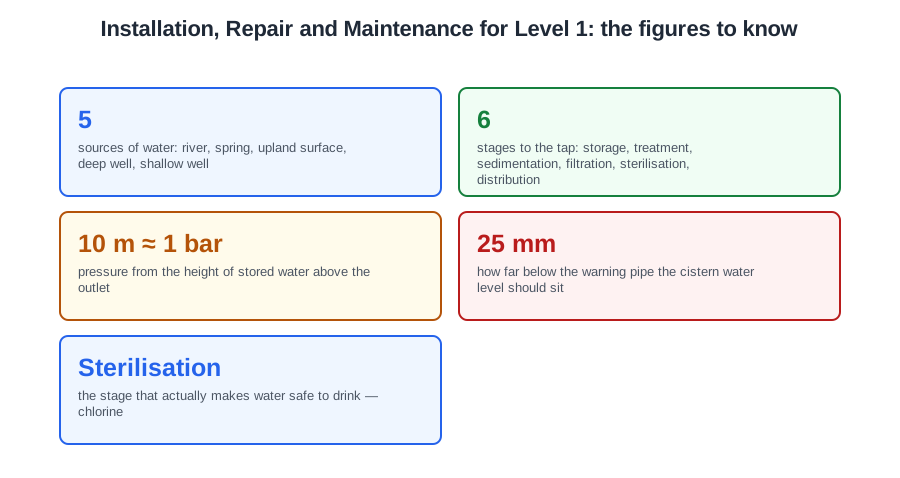
- 5
- sources of water: river, spring, upland surface, deep well, shallow well
- 6
- stages to the tap: storage, treatment, sedimentation, filtration, sterilisation, distribution
- 10 m ≈ 1 bar
- pressure from the height of stored water above the outlet
- 25 mm
- how far below the warning pipe the cistern water level should sit
- Sterilisation
- the stage that actually makes water safe to drink — chlorine
⚠️ Where people go wrong
- Dripping spout = washer. Weeping spindle = gland. Where the water comes from tells you the repair.
- A ceramic disc tap has no washer. You replace the cartridge, and hot and cold are handed.
- Gate valve = low pressure gravity. Stopcock = mains. Round wheel against a crutch head.
- Silicone grease only on a water fitting. Oil and ordinary grease attack the rubber and are not safe with drinking water.
- Valves that are never operated seize. Turning them off and on is part of planned maintenance, not a waste of time.
📝 8-Question Self-Test
Straight from the Level 1 course question bank. Click an option to see whether you got it right — the explanation appears instantly, and there is nothing to submit.
The deeper and the higher, the cleaner. Deep wells and upland surface water need least treatment.
All water on earth is recycled through the water cycle: evaporation, condensation, rain, run-off and back to the sea.
All water on earth is recycled through the water cycle — the water coming out of a tap today is the same water that has been going round for millions of years.
The sun evaporates water from the sea, it condenses into cloud, falls as rain, runs into rivers or soaks into the ground, and returns to the sea.
River water is surface water that has run over land and through towns, so it needs the most treatment. The deeper and the higher, the cleaner.
A shallow well goes into the water table near the surface, so it is more easily contaminated from the ground above.
The six labels in order: heat from the sun, evaporation, water vapour, water saturated clouds, rain or snow, and the river running back to the sea to restart the process.
The five sources split into surface water — river and upland surface — and underground water — spring, deep well and shallow well.
Going deeper: the same ground at Level 2
Level 1 gives you the shape of this. The Level 2 guides below take it considerably further — the regulations, the calculations and the detail you will need next. Free to read, same as these.
- All 72 Level 1 guides — one per lesson, across all ten units
- The Level 1 glossary — 620 terms in plain English