Every noise in a cold water system tells you where the fault is. The trick is not listening harder — it is noticing exactly when the noise happens.
The three noises
Noise is one of the most common complaints in a cold water system, and each noise points to a specific fault. Learn them as three pairs of cause and correction.
Humming or squealing when a tap is opened
Cause: a worn or split tap washer vibrating in the flow.
Correction: renew the tap washer.
A washer that has hardened or split no longer sits still. The water rushing past it makes it flutter, and the flutter is the noise.
Loud hum in the pipework
Cause: a worn or split washer in the float operated valve, vibrating as the cistern fills.
Correction: renew the FOV washer.
Exactly the same mechanism as the tap, in a different place. The difference is that this one happens on its own, without anybody touching a tap.
Loud or violent banging in the system
Cause: loose or incorrectly supported pipework moving and striking the structure when the flow stops suddenly.
Correction: identify the loose pipework and refix it.
Telling them apart
The useful question is when the noise happens. That alone separates all three.
- Only while a tap is running → the tap washer.
- Only while a cistern is filling, and it stops when the cistern is full → the float valve washer.
- A bang as the water stops → loose pipework.
So on the phone, before you have seen anything, three questions get you most of the way: does it happen when you run a tap, does it happen after flushing the WC, or does it happen the moment something turns off?
Water hammer
The banging has a proper name: water hammer.
Here is what is actually happening. Water in a pipe has weight and it is moving. When a valve closes, that moving column of water is stopped suddenly, and all its momentum has to go somewhere. It becomes a pressure shock that travels back along the pipe.
That shock makes the pipe jump. If the pipe is properly clipped, it cannot move and you hear nothing. If it is loose, it moves and hits the joist, and the bang travels through the structure of the house — which is why the noise often seems to come from a completely different room.
Why it has got more common
Worth knowing, because customers notice it after a new appliance goes in.
Quarter turn ceramic taps and washing machine valves make water hammer more likely, because they close so quickly. A traditional tap takes several turns to close, so the water slows down gradually. A quarter turn tap or a solenoid valve in a washing machine shuts in a fraction of a second, and the faster the stop, the bigger the shock.
Proper clipping is the answer. The pipework was probably always underclipped; the new appliance just revealed it.
🔢 The numbers worth memorising
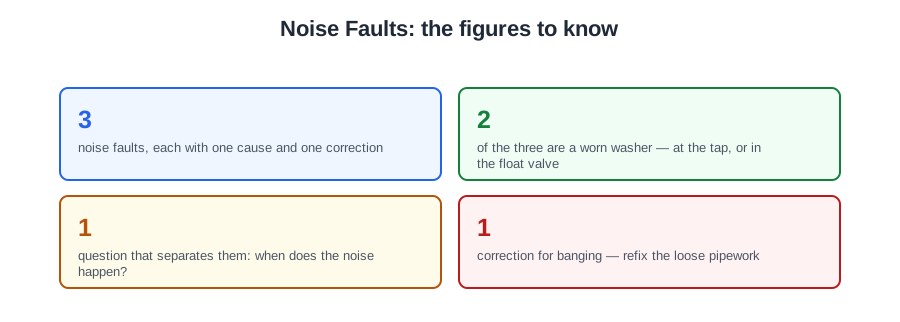
- 3
- noise faults, each with one cause and one correction
- 2
- of the three are a worn washer — at the tap, or in the float valve
- 1
- question that separates them: when does the noise happen?
- 1
- correction for banging — refix the loose pipework
⚠️ Where people go wrong
- Treating banging as a valve fault. It is loose pipework.
- Confusing the two hums. A tap hum happens while a tap runs; an FOV hum happens while a cistern fills.
- Blaming a new quarter turn tap for water hammer. It revealed the underclipped pipework rather than causing it.
- Giving a cause without a correction. Each of the three is assessed as a pair.
📝 8-Question Self-Test
Straight from the Level 1 course question bank. Click an option to see whether you got it right — the explanation appears instantly, and there is nothing to submit.
Banging as the water stops is loose or incorrectly supported pipework moving and striking the structure.
A hum while the cistern fills is a worn or split washer in the float operated valve.
Humming or squealing when a tap is opened is a worn or split tap washer vibrating in the flow. Renew the washer.
The useful question is when the noise happens. Only while a cistern is filling, stopping when it is full, is the float valve washer.
A bang as the water stops is loose or incorrectly supported pipework striking the structure. Identify the loose pipework and refix it.
Water hammer is the moving column of water being stopped suddenly, and the shock moving the pipe. Quarter turn fittings close fast, so the stop is more abrupt. Proper clipping is the answer.
The noise is the loose edge of the washer vibrating in the flow, thousands of times a second, as the water moves fastest past it.
Ask when the noise happens. When a tap is opened means the tap washer, every time.
- Start here: Installation, Repair and Maintenance for Level 1 — the whole unit in one piece
- All 72 Level 1 guides — one per lesson, across all ten units
- The Level 1 glossary — 620 terms in plain English