Nearly all of it is banter that carried on after somebody asked it to stop, and nearly all of it is witnessed by people who said nothing.
The short answer
Nine protected characteristics: age, disability, gender reassignment, marriage and civil partnership, pregnancy and maternity, race, religion or belief, sex, sexual orientation. Older material, including some papers, names six of them. Treating somebody worse for any of them is unlawful — in recruitment, pay, promotion, training, dismissal and in day-to-day treatment.
Our Level 1 lesson covers the six and what they mean. This is about what actually happens on sites and what to do about it.
What it really looks like
Almost none of it is somebody announcing they will not employ you. It is:
- A nickname based on where somebody is from, that everybody uses and nobody thinks about.
- Banter that was fine on day one and carried on for six months after the person asked it to stop.
- The same person getting the worst job every time, without anybody deciding it.
- Someone left out of the tea run, the lift, the WhatsApp group.
- "We tried a woman once, it did not work out."
The legal test is not whether it was meant unkindly. It is whether somebody is being treated worse for a reason on that list. Intent is not the test, and "it was only a joke" is not a defence.
The bit the syllabus does not cover: what to do
If it is happening to you
Write it down as it happens. Date, what was said, who was there. Do it the same day. This is the single most useful thing you can do, because these situations are almost always one person's word against another's, and a contemporaneous note is evidence in a way that a memory six months later is not.
Say clearly that you want it to stop, if you safely can. A lot of it does stop at that point, and if it does not, the fact that you asked matters a great deal afterwards.
Raise it formally, in writing. Your employer should have a grievance procedure. Writing it down starts a process with a record, where a conversation in a van does not.
Get advice early. ACAS is free, independent and confidential, and it is what they are there for. If it ever goes to an employment tribunal there are strict time limits — much shorter than people assume — and ACAS conciliation is a required step before a claim. Early advice keeps your options open; late advice sometimes cannot.
You are also protected from being punished for raising it. Being treated worse because you complained is victimisation, and it is unlawful in its own right.
If you are watching it happen
This is most people, most of the time, and it is where sites actually change.
You do not have to make a speech. "Leave it out" from one other person is usually enough, because most of this behaviour depends on the room going along with it. Not laughing is itself a response. If you cannot say anything in the moment, say something to the person afterwards, or to a supervisor.
Apprentices are the least powerful people on any site and this is genuinely harder for you than for anyone else. Telling your college or training provider is a legitimate route when telling the site is not.
Reasonable adjustments, which get missed
Disability is the one ground that carries a positive duty. An employer must not only avoid treating a disabled worker worse — they must make reasonable adjustments so the person can do the job.
In this trade that is more relevant than it sounds. Dyslexia is common and adjustments for written assessment are routine. So are adjustments after a back injury or for hearing loss — both occupational injuries this industry produces in quantity. Asking for one is not asking for a favour.
Why this is on a plumbing course
Construction is one of the least diverse industries in the country, and the people who leave it early are disproportionately the ones who were made unwelcome. Every firm complains about the skills shortage; a fair number are part of the reason for it.
You will spend your career in small teams, in vans and in people's homes. What gets tolerated in those teams is set by what the people in them let pass.
What comes next
The obligations do not change at Level 2 — the nine are the nine. What changes is your position: supervising an apprentice makes you responsible for what happens on your job, not just for what you do yourself.
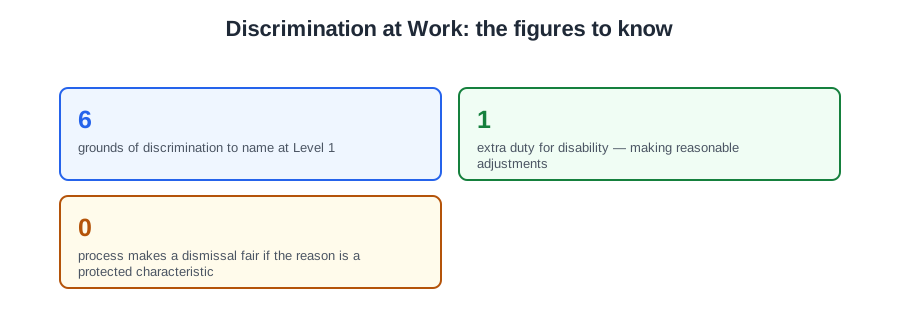
🔢 The numbers worth memorising
- 6
- grounds of discrimination to name at Level 1
- 1
- extra duty for disability — making reasonable adjustments
- 0
- process makes a dismissal fair if the reason is a protected characteristic
⚠️ Where people go wrong
- Thinking discrimination only means refusing someone a job. Day-to-day treatment counts, and that is where most of it happens.
- Confusing redundancy with dismissal. Redundancy is the job ending; dismissal is the person being let go.
- Treating age discrimination as only affecting older workers. It applies in both directions.
- Forgetting that religion includes having no religion.
- Not knowing that being punished for complaining is itself unlawful.
📝 8-Question Self-Test
Straight from the Level 1 course question bank. Click an option to see whether you got it right — the explanation appears instantly, and there is nothing to submit.
The list is gender, sexual orientation, age, race, disability and religion.
The nine protected characteristics are age, disability, gender reassignment, marriage and civil partnership, pregnancy and maternity, race, religion or belief, sex and sexual orientation.
Redundancy is the job itself ceasing to exist. Dismissal is the person being let go, which needs fair grounds and a proper procedure.
Sex is one of the nine protected characteristics. Older material calls it gender; the Equality Act 2010 says sex.
Sexual orientation — which sex or sexes a person is attracted to — is one of the nine protected characteristics. Gender is a separate ground.
Age is one of the nine protected characteristics, and it protects older and younger workers alike — there is no age at which you stop being covered.
Race is one of the nine protected characteristics. It covers colour, nationality, and ethnic or national origin.
Disability is one of the nine protected characteristics, and it carries a duty to make reasonable adjustments rather than only a duty not to treat someone worse.
Going deeper: the same ground at Level 2
Level 1 gives you the shape of this. The Level 2 guides below take it considerably further — the regulations, the calculations and the detail you will need next. Free to read, same as these.
- Start here: The Construction Industry for Level 1 Plumbers — the whole unit in one piece
- All 72 Level 1 guides — one per lesson, across all ten units
- The Level 1 glossary — 620 terms in plain English