Everybody respects the hazards that hurt straight away. The ones that take twenty years are the ones that get people, because nothing warns you to stop.
The short answer
Thirteen named hazards at Level 1: electric shock, burns, cuts and abrasions, dust inhalation, working at height, lifting and carrying, solvents, vapours, asbestos, vibration, noise, extremes of temperature, and slips, trips and falls.
Two figures are worth separating and are constantly confused. Slips, trips and falls cause the most injuries. Falls from height cause the most deaths. Our Level 1 lesson takes the list properly; this goes at what the slow ones actually do to people.
The ones that take twenty years
Construction has a long tail of ill health that does not show up in accident figures at all, because there is no accident. Nobody fills in a form the day their hearing starts going.
Silica dust
Cutting or drilling brick, block, concrete or stone releases respirable crystalline silica — particles small enough to reach the deepest part of the lung and stay there. Over years it causes silicosis: permanent scarring, permanently reduced lung capacity, and it does not reverse when you stop.
The controls are unglamorous and they work. Cut wet. Use on-tool extraction. Wear a mask rated for the job — and one that fits, which is why face-fit testing exists and why a beard is a genuine problem rather than a rule for the sake of it.
Hand-arm vibration
Breakers, SDS drills, grinders. Sustained vibration damages the nerves and blood vessels in the hands, and the result — hand-arm vibration syndrome — means numbness, loss of grip, and fingers that go white and painful in the cold. For a trade that depends on feeling a fitting go tight, that is a career-ending injury.
It is dose-based, which is why rotating a job between people is a real control and not a way of dodging work.
Asbestos
Still the single biggest cause of work-related deaths in the UK, decades after it was banned, because the illnesses take thirty or forty years to appear. Anything built or refurbished before 2000 may contain it — artex, insulation board, cement sheet, pipe lagging, floor tiles.
You are not expected to identify it and you are not allowed to remove it. You are expected to stop, not disturb it, and report it. The plumber's version of this is real: pipe lagging in an old plant room and artex on a ceiling you are about to drill are both common.
Why the slow ones get ignored
A cut hurts, so you deal with it. Dust does not, so you do not. There is no moment where your body tells you to stop, and by the time there is, the damage is already permanent.
That is the whole argument for wearing protection when you cannot feel a reason to. It is also why the PPE people skip is almost always the mask and the ear defenders, and almost never the gloves.
What PPE actually does, and what it does not
PPE is the last line, not the first. The order is: get rid of the hazard, control it at source, then protect the person. A mask is what you use when you cannot cut wet — not instead of cutting wet.
It matters because PPE only works when it is right, worn, and fitted. An unfitted mask, defenders round the neck, or gloves that are wrong for the job are all worse than useless, because they feel like protection.
Working at height, for a plumber
Plumbers do not think of themselves as working at height, and then spend a morning on a stepladder in a loft. Most falls in construction are not from scaffolds — they are from ladders, stepladders and through fragile surfaces, at heights people do not think of as dangerous.
A loft hatch, a flat roof to a boiler flue, a stepladder on an uneven floor: that is the plumber's working-at-height risk, and it is where the real numbers come from.
What comes next
At Level 2 this stops being a list and becomes a set of duties with names attached — the Health and Safety at Work Act, COSHH for the solvents and cements, the regulations on manual handling, noise and vibration, and the specific rules for working at height. Level 1 teaches you what can hurt you; Level 2 teaches you whose legal job it is to stop it.
🔢 The numbers worth memorising
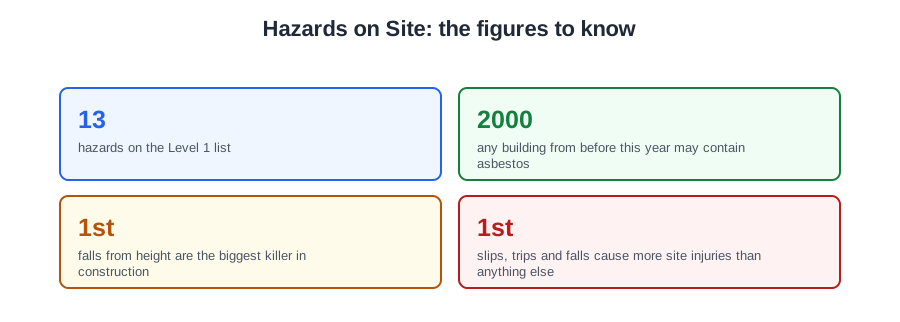
- 13
- hazards on the Level 1 list
- 2000
- any building from before this year may contain asbestos
- 1st
- falls from height are the biggest killer in construction
- 1st
- slips, trips and falls cause more site injuries than anything else
⚠️ Where people go wrong
- Confusing hazard with risk. A hazard is anything that could cause harm; the risk is how likely it is and how bad it would be.
- Only naming the dramatic hazards. Dust, noise and vibration are on the list and are asked about often.
- Thinking asbestos means old industrial buildings. Any building from before 2000 can contain it, including ordinary houses.
- Mixing up the two "biggest" facts: falls kill the most people; slips and trips injure the most people.
📝 8-Question Self-Test
Straight from the Level 1 course question bank. Click an option to see whether you got it right — the explanation appears instantly, and there is nothing to submit.
Slips, trips and falls cause more site injuries than anything else, and nearly all come from mess left lying about.
The dust from bricks, blocks and concrete contains silica. Breathed in over years it permanently scars the lungs — silicosis — and the damage cannot be undone. Cut wet, or use dust extraction.
Vibration causes permanent nerve damage to the hands. Like dust and noise it does its damage slowly, so nothing warns you at the time.
Falling from height kills more construction workers than anything else. Slips and trips injure more people; falls from height kill more of them.
Lifting and carrying badly damages the back, and it builds up over years rather than happening in one go. This is why manual handling — also called kinetic lifting — is taught.
Burns are one of the thirteen named hazards, and the plumber meets them more than most trades — blowtorches, hot pipework and hot water.
Solvents and their vapours are both on the named hazard list. In a space with no ventilation the vapour builds up instead of dispersing, and breathing it in can make you dizzy or knock you out.
Cuts and abrasions are one of the thirteen named hazards. Cut pipe, sheet metal and broken tile all leave edges that will open a hand up — which is what gloves are for.
Going deeper: the same ground at Level 2
Level 1 gives you the shape of this. The Level 2 guides below take it considerably further — the regulations, the calculations and the detail you will need next. Free to read, same as these.
- Start here: The Construction Industry for Level 1 Plumbers — the whole unit in one piece
- All 72 Level 1 guides — one per lesson, across all ten units
- The Level 1 glossary — 620 terms in plain English