Unit 101 is the one people skim, and it is full of marks. It is not about plumbing — it is about the industry you have just joined, the people you will be working alongside, and what the law says you are owed. Here is the whole thing in plain English.
The five key trades
Every building needs the same core group of people, and you are one of them. The five you have to know are the electrician, plumber, carpenter, bricklayer and plasterer.
Your own job covers more than most people outside the trade realise: hot and cold water supply, central heating, bathroom installation, and sanitation and drainage. The bricklayer does brick, stone and concrete block. The plasterer does plastering and dry lining. Simple, and it comes up.
Who runs the job
On anything bigger than a house, a group of people plan and run the work before a single pipe goes in. You will not meet all of them, but you are expected to know what each one does — and, more usefully, who to ask when something is wrong.
- Architect — designs the building and produces the drawings everyone works from. If a drawing looks wrong, the answer comes from here.
- Structural engineer — makes sure the building stands up. They decide what you may and may not cut into. If you need to notch a joist, this is whose call it is.
- Clerk of works — works for the client, not the contractor, checking the work is to the drawings and to the right standard.
- Site manager — runs the site day to day. Also called the site agent, or the construction manager.
- Estimator — works out what the job will cost, so the firm can price it.
- Buyer — gets the right materials there on time and at the right price. Also called the procurement officer.
As an apprentice you will mostly deal with your own supervisor and the site manager. Knowing the rest is what stops you asking the wrong person and getting a wrong answer.
Main contractor and sub contractor
The main contractor holds the contract with the client and is responsible for the whole build. They rarely do every trade themselves, so they bring in sub contractors for the specialist work.
If you work for a plumbing firm on a new housing estate, your firm is almost certainly a sub contractor. That is normal, and it is the usual arrangement for plumbing on any large site.
Four ways a business can be owned
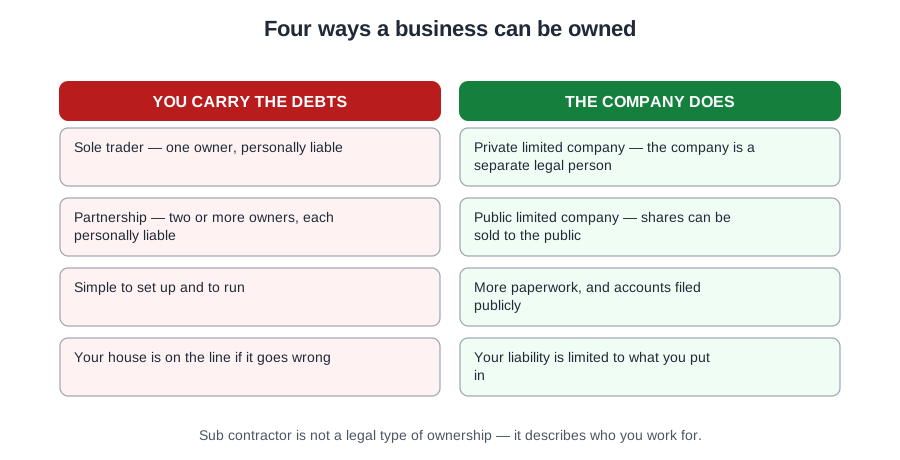
This is the bit people find dry, and it is worth two minutes because the difference between them is one idea: who pays if it all goes wrong.
- Sole trader — one person owns the business. Simple to set up, keeps the profit, and is personally responsible for the debts.
- Partnership — two or more people share the business, the profits and the responsibility for the debts.
- Private limited company (Ltd) — the business is a separate legal thing from its owners. That is what “limited” means: the owners’ personal money is protected if the company fails.
- Public limited company (plc) — the same, but shares can be bought by the public on the stock market. Used by the largest contractors.
Limited companies and plcs have to register with Companies House and file their accounts, which anyone can look up. Sole traders and partnerships do not.
The bodies, and how to keep them apart
Six organisations, and the exam likes asking which is which. There is a shortcut for each one.
- JIB (Joint Industry Board) — pay and conditions. Grades, wages, allowances, industrial agreements.
- IET (Institution of Engineering and Technology) — the wiring regulations.
- ECA (Electrical Contractors Association) — the E is for electrical.
- APHC (Association of Plumbing and Heating Contractors) — ours.
- Water Authority — the water supply itself, and taking the waste away.
- Local Authority — building regulations.
The one people mix up is ECA and APHC. Both support contractors; the E tells you which trade.
What you are owed at work
These are rights in law, whether or not your employer mentions them.
You are entitled to a written statement of your main terms — the job, the pay, the hours, the holiday. There is a legal minimum hourly wage, with a separate apprentice rate. Your week is normally capped at 48 hours, averaged over 17 weeks; you can opt out of that in writing, but nobody can force you to.
Paid leave is 5.6 weeks a year for a full time worker — 28 days including bank holidays. Maternity leave runs up to 52 weeks; paternity is normally one or two.
Rights come with duties, and they are the obvious ones: turn up, do the work, follow reasonable instructions, work safely, look after the tools.
Discrimination
It is unlawful to discriminate on any of the nine protected characteristics named by the Equality Act 2010: age, disability, gender reassignment, marriage and civil partnership, pregnancy and maternity, race, religion or belief, sex, sexual orientation. Older material, some exam papers included, lists six of them.
Discrimination is not only refusing someone a job. It includes how people are treated day to day, and “banter” aimed at one person can be part of it. Worth being clear about: redundancy is the job ceasing to exist; dismissal is the person being let go, which needs fair grounds and a proper procedure.
If something is wrong and you do not know where you stand, two places: direct.gov for what the law says, and ACAS — the Advisory, Conciliation and Arbitration Service — for free independent advice and help sorting out a dispute without going to court.
Getting qualified, and getting on
To work as a qualified plumber you need three things: a CSCS card (Construction Safety Certificate Scheme), the relevant trade qualification — NVQ Level 2 for a plumber — and relevant on-site experience.
Note the difference: a plumber needs NVQ Level 2, an electrician NVQ Level 3. The usual route on from there is apprentice, qualified tradesperson, supervisor, manager, director.
🔢 The numbers worth memorising
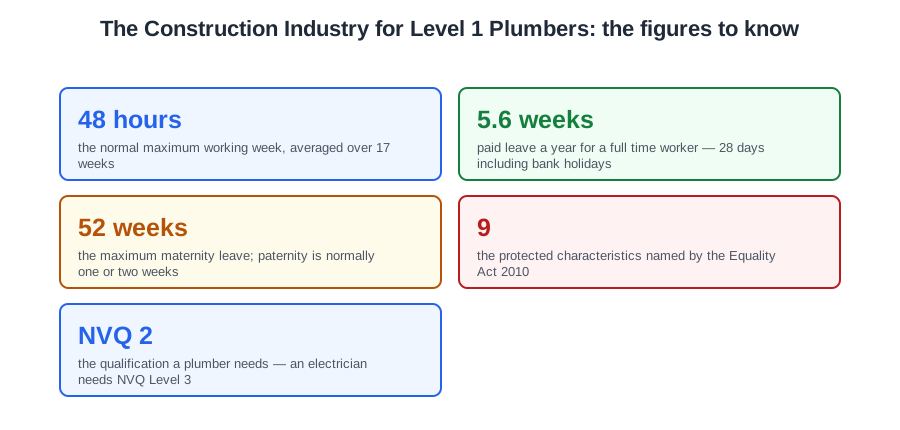
- 48 hours
- the normal maximum working week, averaged over 17 weeks
- 5.6 weeks
- paid leave a year for a full time worker — 28 days including bank holidays
- 52 weeks
- the maximum maternity leave; paternity is normally one or two weeks
- 9
- the protected characteristics named by the Equality Act 2010
- NVQ 2
- the qualification a plumber needs — an electrician needs NVQ Level 3
⚠️ Where people go wrong
- ECA or APHC? The E is for electrical. APHC is the plumbing and heating one.
- Redundancy is not dismissal. Redundancy is the job disappearing. Dismissal is the person being let go, and needs fair grounds.
- The clerk of works does not work for the builder. They work for the client, which is the entire point of the role.
- “Limited” is about the owners, not the size. It means their personal money is protected if the company fails.
- You cannot be made to opt out of the 48-hour week. You can choose to, in writing.
📝 8-Question Self-Test
Straight from the Level 1 course question bank. Click an option to see whether you got it right — the explanation appears instantly, and there is nothing to submit.
The five key trades are electrician, plumber, carpenter, bricklayer and plasterer.
The carpenter hangs doors, installs windows and installs timber roofs.
The five key trades are electrician, plumber, carpenter, bricklayer and plasterer. Plastering and dry lining is the plasterer's work.
Five: electrician, plumber, carpenter, bricklayer and plasterer.
A plumber's work covers hot and cold water supply, central heating, bathroom installation, and sanitation and drainage.
Bathroom installation is one of the four areas of plumbing work, alongside hot and cold water supply, central heating, and sanitation and drainage.
Lighting wiring, power supply wiring and maintenance are the three jobs the standard names for the electrician.
Hanging doors, installing windows and timber roof installation are the three jobs the standard names for the carpenter.
Going deeper: the same ground at Level 2
Level 1 gives you the shape of this. The Level 2 guides below take it considerably further — the regulations, the calculations and the detail you will need next. Free to read, same as these.
- Construction Roles and Site Structure
- Risk Assessment, Accidents and First Aid
- Fire Safety, Manual Handling, Noise and Other Risks
- Workplace Documents, Drawings and Information
- Safety Legislation and Enforcement
- Employment, Equality and Contracts
- How to Become a Plumber in the UK: A Complete 2026 Guide
- How to Pass Level 2 Plumbing in 2026: A Lecturer's Survival Guide
- All 72 Level 1 guides — one per lesson, across all ten units
- The Level 1 glossary — 620 terms in plain English