The rights are easy to look up. Knowing what to do when your employer is not keeping to them is the part nobody teaches.
The short answer
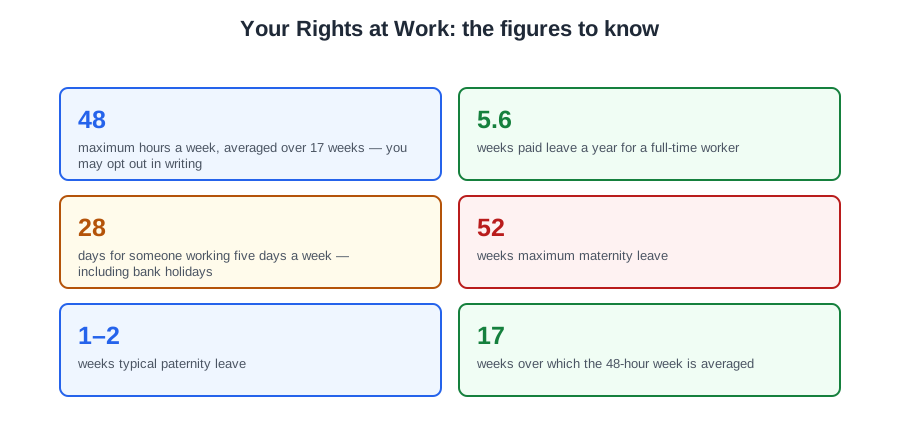
Seven employment rights at Level 1: contracts, paid leave, termination of employment, minimum wage, sick pay, maternity and paternity leave, and working hours. The figures that get asked: 48 hours a week averaged over 17 weeks, 5.6 weeks of paid leave (28 days including bank holidays), sick pay from the first day off sick for up to 28 weeks, maternity leave up to 52 weeks, paternity normally one or two.
Our Level 1 lesson covers those properly. This is about being an apprentice specifically, which the syllabus does not go into.
An apprentice is an employee
Start here, because it is the thing people get wrong. An apprentice is not a student on work experience and not a volunteer. You are an employee with a contract, and every right on that list applies to you in full.
Holiday is the clearest example. Apprentice holiday is 5.6 weeks like everybody else's, and time at college counts as working time — it is not your holiday, and being told to take it as leave is wrong.
The apprenticeship agreement
On top of the normal contract, an apprenticeship has its own agreement setting out the qualification you are working towards, how long it runs, and the training you will get. There should also be a training plan covering how off-the-job training is delivered.
Ask for a copy, and keep it. If the training half of the deal stops happening, that document is what the conversation is about.
When the training is not happening
This is the commonest genuine complaint from apprentices, and it rarely looks dramatic. It looks like six months of carrying materials, digging, and being left in the van — useful for the firm, useless for your portfolio.
It matters more than it feels at the time, because an NVQ is assessed on evidence of what you have actually done. No range of work, no evidence, no qualification — regardless of how hard you worked.
The order to take it in:
- Keep your own record of what you do each week. Dull, and it turns a vague complaint into a specific one.
- Raise it with your supervisor, framed as your portfolio rather than as a grievance. Most firms are not obstructive, just busy.
- Tell your college assessor or training provider. This is exactly what they are for, and they will usually raise it with the employer on your behalf.
- If nothing changes, the provider can help you move to another employer. It happens more often than people think and it is not a black mark.
Getting paid properly
Two things worth checking on your own payslip, because errors are common and rarely deliberate.
Your rate on your birthday and your anniversary. Apprentice pay steps up when you turn 19 and have completed your first year. Payroll does not always notice, and the money is yours from the date it changes, not from the date somebody spots it.
Travel and college time. Travel between jobs during the day is working time. Time at college is working time. Your normal commute is not. If any of those are being treated differently, ask.
If you think you have been underpaid, raise it in writing first — that creates a record and usually fixes it. ACAS gives free confidential advice if it does not, and HMRC enforces the minimum wage directly.
Health and safety is a right too
Not on the list of seven, but worth saying: you have the right to be trained for the work you are given, to be given the right protective equipment free of charge, and to refuse work you reasonably believe is dangerous.
The last one is the hardest to use when you are the youngest person on site and want to look willing. But an apprentice being told to go up an unfooted ladder or into an unsupported trench is exactly the situation the protection exists for, and refusing is not insubordination.
What comes next
At Level 2 the emphasis moves from your rights as an employee to your duties as a tradesperson — what you are personally responsible for under health and safety law, and what happens when work does not meet the standard. Level 1 is what you are owed; Level 2 is what you owe.
🔢 The numbers worth memorising
- 48
- maximum hours a week, averaged over 17 weeks — you may opt out in writing
- 5.6
- weeks paid leave a year for a full-time worker
- 28
- days for someone working five days a week — including bank holidays
- 52
- weeks maximum maternity leave
- 1–2
- weeks typical paternity leave
- 17
- weeks over which the 48-hour week is averaged
⚠️ Where people go wrong
- Thinking the 28 days is on top of bank holidays. It includes them.
- Saying you cannot work more than 48 hours in any single week. It is an average over 17 weeks, and you may opt out in writing.
- Assuming the apprentice minimum wage applies for the whole apprenticeship. It applies in the first year, and after that only to apprentices under 19.
- Thinking an opt-out from the 48-hour week can be required. It has to be your choice and it has to be in writing.
- Naming ACAS as a government department. It is independent, which is exactly why it can help both sides.
📝 8-Question Self-Test
Straight from the Level 1 course question bank. Click an option to see whether you got it right — the explanation appears instantly, and there is nothing to submit.
48 hours a week is the normal legal maximum. A worker can opt out in writing, but cannot be forced to.
5.6 weeks — 28 days for a full time worker, including bank holidays.
The Advisory, Conciliation and Arbitration Service gives free advice and helps settle disputes without going to court.
Since 6 April 2026 statutory sick pay is paid from the first day of sickness, with no unpaid waiting days, and it can run for up to 28 weeks.
ACAS — the Advisory, Conciliation and Arbitration Service.
direct.gov is the government website that sets out what the law says. ACAS is the other place to go, for advice and dispute resolution.
The National Minimum Wage is the lowest hourly rate an employer may legally pay. It is a floor, not a going rate, and there is a separate lower rate for apprentices.
The National Living Wage is the higher rate that applies from age 21. Under 21 there are lower age bands, and apprentices have their own rate again.
Going deeper: the same ground at Level 2
Level 1 gives you the shape of this. The Level 2 guides below take it considerably further — the regulations, the calculations and the detail you will need next. Free to read, same as these.
- Start here: The Construction Industry for Level 1 Plumbers — the whole unit in one piece
- All 72 Level 1 guides — one per lesson, across all ten units
- The Level 1 glossary — 620 terms in plain English