Knowing the six job titles gets you a mark. Knowing which one to go to when a drawing is wrong saves you half a day and somebody else a re-fit.
The short answer
Six roles: architect (designs it and draws it), structural engineer (makes sure it stands up), clerk of works (checks it, for the client), estimator (prices it), buyer (buys the materials), site manager (runs the site day to day).
The Level 1 lesson covers who they are. This is about using them.
The question behind the question
Every one of those roles is really an answer to "who decides this?" — and on a site, the cost of guessing is high. Cut a joist you should not have and the fix is structural. Fit to a drawing that was wrong and the re-fit is yours.
So the practical version of this lesson is short: when in doubt, ask, and ask the right person. Nobody on a site has ever been annoyed by a question that stopped something being built wrong.
Going up the chain, as an apprentice
You will almost never speak to the architect directly, and you should not try. The route is: you tell your supervisor, your supervisor decides whether it goes further, and it travels up through the site manager. On a large job a written question like that becomes a formal request for information, gets a written answer, and both get filed — which is why the answer takes a day rather than a minute.
That feels slow when you are standing there with a pipe in your hand. It exists because a verbal answer nobody wrote down is worthless when the job is inspected six months later.
The one worth understanding properly
The clerk of works is the one apprentices misread, because they assume anybody inspecting their work is on their side.
The clerk of works is employed by the client, not the contractor. Their job is to check that the client is getting what they paid for. They are not there to help you pass; they are there to catch work that does not meet the drawing or the standard.
The right attitude to that is not defensiveness. A clerk of works who finds a problem at first fix has done you a favour, because the alternative is finding it after the plasterer has been. The ones who cause trouble are the ones who find nothing for six weeks and then reject a floor.
The structural engineer, and the question you will actually ask
Of all six, this is the one you will have a real reason to consult, and often. Running pipework through a building means going through joists, and there are rules about where you may notch and where you may drill — because a hole in the wrong part of a joist takes strength out of the floor.
At Level 1 the point is simply that the structural engineer decides, not you and not the site manager. At Level 2 you learn the permitted zones as actual measurements.
Why the estimator matters to you, eventually
The estimator priced this job before anybody arrived, and that price is why the programme is what it is. When you are told there are two days for a plot that needs three, that number came from an estimator, months ago, possibly before the drawings were final.
It becomes your problem the day you price your own work. Estimating badly is the commonest way a competent tradesperson goes out of business — not poor work, just a series of jobs priced below what they cost to do.
The names change from site to site
Worth knowing, because the same job goes by several titles. Site manager, site agent and construction manager are the same role. Buyer and procurement officer are the same role. You may also meet a quantity surveyor, who measures and values the work for payment — not one of the six at Level 1, but the person who decides whether your firm gets paid for a variation.
What comes next
At Level 2 this becomes documentation rather than people: drawings and their symbols, specifications, work programmes, and the paperwork trail that records who asked what and who approved it. The six roles are where that paperwork comes from.
🔢 The numbers worth memorising
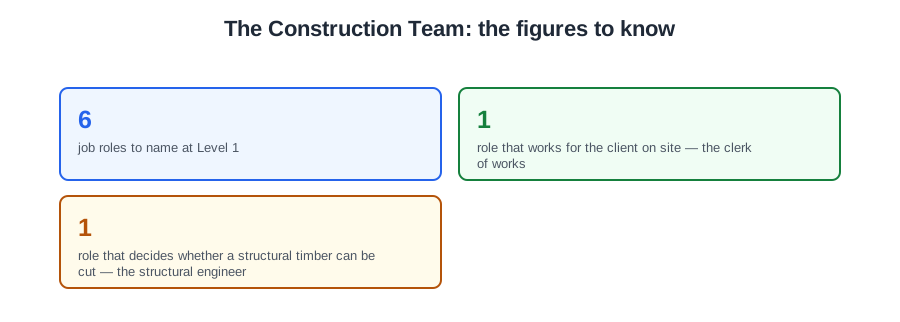
- 6
- job roles to name at Level 1
- 1
- role that works for the client on site — the clerk of works
- 1
- role that decides whether a structural timber can be cut — the structural engineer
⚠️ Where people go wrong
- Confusing the clerk of works with the site manager. The clerk of works works for the client; the site manager works for the contractor.
- Saying the architect decides whether a joist can be cut. That is the structural engineer.
- Mixing up the estimator and the buyer. The estimator prices the job; the buyer purchases the materials.
- Forgetting that a site manager may be called a site agent or construction manager — all three names can appear in a question.
📝 8-Question Self-Test
Straight from the Level 1 course question bank. Click an option to see whether you got it right — the explanation appears instantly, and there is nothing to submit.
The architect designs the building and produces the drawings everyone works from.
The structural engineer makes sure the building will stand up, so what may and may not be cut is their decision.
The clerk of works works for the client, on site, checking the work is being done to the drawings and to the right standard. That independence is the whole point of the role.
The architect designs the building and produces the drawings everyone works from. If a drawing looks wrong, the architect is who answers.
The structural engineer is responsible for the structure holding up — which is why they, not the architect, decide whether a joist or a beam may be cut.
The clerk of works works for the client, checking that the work matches the drawings and meets the right standard. Everyone else on that list works for the contractor.
The estimator works out what the job will cost. Their figures are what the firm prices the job from, so an error there costs the firm the job or the profit.
The buyer — also called the procurement officer — gets the right materials to site in time and at the right price.
Going deeper: the same ground at Level 2
Level 1 gives you the shape of this. The Level 2 guides below take it considerably further — the regulations, the calculations and the detail you will need next. Free to read, same as these.
- Start here: The Construction Industry for Level 1 Plumbers — the whole unit in one piece
- All 72 Level 1 guides — one per lesson, across all ten units
- The Level 1 glossary — 620 terms in plain English