Every route to qualifying runs through the same bottleneck, and it is not the exams. It is finding an employer.
The short answer
Three things: a CSCS card, the relevant trade qualification (for a plumber, an NVQ at Level 2), and relevant on-site experience. All three, not two of them.
Our Level 1 lesson covers what they are. This is how people actually get them, and where it goes wrong.
The routes, and how long each takes
Apprenticeship
Employed from the start, usually at college one day a week. Typically three to four years to a full Level 3. You are paid throughout, your training is funded, and your NVQ evidence comes from work you are doing anyway.
It is the best route by some distance, and the hardest to get onto, because it needs an employer to take you on before you have proved anything.
College first, then employment
What most people on a Level 1 course are doing. You take Level 1, then a Level 2 Certificate, and look for work as you go. The classroom part moves faster — but it stops at the point where you need workplace evidence, and until you find an employer you cannot finish.
Adult and career-change routes
Common in this trade, and the same rule applies: whatever the marketing says, the NVQ needs real work. Be careful with any course promising a full qualification in a few weeks with no employment. The classroom half can be done quickly; the evidence half cannot.
The bottleneck, said plainly
Every route stalls in the same place: getting employed. Not the exams, not the practical assessments. People finish Level 2 at college and then spend a year unable to progress because nobody will take them on.
Which means the most valuable thing you can do this year is not revision. It is:
- Get your CSCS card early. It removes a reason to say no, and it is cheap.
- Ask everybody. Most apprenticeships in this trade are never advertised. Small firms take on the person who turned up asking, or somebody's cousin.
- Take the labouring job. Time on site with a plumbing firm turns into an apprenticeship far more often than applications do.
- Get a driving licence. For a small firm, an apprentice who can move the van is worth more than one who cannot, and it is often the deciding factor.
- Ask your college. They have employer contacts and it is their job to place people. Ask early and ask repeatedly.
The CSCS card, practically
You need two things: an approved health, safety and environment test, and a relevant qualification. The card you get depends on your qualification — as a Level 1 learner you are typically looking at a labourer or apprentice card, and you move up as you qualify.
Book the test through the official route. There are unofficial sites charging several times the real fee for the same thing, and they are a well-known trap.
What the money looks like
Deliberately no figures here, because they change every April and a stale number is worse than none. The shape is what matters.
An apprentice starts on the apprentice minimum, steps up with age and completed years, and rises again on qualifying. A qualified plumber earns comfortably above the national average. Self-employment pays more per hour and less reliably, and you carry your own tools, van, insurance, pension and unpaid days.
The thing worth internalising now: the apprentice years are the badly paid part, and they are short. People leave in year one for better-paid work with no qualification at the end of it, and that decision is usually regretted.
Where it goes after qualifying
The route the standard names — apprentice, qualified trades person, supervisor, manager, director — is one path, and it is the employed one.
Most plumbers take a different one. They add tickets: Gas Safe registration, which is a separate legal requirement and a step change in earnings; unvented hot water; water regulations; and increasingly heat pumps and low-temperature heating, which is where the domestic heating trade is going. Each is a qualification bolted on after the core, and each opens work the core does not.
Then most go self-employed, which is why the types-of-company lesson is on this course.
What comes next
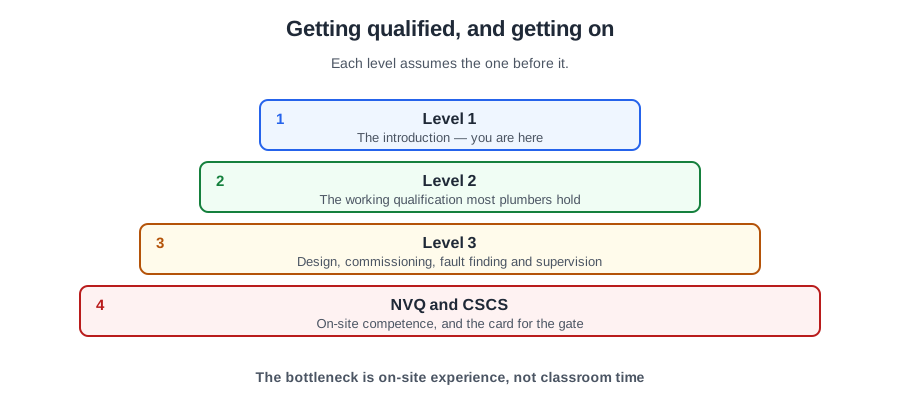
Level 2 is the real qualification — the one employers ask about. Level 1 exists to get you safe, useful and employable enough that somebody will take you on so you can start it.
🔢 The numbers worth memorising
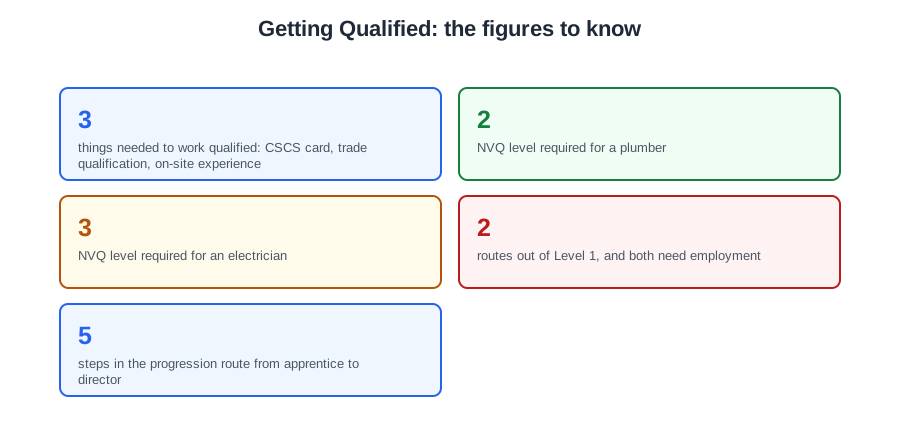
- 3
- things needed to work qualified: CSCS card, trade qualification, on-site experience
- 2
- NVQ level required for a plumber
- 3
- NVQ level required for an electrician
- 2
- routes out of Level 1, and both need employment
- 5
- steps in the progression route from apprentice to director
⚠️ Where people go wrong
- Saying a plumber needs an NVQ Level 3. That is the electrician. A plumber needs Level 2.
- Thinking Level 1 qualifies you to work unsupervised. It is a foundation, not a licence.
- Believing an NVQ can be completed at college without a job. It is assessed on real work, so it needs employment.
- Forgetting the CSCS card. Without it most sites will not let you on at all.
- Muddling the progression order. Apprentice, qualified tradesperson, supervisor, manager, director.
📝 8-Question Self-Test
Straight from the Level 1 course question bank. Click an option to see whether you got it right — the explanation appears instantly, and there is nothing to submit.
A plumber needs an NVQ Level 2. An electrician needs Level 3.
Apprentice, qualified trades person, supervisor, manager, director.
Construction Safety Certificate Scheme — that is the wording the spec uses, so it is the one to write. On site the scheme is actually called the Construction Skills Certification Scheme. A CSCS card is one of the three things needed to work as a qualified plumber.
A plumber needs NVQ Level 2; an electrician needs NVQ Level 3. It is a common mix-up.
Apprentice, qualified tradesperson, supervisor, manager, director.
The three are a CSCS card, the relevant trade qualification (NVQ Level 2), and relevant on-site experience.
The CSCS card shows you have the health and safety knowledge to work on a construction site. It is one of the three key requirements, and it is what gets you through the gate.
The Construction Safety Certificate Scheme card — the spec's wording; the scheme's real name is the Construction Skills Certification Scheme — is one of the three key requirements, with the relevant trade qualification and relevant trade on site experience.
Going deeper: the same ground at Level 2
Level 1 gives you the shape of this. The Level 2 guides below take it considerably further — the regulations, the calculations and the detail you will need next. Free to read, same as these.
- Start here: The Construction Industry for Level 1 Plumbers — the whole unit in one piece
- All 72 Level 1 guides — one per lesson, across all ten units
- The Level 1 glossary — 620 terms in plain English