Nothing hurts on the day. Back damage from lifting builds up a little at a time, and it is one of the commonest reasons people leave this trade early.
The short answer
Two parts: assessment of the load, then safe kinetic lifting technique — bent knees, straight back. Manual handling and kinetic lifting are the same thing under two names, and both come up.
Why this one matters more than it reads
Manual handling injuries are among the largest causes of work-related ill health across every industry, and construction is worse than most. They are also cumulative: not one dramatic lift, but thousands of ordinary ones done slightly wrong.
The plumber's version is the worst on site. Baths, boilers, cylinders and radiators are heavy, awkward, have no handholds, and almost always have to go up a staircase or through a loft hatch. A cast iron bath is a two-person lift on a good day and a four-person lift up a Victorian staircase.
The assessment is the part people skip
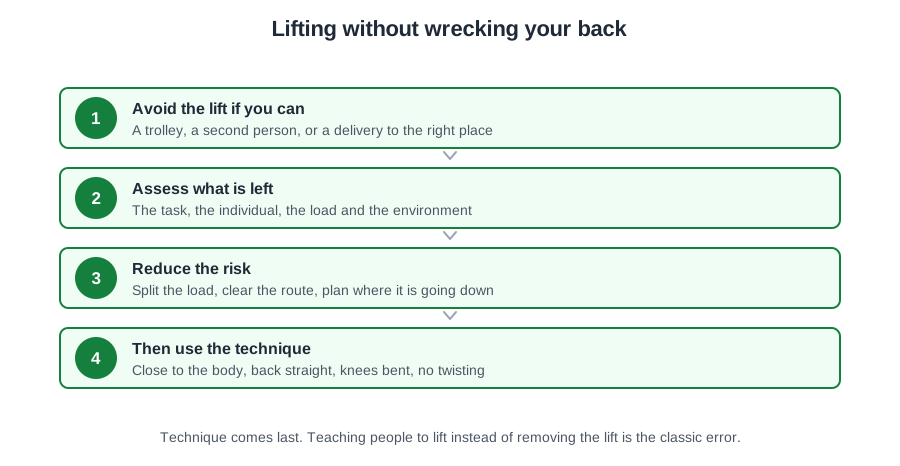
It looks like standing about doing nothing, and it is where the decision gets made. Weight, size, shape, the distance, the route, whether there are stairs, whether the floor is clear, and whether you can actually see over it.
Three outcomes are all correct answers: lift it yourself, get help and lift as a team, or use a mechanical aid. Deciding halfway through a lift — which is what happens when there was no assessment — is how backs go.
There is no legal maximum weight for a one-person lift, which surprises people. Guidance figures exist and they drop sharply the further the load is from your body and the higher or lower you have to reach. The honest test is whether you could put it down again under control.
The aids worth having
A sack trolley is the single most useful thing in a plumber's van and the one most likely not to be there. A boiler, a cylinder or a stack of radiators moves on one in a fraction of the time and with none of the risk.
Beyond that: pipe trolleys, panel lifters for plasterboard and baths, and lifting straps that let two people carry an awkward item without bending. None of it is expensive against one back injury.
Using an aid is not an admission that you could not manage. It is the correct answer to the assessment, and it is what the assessment is for.
Team lifting, which goes wrong more than solo
Two people lifting badly can be worse than one lifting well, because the load shifts unpredictably and nobody knows what the other is about to do.
One person calls it. Agree who lifts, who leads, and which way you are going before anything comes off the floor. Lift together, move together, put it down together. The moment most team lifts fail is coming down a step, when one person drops and the other does not.
The one that gets everybody
Twisting. Turning at the waist while holding a load is the classic way to do sudden damage, and it happens most when somebody is putting something down slightly to one side rather than in front of them.
Turn with your feet. It is slower by half a second and it is the difference.
What comes next
At Level 2 this becomes the Manual Handling Operations Regulations, with the employer's duty to avoid, assess and reduce — and the assessment becomes a document rather than something you do in your head.
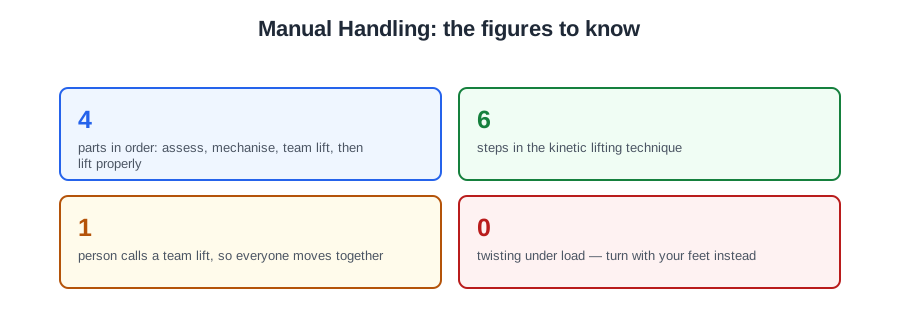
🔢 The numbers worth memorising
- 4
- parts in order: assess, mechanise, team lift, then lift properly
- 6
- steps in the kinetic lifting technique
- 1
- person calls a team lift, so everyone moves together
- 0
- twisting under load — turn with your feet instead
⚠️ Where people go wrong
- Jumping straight to the lifting technique. The first step is assessing whether to lift it at all.
- Judging a load only by weight. Bulk, distance, visibility and stairs all change the answer.
- Twisting to put something down. That is where most lifting injuries happen.
- Forgetting the set-down. Knees bent and back straight applies at both ends of the lift.
- Treating mechanical aids as a last resort. They come before lifting it yourself, not after.
📝 8-Question Self-Test
Straight from the Level 1 course question bank. Click an option to see whether you got it right — the explanation appears instantly, and there is nothing to submit.
Assess the load first — how heavy and bulky it is, how far it is going, and whether one person can manage it safely.
Assess the load first — how heavy, how bulky, how far it is going, whether the route is clear. Everything else depends on what you find out.
Twisting while carrying is one of the commonest ways to injure your back. Turn by moving your feet instead.
Assessment of the load. How heavy, how bulky, how far it is going and whether the route is clear — and out of that comes the decision to lift it yourself, get help, or use a mechanical aid.
Bent knees, straight back. The back is strong in a straight line and weak when curved, so bending at the knees puts the work through the legs and keeps the spine straight.
Three procedures: assess whether the load is safe for one person, apply safe kinetic lifting technique, and use simple mechanical lifting aids such as a sack trolley. Speed is not one of them.
Assessment of a safe load that a person can lift is the first of the three procedures. The judgement is made before the lift, not during it — once you have taken the weight it is already too late.
Application of safe kinetic lifting technique is the second named procedure. The legs do the work, the load stays close, and the feet move rather than the spine — twisting under load is what causes the injury.
Going deeper: the same ground at Level 2
Level 1 gives you the shape of this. The Level 2 guides below take it considerably further — the regulations, the calculations and the detail you will need next. Free to read, same as these.
- Start here: Safe Working for Level 1 Plumbers — the whole unit in one piece
- All 72 Level 1 guides — one per lesson, across all ten units
- The Level 1 glossary — 620 terms in plain English