The accident book protects you, not the firm. An injury that turns into something months later is only provable if somebody recorded it at the time.
The short answer
Discover a fire: raise the alarm, contact the emergency services, evacuate. First aid provision: a first aid box and a first aider or appointed person. A cut: clean the wound, dress it. A minor burn: run it under cold water. After an accident: report it, complete the accident book, get witness statements.
Why the accident book is on your side
It looks like paperwork for the firm's benefit. It is the opposite.
The pattern that catches people: a wrenched back or a knock that seemed minor on the day, shrugged off, and eighteen months later it is a genuine problem. At that point the question is whether it happened at work, and the only thing that answers it is a contemporaneous record.
No entry, no evidence. Employers with more than a handful of staff have to keep an accident book, entries are confidential, and you are entitled to have one made. Insist, politely, even when it feels like a fuss over nothing.
RIDDOR, in plain terms
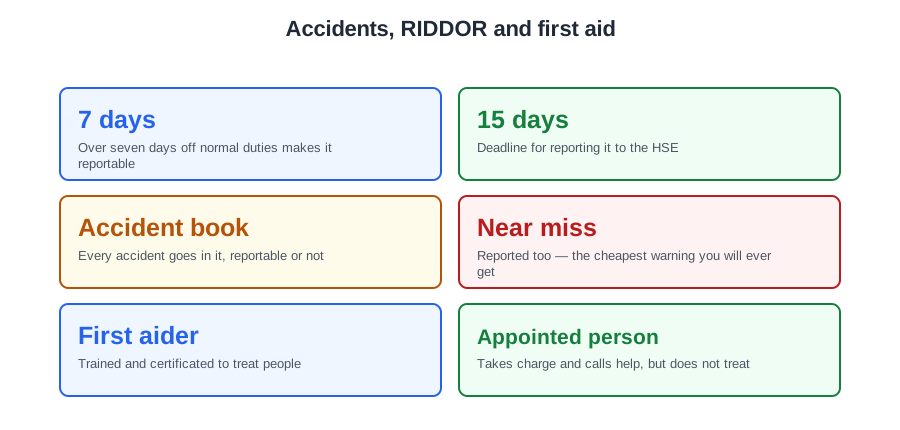
Some injuries have to be reported to the HSE by the employer, not just written in the book. Broadly: deaths, a list of specified injuries including fractures other than fingers and toes, amputations, serious burns and loss of sight; injuries that keep somebody off normal work for more than a set number of days; certain occupational diseases; and dangerous occurrences — things that could have caused serious harm and happened not to, like a scaffold collapse or an electrical short causing fire.
You will not be making these reports as an apprentice. Knowing the word matters because it explains why some incidents trigger a lot of activity and others do not, and because "is this RIDDOR reportable" is a question you will hear.
Burns, which are ours
Plumbers burn themselves more than most trades — blowtorches, hot pipework, hot water, and steam from a system that was not drained.
Cold running water, for twenty minutes, which is what the NHS advises. Older guidance said ten, and you may still see that figure. Longer than feels necessary, because it is still cooling the tissue underneath after the surface stops hurting. Remove rings and watches before swelling starts. Cover loosely with something that will not stick — cling film is the standard advice.
What not to do: no butter, no cream, no ointment, do not burst a blister, and never use ice, which does further damage. Anything you put on it has to come off again before it can be treated.
Get it looked at properly if it is bigger than a coin, if it is on the face or hands, or if the skin is broken.
The first aider and the appointed person
A first aider is trained and certificated. An appointed person is not: their job is to look after the box and call the emergency services. A small, low-risk site may legally only need the second.
Find out which you have at the induction. It is one of the two things you cannot look up while somebody is bleeding, along with where the assembly point is.
What comes next
At Level 2 reporting becomes RIDDOR by name, with the categories and the time limits. And if you go self-employed, keeping the record becomes your job rather than somebody else's.
🔢 The numbers worth memorising
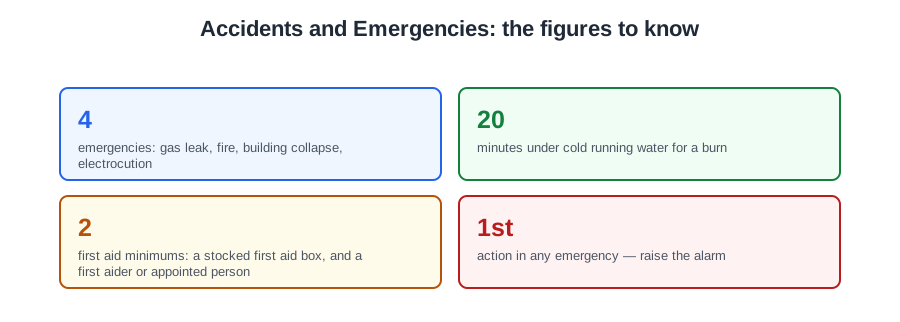
- 4
- emergencies: gas leak, fire, building collapse, electrocution
- 20
- minutes under cold running water for a burn
- 2
- first aid minimums: a stocked first aid box, and a first aider or appointed person
- 1st
- action in any emergency — raise the alarm
⚠️ Where people go wrong
- Dealing with the incident before raising the alarm. The alarm comes first.
- Touching an electrocution casualty before the supply is isolated. That makes two casualties.
- Confusing a first aider with an appointed person. The appointed person need not be trained in first aid.
- Stopping a burn under water too soon. Twenty minutes is the NHS advice.
- Thinking the employee makes the RIDDOR report. The employer reports to the HSE.
📝 8-Question Self-Test
Straight from the Level 1 course question bank. Click an option to see whether you got it right — the explanation appears instantly, and there is nothing to submit.
A properly stocked, accessible first aid box, and a first aider or at least an appointed person.
Raise the alarm and get help. Moving a casualty can make an injury worse, and the report comes later.
Moving a casualty can turn a serious injury into a permanent one. You move someone only if leaving them puts them in more danger.
Make it safe — turn the torch off — and go, by the nearest exit, to the assembly point. Nothing on site is worth staying for.
As a minimum, a suitably stocked first aid box and an appointed person to take charge of first aid arrangements and call the emergency services.
Raise the alarm, contact the emergency services, evacuate the premises. Tackling it is a separate decision that comes after the alarm has gone — never instead of it.
A first aider has been trained and holds a certificate. An appointed person has not — their job is to look after the first aid box and to call the emergency services. A small, low risk site may only need the second.
Raise the alarm, follow concise instructions for contacting emergency services, and follow emergency evacuation procedures. Moving an injured person can make an injury far worse.
Going deeper: the same ground at Level 2
Level 1 gives you the shape of this. The Level 2 guides below take it considerably further — the regulations, the calculations and the detail you will need next. Free to read, same as these.
- Start here: Safe Working for Level 1 Plumbers — the whole unit in one piece
- All 72 Level 1 guides — one per lesson, across all ten units
- The Level 1 glossary — 620 terms in plain English