Unit 102 is the biggest unit at Level 1 and the one that matters most once you are actually on site. It is not paperwork. Falls, asbestos and fire are the three things most likely to seriously hurt a plumber, and all three are in here.
The law, in one line each
The Health and Safety at Work Act 1974 is the big one, and it has two aims: the health, safety and welfare of people at work, and protecting other people from harm arising out of that work. It is enforced by the HSE — the Health and Safety Executive.
Your employer has to provide a safe place to work, safe equipment, training, and PPE free of charge. You have three duties: take reasonable care of yourself and others, cooperate with your employer, and report hazards.
Reading a sign before you read the words
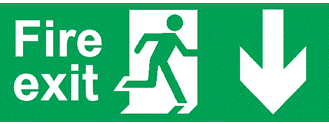
Every site sign tells you what it means by its shape and colour, before you get close enough to read it. Learn the four and you can read any site in the country.
- Round, red border with a red diagonal bar — prohibition. You must NOT. (No smoking.)
- Round, solid blue — mandatory. You MUST. (Eye protection must be worn.)
- Yellow triangle, black border — hazard warning. Take care, this is the danger. (Danger of electric shock.)
- Green square or rectangle — safe condition. Where things are. (Fire exit, first aid.)
- Red square or rectangle — fire equipment. Where the extinguishers are.
The catch people fall for: a fire exit sign is green, not red. Green tells you the way out; red tells you where the kit is. The word “fire” is in both and is not the thing that decides.
PPE — learn the pairs
The exam asks what each item is for, not just what it is called. Learn them as pairs.
- Safety helmet — falling objects and bumps.
- Safety footwear — dropping heavy things on your feet, and standing on tools and nails.
- Eye protection — dust and dirt.
- Gloves — hot materials, and sharp implements and tools.
- Hearing protection — noise.
- Dust mask — inhaling dust and fumes.
- High visibility wear — being seen around plant and vehicles.
- Protective clothing (overalls) — oils and grease.
PPE is the last line of defence, not the first. The first is removing the hazard. And it has to fit: a helmet that falls off and a mask that leaks round the edge protect nobody.
Lifting without wrecking your back
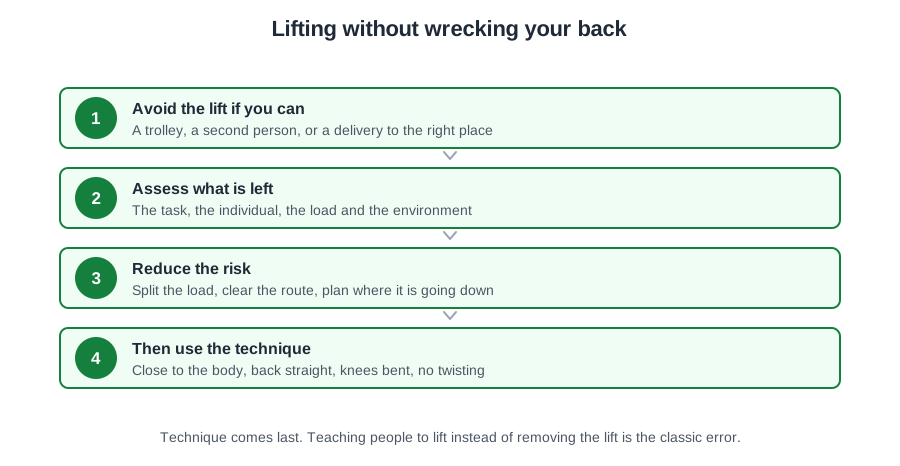
Lifting injures more workers than almost anything else, and the damage is usually slow and permanent rather than dramatic. The order never changes:
- Assess the load — how heavy, how bulky, how far it is going, whether the route is clear.
- Decide — lift it yourself, get help and lift as a team, or use a mechanical aid.
- Feet apart, one slightly forward. Bend your knees, not your back.
- Firm grip, load close to your body, lift smoothly by straightening your legs.
- Never twist while carrying — turn by moving your feet.
- Set it down the same way: knees bent, back straight.
The version worth remembering: can it be avoided, can it be mechanised, can it be shared — and only then, lift it properly yourself.
Working at height
Falls kill more construction workers than any other single cause, and plumbers are up ladders constantly — guttering, lofts, cylinders, high level pipework.
The first question is always whether the job can be done from the ground instead. Occasionally it can.
Three kinds of access equipment: step ladders for short jobs at low height, ladders for access and short-duration work, and MEWPs (mobile elevated work platforms) which lift you on a guarded platform. A ladder is for getting somewhere, not for working from all day.
Check a ladder before it goes up: stiles not bent or split, all rungs present and sound, no cracks, rungs clean of mud and grease, and the safety tag in date. Any one of those failing takes it out of use.
Then set it properly:
- 75° — the one out to four up rule. Four metres of height, one metre out.
- It must extend about 1 metre above the landing point if you are stepping off it.
- Secure it — tied at the top is best, footed by someone if it cannot be.
- Three points of contact when climbing.
- Do not overreach: your belt buckle should stay between the stiles. Move the ladder instead.
Asbestos: the short version
Asbestos-related disease still kills around 5,000 people a year in Great Britain, decades after it was banned, and plumbers are among the worst affected trades — because our work takes us to exactly the places it was used.
It causes lung cancer, asbestosis (scarring of the lungs) and mesothelioma (a cancer of the lining of the lungs, caused almost only by asbestos). Two facts you must know: these can be fatal, and they can take 20 years to develop. That delay is what makes it so dangerous — you feel nothing at the time, so nothing warns you to stop.
Any building built or refurbished before the year 2000 may contain it. Look out for pipe and boiler lagging, insulating board, roof and wall sheeting, textured coatings like Artex, asbestos cement guttering and flues, heat proofing round boilers, and gaskets and rope seals in old boilers.
What to do is four words long: stop work, tell your supervisor. Do not drill it, cut it, sand it, sweep it or move it. Do not try to identify it — only a laboratory can. Leave the area to someone qualified. If you are not sure, treat it as if it does contain asbestos.
Fire
Plumbers take a naked flame to work. Soldering near timber, felt or insulation starts fires every year, often hours after the operative has left.
A fire needs three things — fuel, heat and oxygen. Take away any one and it goes out. That is what every extinguisher does.
The classes of fire: A solids, B flammable liquids, C flammable gases, D metals, E electrical apparatus.
All extinguishers are red; the label colour tells you the type.
- Water (red label) — A only. Never on electrics or liquids.
- Foam (cream) — A and B. Never on electrics.
- Dry powder (blue) — A, B, C and electrical.
- CO₂ (black) — B and electrical.
- Wet chemical (yellow) — cooking oils.
Near live electrics use CO₂ or dry powder. Never water or foam — both conduct electricity back to you.
Using one: PASS — Pull the pin, Aim at the base, Squeeze the handle, Sweep side to side. Knowing when not to matters just as much. Leave it and get out if it is bigger than about a waste bin, if it is spreading, if the room is filling with smoke, if you are not sure which extinguisher to use, or if you have no clear way out behind you.
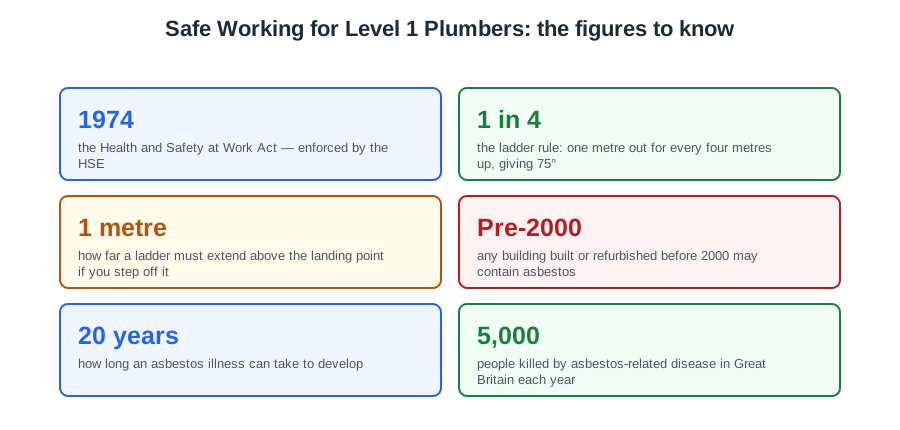
🔢 The numbers worth memorising
- 1974
- the Health and Safety at Work Act — enforced by the HSE
- 1 in 4
- the ladder rule: one metre out for every four metres up, giving 75°
- 1 metre
- how far a ladder must extend above the landing point if you step off it
- Pre-2000
- any building built or refurbished before 2000 may contain asbestos
- 20 years
- how long an asbestos illness can take to develop
- 5,000
- people killed by asbestos-related disease in Great Britain each year
⚠️ Where people go wrong
- A fire EXIT sign is green. Red square = where the equipment is. Green = the way out.
- Never water or foam near live electrics. Both conduct it straight back to you. CO₂ or dry powder.
- You cannot identify asbestos by looking at it. Only a laboratory can. If in doubt, treat it as if it is.
- Sweeping asbestos dust is one of the worst things you can do. Settled fibres are relatively harmless; airborne ones are what get breathed.
- PPE is the last line of defence, not the first. Removing the hazard comes first.
- Your employer pays for PPE. It must be provided free of charge, and it has to fit.
📝 8-Question Self-Test
Straight from the Level 1 course question bank. Click an option to see whether you got it right — the explanation appears instantly, and there is nothing to submit.
Welfare is not another word for safety. It covers the facilities a workplace has to provide — toilets, washing, drinking water, somewhere to eat and somewhere to change. They are legal requirements, not favours.
The employer must provide PPE free of charge. You should never be asked to pay for the equipment that keeps you safe.
Employees must take reasonable care, cooperate with their employer, and report hazards.
The Health and Safety Executive enforces the Act.
The second aim is protecting other people from harm. A site has the public walking past, the customer in the next room, and the family living in the house — the duty runs to all of them.
Your employer must provide PPE free of charge. It also has to fit — a helmet that falls off protects nobody.
Employers must provide a safe place to work, safe equipment, training, and PPE free of charge.
An employee must take reasonable care, cooperate with the employer, and report hazards.
Going deeper: the same ground at Level 2
Level 1 gives you the shape of this. The Level 2 guides below take it considerably further — the regulations, the calculations and the detail you will need next. Free to read, same as these.
- Safety Legislation and Enforcement
- Risk Assessment, Accidents and First Aid
- Excavations and Confined Spaces
- Hazardous Substances: COSHH, Asbestos and Lead
- Fire Safety, Manual Handling, Noise and Other Risks
- Working at Height and Access Equipment
- Working with Gases: LPG, Oxy-Acetylene and Hot Work
- Sanitary Appliances, Water Efficiency and Outside Use: Baths, Taps, Troughs and Hoses
- Combustion and Fuels
- All 72 Level 1 guides — one per lesson, across all ten units
- The Level 1 glossary — 620 terms in plain English