Everyone learns the duties. Almost nobody is told what happens when they are broken, which is the part that makes them make sense.
The short answer
The Health and Safety at Work Act 1974 exists for two reasons: the health, safety and welfare of people at work, and protecting other people from harm. Employers must provide a safe working environment, PPE, training, and ensure your safety and welfare. You must take reasonable care, cooperate with your employer, and report hazards.
Our Level 1 lesson covers that for the exam. This is what sits behind it.
What an HSE inspector actually does
Inspectors can turn up unannounced. They do not need an appointment, an invitation, or a reason. Construction gets targeted campaigns where a region is visited over a period of weeks, and the things they look for first are the ones that kill people: work at height, unsafe excavations, and uncontrolled dust.
What they can issue, in order of seriousness:
- Verbal or written advice, where something is wrong but not dangerous.
- An improvement notice — put this right within a stated period.
- A prohibition notice — stop this activity now. It takes effect immediately and the work does not restart until it is lifted.
- Prosecution.
There is also Fee for Intervention: if an inspector finds a material breach, the HSE charges the duty holder for the time spent dealing with it, by the hour. That surprises small firms more than anything else on the list.
Who ends up in court
Usually the company. But the Act puts duties on individuals too, and directors, managers and supervisors have been prosecuted personally where a failure was down to their neglect. Sentences for the most serious cases have included prison.
Employees are prosecuted far more rarely, and when it happens it is for something deliberate — removing a guard, disabling an interlock, falsifying a check. "I was told to" is not a defence, but nor is it usually where the blame lands.
The practical version for an apprentice: you will not be prosecuted for following an unsafe instruction you did not know was unsafe. You might be if you knew and did it anyway.
The right nobody uses
You can refuse work you reasonably believe is dangerous, and you are protected from being punished for it. Being dismissed or treated worse for raising a genuine safety concern is unlawful, and it is one of the few employment claims with no minimum service requirement.
This is genuinely hard to use when you are the youngest person on site and want to look willing. It exists for exactly that situation. If it feels too big to say out loud, telling your college or training provider is a legitimate route — they will raise it without your name on it.
What a site induction is really for
Twenty minutes of somebody reading slides, and two pieces of information you cannot look up in an emergency: where the assembly point is, and who the first aider is. Everything else in it you could find out later.
Larger sites will also want to see your CSCS card, and will run their own induction regardless of how many you have sat elsewhere. Site-specific means site-specific.
What comes next
At Level 2 the general duties become specific regulations with names — the Work at Height Regulations, COSHH, the Manual Handling Operations Regulations, RIDDOR for reporting. Level 1 teaches you that duties exist and whose they are; Level 2 teaches you which regulation covers what, and what each one requires.
🔢 The numbers worth memorising
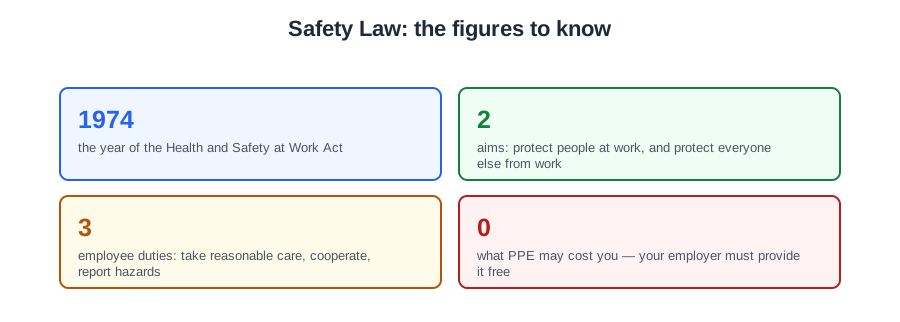
- 1974
- the year of the Health and Safety at Work Act
- 2
- aims: protect people at work, and protect everyone else from work
- 3
- employee duties: take reasonable care, cooperate, report hazards
- 0
- what PPE may cost you — your employer must provide it free
⚠️ Where people go wrong
- Confusing HASAWA with the HSE. HASAWA is the Act; the HSE is the body that enforces it.
- Thinking your safety duty stops at your workmates. It covers the public and the customer too.
- Believing an employer can charge for PPE or stop it out of wages. They cannot.
- Forgetting that employees have duties at all. Naming only the employer’s duties loses half the marks.
📝 8-Question Self-Test
Straight from the Level 1 course question bank. Click an option to see whether you got it right — the explanation appears instantly, and there is nothing to submit.
Welfare is not another word for safety. It covers the facilities a workplace has to provide — toilets, washing, drinking water, somewhere to eat and somewhere to change. They are legal requirements, not favours.
The employer must provide PPE free of charge. You should never be asked to pay for the equipment that keeps you safe.
Employees must take reasonable care, cooperate with their employer, and report hazards.
The Health and Safety Executive enforces the Act.
The second aim is protecting other people from harm. A site has the public walking past, the customer in the next room, and the family living in the house — the duty runs to all of them.
Your employer must provide PPE free of charge. It also has to fit — a helmet that falls off protects nobody.
Employers must provide a safe place to work, safe equipment, training, and PPE free of charge.
An employee must take reasonable care, cooperate with the employer, and report hazards.
Going deeper: the same ground at Level 2
Level 1 gives you the shape of this. The Level 2 guides below take it considerably further — the regulations, the calculations and the detail you will need next. Free to read, same as these.
- Start here: Safe Working for Level 1 Plumbers — the whole unit in one piece
- All 72 Level 1 guides — one per lesson, across all ten units
- The Level 1 glossary — 620 terms in plain English