Almost every accident on a site was reported as a near miss first, by somebody, at some point. Usually nobody wrote it down.
The short answer
Prevent accidents by following procedures, reporting hazards, staying alert, using correct PPE, reading and following safety signs, training, and inductions. Dangerous situations are mostly ordinary: trailing leads, open holes, damaged tools, blocked exits, materials stacked badly.
What the figures actually show
Two things worth separating, because they get confused constantly. Slips, trips and falls cause the most injuries. Falls from height cause the most deaths. Different questions, different answers.
The less obvious point is that construction's biggest killer is not accidents at all. Far more people die each year of work-related ill health from this industry — asbestos, silica dust, and the long-term consequences of noise and vibration — than are killed by anything that happens in a single moment. Accidents are what get investigated; ill health is what actually does the damage.
Near misses
A near miss is something that could have hurt somebody and did not. A dropped tool that missed. A ladder that slipped as you got off it. A cable you discovered after you drilled.
They matter because they are the same event as an accident with the outcome changed by luck, and luck is not a control. A site that collects near misses finds out about the loose scaffold board before somebody goes through it.
The reason so few get reported is that nothing happened, so it feels like making a fuss. Report it anyway, and report your own — the ones where you were the person who nearly caused it are the most useful of all and the hardest to admit.
Risk assessment and method statement
The two documents behind "follow procedures", usually seen together as a RAMS.
The risk assessment asks what could go wrong, who could be hurt, and what will be done about it. The method statement says how the job will actually be carried out, step by step, so that the controls happen.
Being handed a RAMS and asked to sign it is normal. Signing it means you have read it and will work to it, so read it — particularly the bit about what to do if conditions change, because they will.
Doing this yourself is what self-employment looks like later: your own risk assessments, your own method statements, and a customer or main contractor who wants to see them before you start.
The hierarchy of control
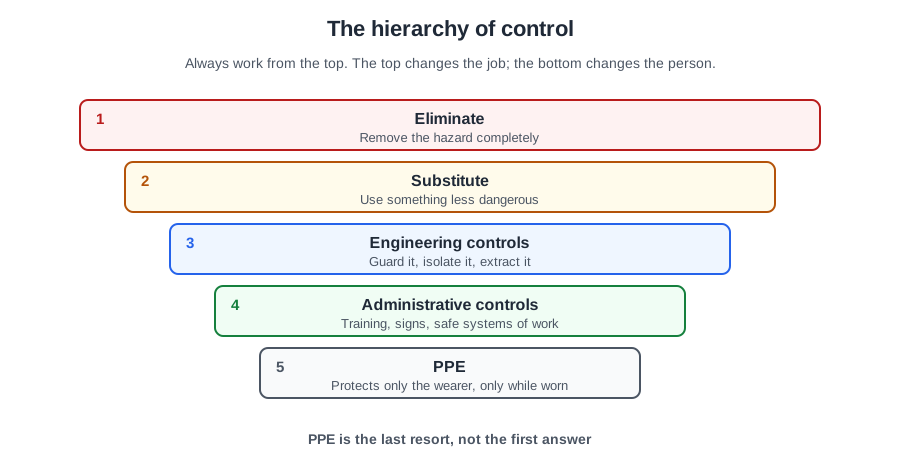
The order safety decisions are supposed to be made in, and worth having early because it explains why PPE is last:
- Eliminate — do not do the dangerous thing at all. Assemble at ground level rather than at height.
- Substitute — use something less dangerous. A cordless tool, a cold jointing method.
- Engineering controls — extraction on the tool, a guard, a barrier.
- Administrative controls — training, signage, rotating a job between people.
- PPE — last, because it protects one person and only if it is worn correctly.
A mask is what you use when you cannot cut wet. Not instead of cutting wet.
What comes next
At Level 2 you write and work to risk assessments rather than just signing them, and the general idea of "follow procedures" becomes specific duties under specific regulations.
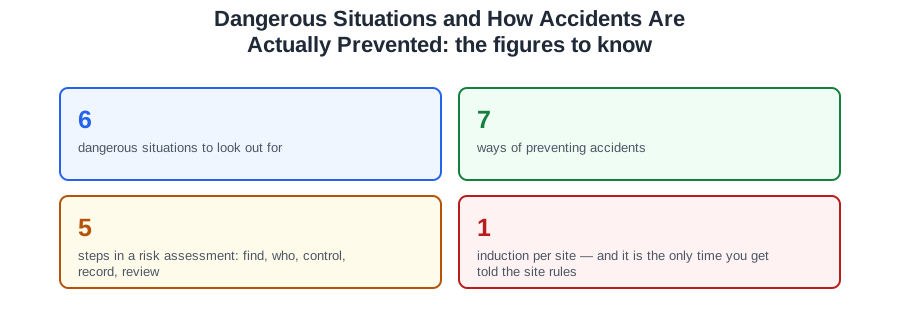
🔢 The numbers worth memorising
- 6
- dangerous situations to look out for
- 7
- ways of preventing accidents
- 5
- steps in a risk assessment: find, who, control, record, review
- 1
- induction per site — and it is the only time you get told the site rules
⚠️ Where people go wrong
- Using hazard and risk as the same word. The hazard is the thing; the risk is how likely and how bad.
- Thinking working at height means high up. Any height where a fall could injure you counts.
- Treating a confined space as an ordinary space. It needs training and a permit, and rescuers are often the casualties.
- Listing only equipment as accident prevention. Most of the list is habits: procedure, alertness, reporting, induction.
📝 8-Question Self-Test
Straight from the Level 1 course question bank. Click an option to see whether you got it right — the explanation appears instantly, and there is nothing to submit.
The list is open holes and trenches, wet surfaces, trip hazards, overhead working, confined space and working at height.
Every site has its own rules, hazards and assembly point, and the induction is where you are told them.
Open holes and trenches, wet surfaces, trip hazards, overhead working, confined spaces and working at height are the dangerous situations named.
Overhead working means anything dropped from above lands on whoever is below — which is why safety helmets and kick boards exist.
Nearly all slips, trips and falls come from mess, so keeping the site tidy prevents more injuries than anything else.
PPE is the last line of defence. The first is removing the hazard altogether; PPE is what stands between you and a hazard that cannot be removed.
Follow procedures is one of the seven named ways, with report hazards, stay alert, use correct PPE, read and follow safety signs, training, and inductions.
Stay alert is one of the seven named ways of preventing accidents. Most accidents happen at the end of a shift and on the last job of the week, when concentration has gone.
Going deeper: the same ground at Level 2
Level 1 gives you the shape of this. The Level 2 guides below take it considerably further — the regulations, the calculations and the detail you will need next. Free to read, same as these.
- Start here: Safe Working for Level 1 Plumbers — the whole unit in one piece
- All 72 Level 1 guides — one per lesson, across all ten units
- The Level 1 glossary — 620 terms in plain English