Falls from height kill more construction workers than anything else, and most of them are not from scaffolds. They are from ladders and steps, at heights nobody thought were dangerous.
The short answer
Three access items to know: step ladder, ladder, and mobile elevated work platform or tower. Tower checks: components assembled, access steps, kick boards, handrails, locking wheels, platform boarded, clean, safety tags.
There is no minimum height
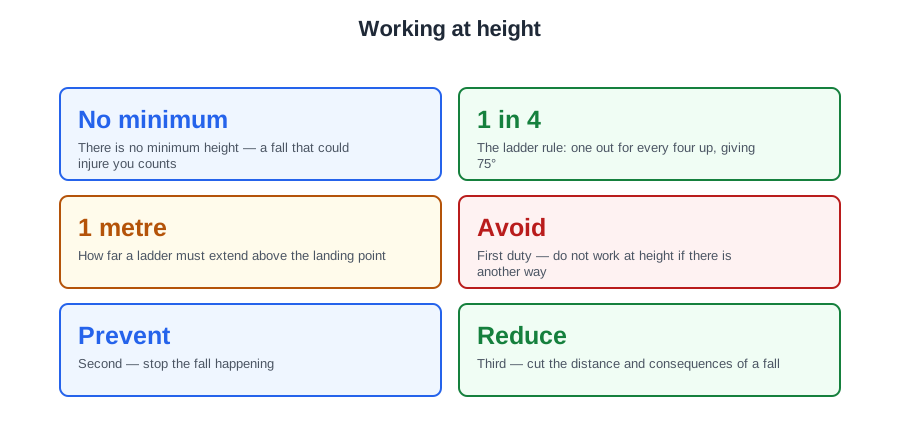
The thing most people get wrong. Work at height means work where a person could fall a distance liable to cause injury — and that includes falling below ground level, into an excavation or through an open hatch.
There is no two-metre rule. A fall from a hop-up onto a tiled floor breaks wrists and skulls, and a large share of serious falls are from under two metres. The dangerous heights are the ones nobody respects.
What the regulations actually ask, in order
The Work at Height Regulations set a sequence, and it explains why "can this be done from the ground?" is the first question:
- Avoid work at height where you reasonably can. Assemble at ground level and lift it up; use an extending tool.
- Prevent a fall where you cannot avoid the work — a tower with guardrails, a proper platform.
- Minimise the distance and consequences where you cannot prevent it.
Ladders are not banned, which is a persistent myth. They are permitted for low-risk, short-duration work — the usual figure quoted is around thirty minutes in one position — where a risk assessment shows something better is not justified. Changing a light fitting, yes. A morning's work on a gutter, no.
The plumber's actual risk
Not the scaffold. It is the loft hatch, the stepladder on an uneven floor, the flat roof reached for a flue, and the leaning ladder up to a gutter with nobody footing it.
Three things cause most of it: overreaching rather than moving the ladder, the base slipping because it was not footed or tied, and the ladder not being long enough, so somebody stands on the top few rungs.
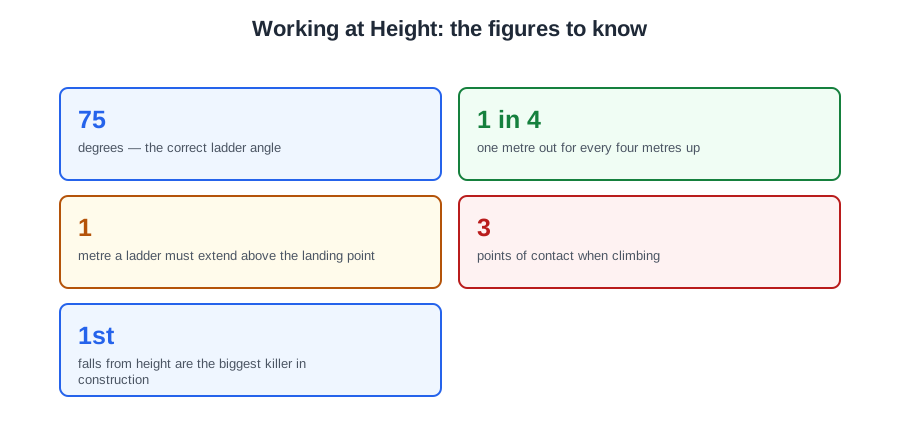
The rules that prevent all three: one out to four up; extend about a metre above the landing point; three points of contact; and keep your belt buckle between the stiles. The moment your buckle leaves the stiles, you are pushing the ladder sideways.
Fragile surfaces
The one that kills plumbers specifically. Roof lights, cement sheet roofs and old corrugated panels look solid and will not take a person's weight. Falls through fragile roofs are a recurring cause of death in this industry, and they happen to people who were only crossing to get to something else.
Assume any roof light and any cement sheet is fragile until somebody proves otherwise.
Tower tickets
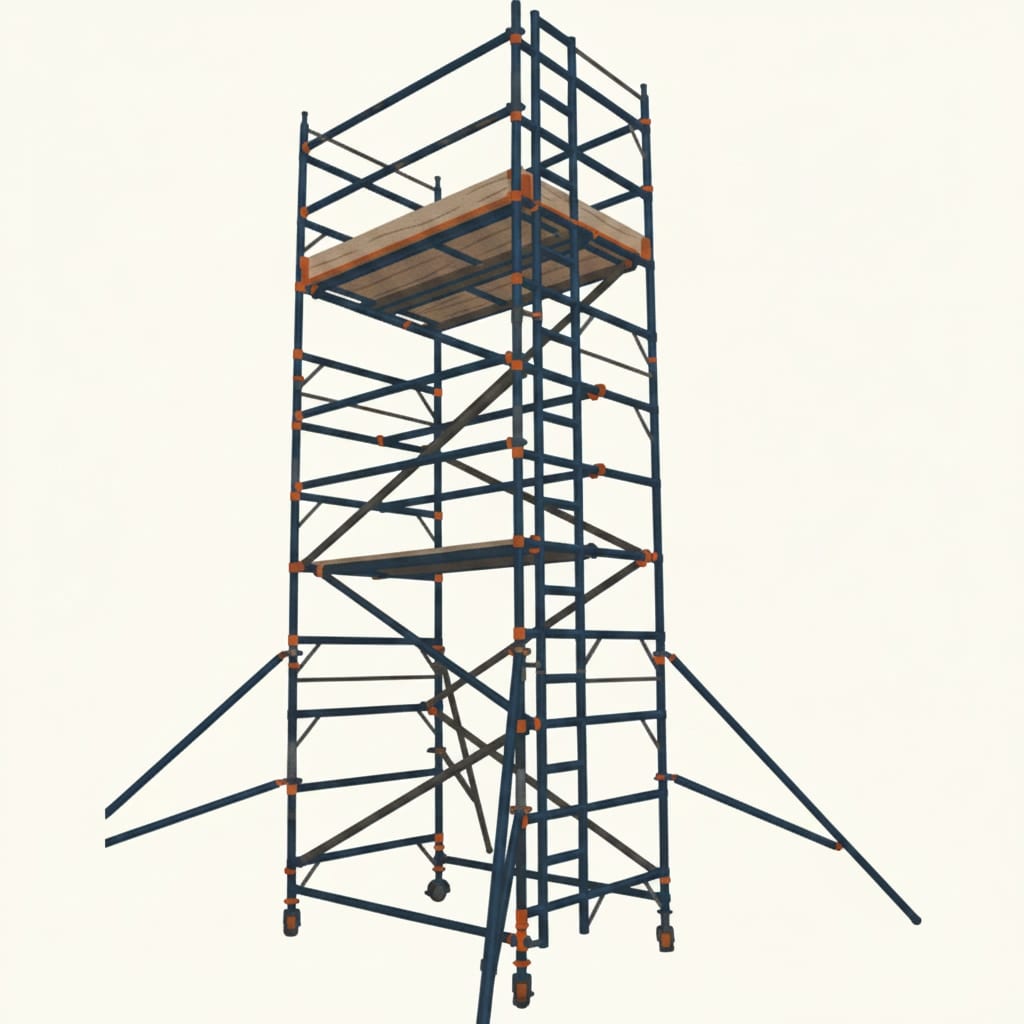
You need training to assemble a mobile tower — PASMA is the recognised card — and the qualification is a short course, typically a day or two. It is one of the cheapest tickets to add and one of the most commonly asked for.
A tower can be assembled perfectly and still be out of use because it has not been inspected. Look for the safety tag before you climb, every time, including on one you built yourself yesterday.
What comes next
At Level 2 this becomes the regulations by name, with the inspection intervals and the records. And the tickets — PASMA, and often a harness course — become part of what makes you employable.
🔢 The numbers worth memorising
- 75
- degrees — the correct ladder angle
- 1 in 4
- one metre out for every four metres up
- 1
- metre a ladder must extend above the landing point
- 3
- points of contact when climbing
- 1st
- falls from height are the biggest killer in construction
⚠️ Where people go wrong
- Thinking working at height means high up. Any height where a fall could injure you counts.
- Working from a ladder all day. A ladder is for access and short jobs, not sustained work.
- Getting the ladder rule backwards. It is one out for every four up, not four out for one up.
- Overreaching instead of moving the ladder. Your belt buckle should stay between the stiles.
- Forgetting the safety tag. An out-of-date tag means the ladder has not been inspected.
📝 8-Question Self-Test
Straight from the Level 1 course question bank. Click an option to see whether you got it right — the explanation appears instantly, and there is nothing to submit.
A MEWP is a powered platform that lifts you and gives a guarded working area.
The named situations include guttering and downpipes, working in a loft or roof space, fitting high level pipework, cylinders and cisterns, and reaching a flue or boiler at height.
A loft or roof space is one of the named work-at-height situations, along with guttering, high level pipework, cylinders, cisterns and flues.
Always ask whether the work can be done from the ground. That is the first answer every time, and occasionally it is yes.
A mobile elevated work platform lifts you and gives you a guarded working area. A ladder is for getting somewhere, not for working from all day.
Installing guttering is one of the three named, with installing a light fitting and gaining access to a loft space.
Gaining access to a loft space is one of the three named situations for working at height. The ladder into a loft hatch is exactly where plumbers fall.
A mobile elevated work platform, also called a tower. On a ladder you are holding on; in a tower you are enclosed, which is why it is right for anything taking more than a few minutes or needing both hands.
Going deeper: the same ground at Level 2
Level 1 gives you the shape of this. The Level 2 guides below take it considerably further — the regulations, the calculations and the detail you will need next. Free to read, same as these.
- Start here: Safe Working for Level 1 Plumbers — the whole unit in one piece
- All 72 Level 1 guides — one per lesson, across all ten units
- The Level 1 glossary — 620 terms in plain English