The fire you start soldering rarely announces itself while you are there. It smoulders inside a joist and shows up in the evening.
The short answer
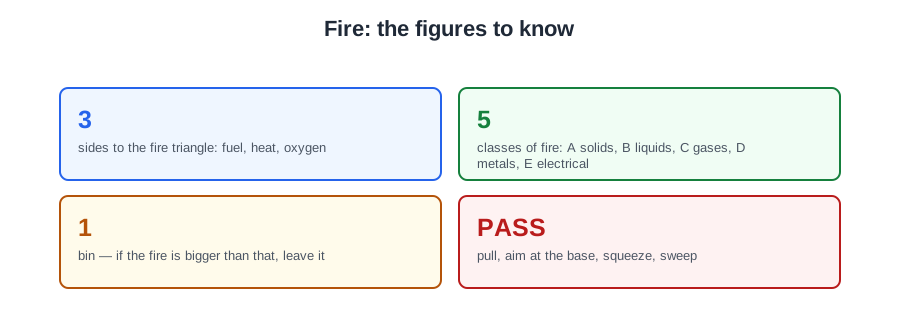
Fire needs heat, fuel and oxygen — remove any one and it goes out. The classes run A solids, B liquids, C gases, D metals, with electrical apparatus as a separate consideration. Prevent fires with good housekeeping, storage of flammables and removal of waste materials.
Why this is our subject more than most trades'
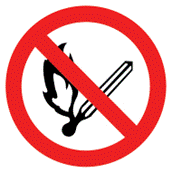
Plumbers carry a naked flame into other people's buildings, routinely, and use it against pipework that runs through timber, felt, insulation and dust that has been collecting since the house was built.
The classic plumbing fire does not flare up while you are there. Heat conducts along the pipe and into the joist or the wall plate behind it, and something smoulders for hours before it finds enough air. The van is long gone when it does.
That is why the controls are about what you do before and after, not during: clear the combustibles, use a heat mat, and check the area again before you leave. A soldering fire is not a lapse of attention — it is a failure to look afterwards.
Hot works permits and the fire watch
On commercial and industrial sites, soldering needs a hot works permit. It typically requires the area cleared, an extinguisher to hand, the work finished by a stated time, and a fire watch — somebody checking the area for a period after the flame goes out, often an hour.
The fire watch is the part that looks like theatre and is the part that works. It exists precisely because of the delay above.
None of this applies in a domestic house, where nobody issues you anything. The habit has to come with you: last thing before you pack up, go back and put a hand near where you were working.
Press fit, and why it is taking over
A large part of the trade has moved to press fit jointing, and the reason is mostly this. No flame means no hot works permit, no fire watch, and no smouldering joist. On occupied buildings, listed buildings and anywhere with a serious fire risk it is often the only method allowed.
The tooling is expensive and the fittings cost more than solder ones, which is why small firms are slower to move. You will meet both, and you should learn both.
Choosing the extinguisher, and the one that matters
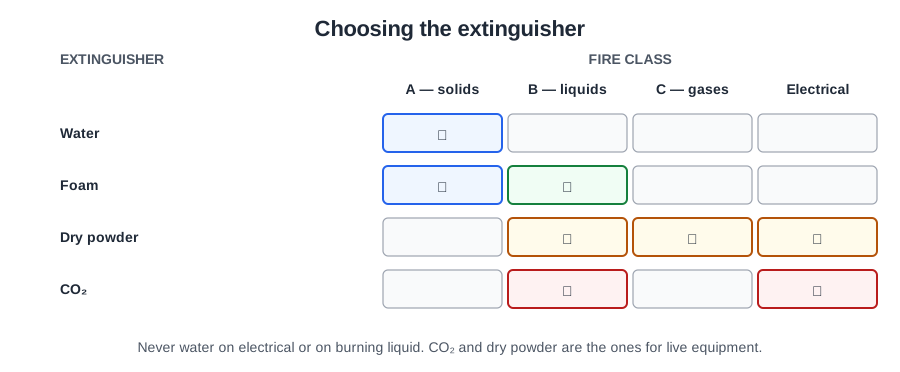
All extinguishers are red; the label colour tells you the type. Water is red-labelled and for class A only. Foam is cream, for A and B. Dry powder is blue and covers A, B, C and electrical. CO₂ is black, for B and electrical. Wet chemical is yellow, for cooking oils.
The one to have straight: never water or foam near anything live, because both conduct back to you. CO₂ or dry powder.
To use one, PASS: pull the pin, aim at the base, squeeze, sweep. Aiming at the flames rather than the base is the commonest mistake, and it does nothing at all.
Knowing when to walk away
Deciding not to fight a fire is a correct decision and not a failure. Leave it if it is bigger than about a waste bin, if it is spreading, if the room is filling with smoke, if you are unsure which extinguisher to use, or if you have no clear way out behind you.
Smoke is what kills people, not flame, and it does it far faster than anyone expects. Raise the alarm and get out.
What comes next
At Level 2, hot works and safe isolation become part of how you plan a job rather than a list to recite — and press fit becomes a jointing method you are assessed on.
🔢 The numbers worth memorising
- 3
- sides to the fire triangle: fuel, heat, oxygen
- 5
- classes of fire: A solids, B liquids, C gases, D metals, E electrical
- 1
- bin — if the fire is bigger than that, leave it
- PASS
- pull, aim at the base, squeeze, sweep
⚠️ Where people go wrong
- Using water or foam near electrics. Both conduct — use CO₂ or dry powder.
- Aiming at the flames. Aim at the base of the fire.
- Thinking the extinguisher body colour identifies the type. All are red; the label colour tells you.
- Leaving straight after soldering. Timber and insulation smoulder for hours before they flame.
- Forgetting that class C is gases and class D is metals. They get swapped constantly.
📝 8-Question Self-Test
Straight from the Level 1 course question bank. Click an option to see whether you got it right — the explanation appears instantly, and there is nothing to submit.
Fuel, heat and oxygen. Remove any one of the three and the fire goes out.
Class B is flammable liquids. A is solids, C is flammable gases, D is metals, E is electrical apparatus.
Water and foam both conduct electricity back to you. Use CO₂ or dry powder near live electrics.
Fuel, heat and oxygen — the fire triangle. Take away any one and the fire goes out.
Foam and CO₂ smother a fire, shutting the air out. Water cools, removing the heat. Turning off a gas supply removes the fuel.
A solids, B flammable liquids, C flammable gases, D metals, E electrical apparatus.
Class C is flammable gases — propane, butane and natural gas.
Fires need fuel, and a tidy site does not provide it. Good housekeeping is the biggest prevention measure.
Going deeper: the same ground at Level 2
Level 1 gives you the shape of this. The Level 2 guides below take it considerably further — the regulations, the calculations and the detail you will need next. Free to read, same as these.
- Start here: Safe Working for Level 1 Plumbers — the whole unit in one piece
- All 72 Level 1 guides — one per lesson, across all ten units
- The Level 1 glossary — 620 terms in plain English