Ask most engineers what a low temperature heating system is and you will get an answer about heat pumps. That is the commonest application, but it is not the definition — and starting there hides what is actually going on.
This article covers Module 1 of the PlumbMate low temperature heating course: what the term means, why the return temperature is the number that matters, where the design figures come from, what Part L requires, and what the designer's duty actually is. There is a 10-question mock test at the end.
The definition, and what it changes
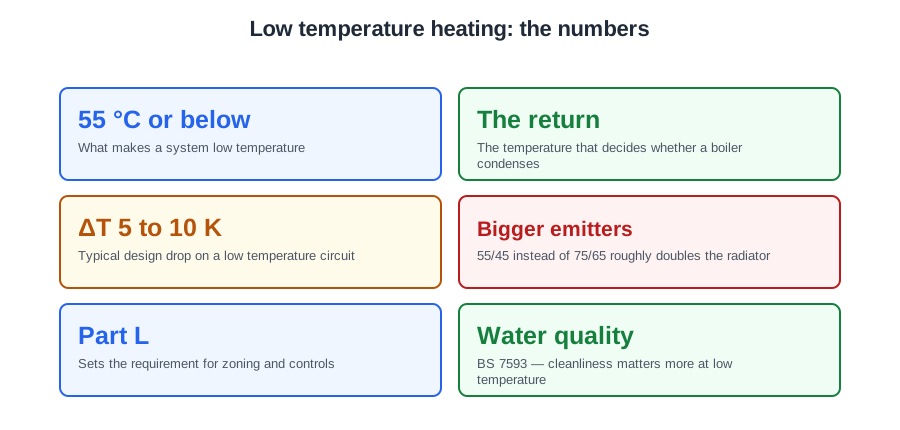
Low temperature hot water heating is a wet system designed to deliver its heat at roughly 35 to 55 °C, rather than the 80 °C a system was drawn around for most of the last fifty years.
That is the whole of it. Everything else in the subject is a consequence.
The old numbers were 82 °C flow and 71 °C return — a mean water temperature of 76.5 °C, about 55 K above a 21 °C room. Design at 45/40 instead and the mean is 42.5 °C, only 21.5 K above the room.
| Design | Flow / return | Mean water temp | ΔT above a 21 °C room |
|---|---|---|---|
| Traditional | 82 / 71 °C | 76.5 °C | 55.5 K |
| Catalogue reference | 75 / 65 °C | 70 °C | 50 K |
| Low temperature | 55 / 45 °C | 50 °C | 29 K |
| Low temperature | 45 / 40 °C | 42.5 °C | 21.5 K |
| Very low (underfloor) | 35 / 30 °C | 32.5 °C | 11.5 K |
The emitter has been left with about 39% of the temperature difference it used to have. That is why a low temperature design is a design and not a setting: you cannot arrive at it by turning the boiler down on a system sized for 80 °C.
Why the return temperature is the one that matters
People say “low flow temperature”, which is reasonable shorthand. But what the appliance cares about is the temperature of the water coming back to it — and both of the heat sources this subject is written around gain from a colder return, for completely different reasons.
A condensing boiler
A condensing boiler recovers extra heat by condensing water vapour out of its own flue gases. That happens only when the heat exchanger surface is below the dew point of those gases — around 55 °C for natural gas. The surface temperature is set by the return water, so a boiler returning at 70 °C is barely condensing at all, whatever the badge says.
This is why the Domestic Building Services Compliance Guide sets a design return temperature not exceeding 55 °C. It is not a comfort figure. It is a dew point.
A heat pump
A heat pump moves heat rather than making it, and the work it has to do is set by the lift — the gap between the source it draws from and the temperature it has to deliver. Widen the gap and the coefficient of performance falls away.
As a working rule, every 1 K off the flow temperature is worth roughly 2 to 2.5% on efficiency. Drop a design from 55 to 45 °C and you have found something in the order of 20 to 25% of the running cost. There is no tariff, control setting or accessory that does that. It is done at the design stage or it is not done at all.
And what it is paid for with
Nothing is free. The heat still has to get out of the emitter and into the room, so a lower water temperature buys its efficiency with emitter size, and often with pipe size and pump duty as well. Sizing that trade honestly is the whole of the subject.
Where the numbers come from
A design is only defensible if you can say where each figure came from.
Regulations — Part L for conservation of fuel and power, Part G for hot water safety, the Water Supply (Water Fittings) Regulations, and the Gas Safety Regulations where there is gas.
Standards — BS EN 12831 for the heat loss method, BS EN 442 for radiator ratings, BS EN 806 and BS 8558 for hot and cold water, BS 7593 for system water treatment, and BS 7671 for the wiring.
Guidance — the Domestic Building Services Compliance Guide, where the practical figures behind Part L live; the Domestic Heating Design Guide and CIBSE Guide A for design temperatures, air change rates and U-values; MCS MIS 3005 where the job is certified; and HSG274 Part 2 with the L8 ACoP for legionella.
Manufacturer's instructions — and this is the one most often skipped. A heat pump will state a minimum flow rate and often a minimum system volume. Those are design constraints, not commissioning details, and missing them produces a system that faults out on a mild afternoon.
The building specification — what the client actually asked for and what the building actually is. A design built on assumptions instead is a guess with a spreadsheet attached.
The order of precedence is worth being able to state out loud. Statute first. Where a manufacturer's instruction is more demanding than a standard, follow the instruction. Where an instruction conflicts with statute, statute wins and you do not fit the appliance that way.
What Part L requires
The four nations diverge here, and it matters. England has Approved Document L in two volumes; Wales has its own; Scotland uses the Technical Handbooks, Section 6; Northern Ireland uses Technical Booklet F. Quoting an English U-value on a Scottish job is a real and common error.
The headline requirement for this subject: in England, a new dwelling's wet heating system must be designed to a maximum flow temperature of 55 °C. In an existing dwelling, when the heat generator is replaced, the system is to be designed to the lowest flow temperature practicable for that building.
Read that carefully. It is not a recommendation about how to set the appliance at commissioning. It is a requirement about how the emitters are sized, and it can only be met by doing a room-by-room heat loss and an emitter calculation.
Approved Document L 2021 (which replaced the Domestic Building Services Compliance Guide in June 2022) adds the control minimum: separate time and temperature control of space heating and hot water in every dwelling, and in a new dwelling of 150 m² or more, at least two independently controlled heating circuits (paragraph 5.14).
The duty, in four stages
Specify. Choosing an appliance that suits this building and this household. The commonest failure is sizing the heat generator off the old boiler's badge — a 24 kW combi replaced like for like on a house with a 6 kW heat loss is four times oversized, and at low temperature that stops being harmless. A heat pump that cannot turn down will cycle, and cycling destroys the seasonal efficiency the exercise was for.
Design. The room-by-room heat loss, the emitter schedule at the chosen mean water temperature, the hot water calculation, the pipe sizes, the pump duty, the expansion vessel, the zoning and the controls. In writing, with the assumptions recorded.
Install. Building what was designed. Where site conditions force a change, the change goes back through the design — because the margins that used to absorb these decisions are gone.
Commission. Proving it. And then the handover, because a low temperature system operated like an 80 °C one will disappoint, and the householder is not the person to blame for that.
Fabric first, and why it belongs here
Anything that reduces the heat loss reduces the emitter size — or, far more usefully, lets the same emitters work at a lower flow temperature. That is very often what makes an existing house viable on a heat pump without a house-wide radiator change.
Do the fabric first and the heat loss falls before anything is sized. Do it the other way round and you have paid for a heat generator and an emitter schedule for a building that no longer exists.
One caution. Insulation does nothing at all to the ventilation half of the heat loss, and tightening a building without providing controlled ventilation produces condensation and mould. Tightening the fabric and providing ventilation are one job, not two.
📝 10-Question Mock Test
Click an option to see whether you got it right. Explanations appear instantly — no submitting at the end.
The design flow temperature, and nothing else. A condensing boiler benefits just as much as a heat pump, and everything else in the subject follows from that one figure.
Mean water temperature is 42.5 °C and the room is 21, so 21.5 K. The 5 K figure is the system ΔT, which sets the flow rate rather than the output.
Around 55 °C for natural gas, and the return water is what sets that surface temperature. It is why the Compliance Guide caps the design return at 55.
So a 10 K reduction is worth 20 to 25% of the running cost. No control setting, tariff or accessory matches that — it is a design decision or nothing.
BS EN 442 rates radiators, BS EN 806 covers hot and cold water inside buildings, and BS 7593 covers cleaning and treating the system water.
A standard is a floor, not a ceiling. Where an instruction conflicts with statute, though, statute wins and the appliance is not fitted that way.
And it governs how the emitters are sized, not how the appliance is set at commissioning. Meeting it requires the heat loss and the emitter calculation.
Technical Booklet F is Northern Ireland, and Volume 2 of Approved Document L is England's existing-dwelling document.
A 24 kW combi on a house with a 6 kW heat loss is four times oversized. At low temperature that stops being harmless — a heat pump that cannot turn down cycles, and cycling destroys the seasonal efficiency.
That is very often what makes an existing house viable on a heat pump without changing every radiator — which is why the fabric work comes first, not after.
Everything in the rest of this series is downstream of one number falling. The emitter has 39% of the temperature difference it used to have, and every calculation that follows — the heat loss, the emitter schedule, the cylinder, the pipe sizes, the pump duty — exists to make that work.