A heat pump touches more of the regulatory framework than a boiler swap does, and the planning side in particular has been amended repeatedly. A good deal of published guidance — and a good many exam papers — still describe rules that no longer apply. This article sets out the position as it stands, and flags where the old answers linger.
This covers Module 3 of the PlumbMate heat pumps course: the Building Regulations, MCS and the standards framework, planning and permitted development, Water Regulations and the DNO, F-Gas, health and safety, and the records that protect you afterwards. There is a 10-question mock test at the end.
The Building Regulations
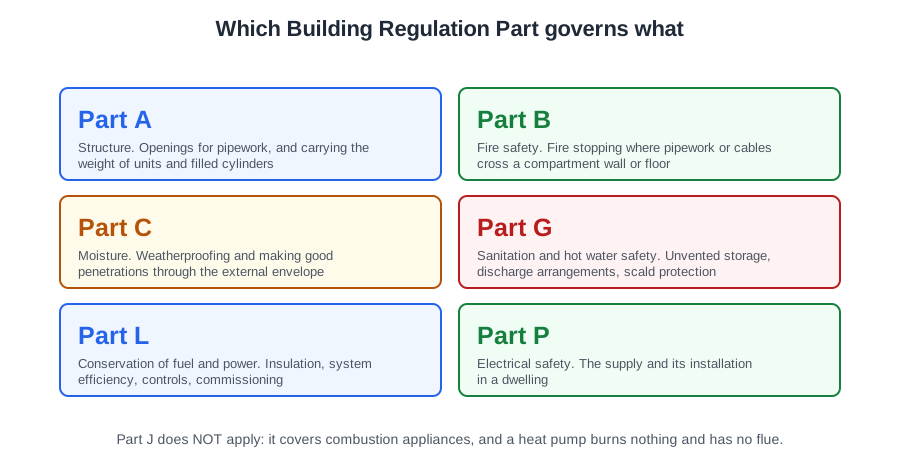
Knowing which Part governs which aspect is straightforward recall, and it comes up in every exam.
| Part | Covers | On a heat pump job |
|---|---|---|
| A | Structure | Forming openings for pipework; supporting the weight of units and filled cylinders |
| B | Fire safety | Fire stopping where pipework or cables cross a compartment wall or floor |
| C | Moisture | Weatherproofing and making good penetrations through the external envelope |
| G | Sanitation and hot water safety | Unvented hot water storage, discharge arrangements, scald protection |
| L | Conservation of fuel and power | Insulation, system efficiency, controls, commissioning |
| P | Electrical safety | The electrical supply and its installation in a dwelling |
Part J does not apply. It covers combustion appliances, and a heat pump burns nothing and has no flue. That makes it a common wrong answer rather than a relevant Part — which is exactly why it appears in question options.
A memory hook that works: A for structure, B for fire, C for moisture, G for hot water, L for loss of heat, P for power.
Demonstrating compliance
Most domestic installations are self-certified through a competent person scheme. The registered installer certifies the work, the scheme notifies the local authority, and a compliance certificate is issued to the customer. A full plans application to building control remains available but is slower and attracts a fee.
Be clear with customers that this certificate is not the same thing as an MCS certificate. They prove different things, and conflating them causes trouble later when a grant or a warranty claim depends on the right one.
MCS and the standards framework
The Microgeneration Certification Scheme is a quality scheme, not a legal requirement. You can lawfully install a heat pump without it. But it is the gateway to government grant funding, so for most domestic customers it is decisive — which makes it effectively mandatory in commercial reality even though it is voluntary in law.
MIS 3005 and MCS 020a do different jobs
- MIS 3005 is the MCS installation standard for heat pump systems. It governs design, sizing, installation, commissioning and handover — including the obligation to carry out a proper heat loss calculation and to give the customer a performance estimate before they commit.
- MCS 020a is a planning standard. It sets out how to calculate the sound pressure level from a proposed unit at the assessment position, so you can demonstrate that the noise condition attached to permitted development is met.
MIS 3005 tells you how to install it. MCS 020a tells you whether you can put it there.
Note the version letter. MCS 020a replaced the original MCS 020, and since 28 May 2026 it is the only permitted certification scheme for the permitted development noise assessment. Material referring to plain “MCS 020” predates that.
Numbering conventions worth knowing
British Standards carry BS numbers, MCS documents carry MIS or MCS numbers, and Energy Networks Association recommendations carry the EREC G prefix. Exam questions frequently swap these to see whether you notice. Other standards you will meet:
- BS 7671 — the wiring regulations, governing the electrical installation.
- BS 7593 — preparation, commissioning and maintenance of system water: cleaning, inhibitor, filtration and testing.
- BS EN 12831 — heat loss calculation methods.
- BS EN 14511 and BS EN 14825 — the rating conditions behind a quoted COP and SCOP.
Planning and permitted development
Permitted development is planning permission granted nationally by statutory instrument — the General Permitted Development Order. Provided every condition is met, no planning application is needed, and most domestic heat pump installations qualify.
Because the rights come from an instrument that gets amended, the conditions have changed more than once. The reform that took effect in England on 29 May 2025 was substantial.
The current England conditions
| Condition | Position |
|---|---|
| Outdoor unit volume, house | Must not exceed 1.5 m³ (raised from 0.6 m³) |
| Outdoor unit volume, block of flats | Must not exceed 0.6 m³ |
| Number of units, detached house | The first two are permitted development |
| Number of units, non-detached house or flats | The first unit only |
| Boundary distance | The old 1 m boundary rule has been removed |
| Flat roof siting | A 1 m rule survives here: all parts of the unit must be at least 1 m from the external edge of that roof |
| Noise assessment | Compliance with MCS 020a in every case |
| Cooling | Air source units used for cooling now benefit from the rights, which brings air-to-air in |
That flat-roof line is the one to watch. “The 1 metre rule has been scrapped” is repeated everywhere, and it is true of the boundary rule — but a 1 m rule still applies to the edge of a flat roof. Read the two as separate rules and you will not be caught out.
The noise condition
Every version of the conditions has required a noise assessment to the MCS planning standard. The sound level is assessed at the nearest habitable room window of a neighbouring property — the condition exists to protect neighbours, not to cap the unit's inherent noise. The limit at that position is 37 dB(A) under MCS 020a. It has been updated from 42 dB(A), which older material still quotes.
This is why siting depends so heavily on where the neighbours' windows are, and why the assessment must be completed and recorded before installing rather than after.
When permitted development does not apply
Three exclusions have stayed constant through every amendment, and they are the ones worth memorising:
- Listed buildings — permitted development rights do not apply to a listed house or anywhere within its curtilage. Listed building consent is required.
- Scheduled monuments — no permitted development on a site designated as a scheduled monument.
- Article 4 directions — a local authority can withdraw permitted development rights in a specific area. Rights may also be removed by a planning condition.
A conservation area or World Heritage Site is not one of them. The right survives there, with conditions: the unit must not be on a wall or roof fronting a highway, or nearer to a highway than any part of the building.
A ground source system usually fares better in sensitive locations, because the collector is buried and the unit is housed internally, so there is little visual impact.
Devolved differences
Planning is devolved. Scotland, Wales and Northern Ireland each legislate separately, and the conditions have diverged and partially re-converged over recent years. Never assume the English position applies elsewhere. Where there is any doubt, the local planning authority is the arbiter, and a lawful development certificate gives formal written confirmation — worth having on any borderline job.
Water Regulations and the DNO
Filling the system
The Water Supply (Water Fittings) Regulations — Byelaws in Scotland — protect the wholesome water supply from contamination by backflow. A sealed heating primary containing inhibitor is exactly the sort of fluid these rules exist to keep out of the mains.
So a system is filled through a temporary connection incorporating suitable backflow protection — typically a filling loop with double check valves — and that connection is physically disconnected after use. Leaving a flexible filling loop permanently coupled at both ends is one of the commonest Water Regulations contraventions found on domestic systems. It takes seconds to disconnect and it is a genuine compliance point.
The DNO — and a distinction people get wrong
A heat pump is a substantial new electrical load, and its starting current can affect local voltage. The Distribution Network Operator — the company that owns the cables and the local network, not the energy supplier — needs to know, so it can assess whether the existing service and network can support it.
Some installations can be connected and then notified; larger ones, or those on constrained parts of the network, need prior approval and may require reinforcement work. That process can take weeks. Establish the position during the survey, not the week before installation.
You will see installer guidance referring to G98 and G99 in connection with heat pumps. Those Engineering Recommendations govern generation — solar, batteries, anything exporting to the network. A heat pump consumes electricity; it does not generate. It is a demand connection, and a different process applies.
F-Gas and environmental duties
Fluorinated gases have a high global warming potential, so their handling is regulated. Deliberate release is prohibited. When a system is decommissioned or worked on, refrigerant must be recovered into suitable cylinders by a qualified operative for reclamation or safe disposal, and records kept.
There is no permitted small quantity that may be vented. There is no dilute-and-drain option. Both appear as distractors precisely because people assume a threshold must exist.
Health and safety on heat pump work
Risk assessment and method statement
These two documents answer different questions and are constantly confused. The risk assessment identifies the hazards, evaluates who might be harmed and how, and records the control measures. The method statement then sets out the safe sequence of work that puts those controls into practice. Hazards first, method second.
CDM applies to domestic work
A widespread misconception is that the Construction (Design and Management) Regulations only cover commercial projects. They apply to all construction work, domestic included. What differs is that a domestic client's duties normally pass to the contractor — or to the principal contractor where more than one contractor is involved. In practice the installer carries the planning, coordination and information duties.
COSHH and glycol
Glycol is a hazardous substance under COSHH. Before work begins you must assess the risk to health, and the manufacturer's safety data sheet is the primary source for hazards, PPE, first aid, spillage procedure and disposal route.
Never decant into unmarked containers — removing the hazard information creates a serious risk, particularly where a container might be mistaken for a drink. Note also that ethylene glycol is considerably more toxic if ingested than the propylene glycol usually specified for heat pump circuits.
Electrical safety
The Electricity at Work Regulations impose the duty to work safely on electrical systems. Part P and BS 7671 concern the standard of the finished installation; this is about the safety of the person working on it.
The safe isolation procedure runs to seven steps: check it is safe to isolate and identify the circuit, isolate, secure, label, prove the indicator, test dead, then re-prove the indicator. Two steps get dropped most often — labelling disappears entirely from some accounts, and the final re-prove gets abbreviated away, which is the step that catches a tester that failed during the test.
Prove the tester, test dead, prove the tester again. Three steps, never two.
Manual handling
The hierarchy is avoid, assess, reduce. First ask whether the handling can be avoided — a mechanical aid, a sack truck, delivery closer to the position. Only then assess what remains and reduce the risk. Good lifting technique is a control measure applied last, not the starting point. Outdoor units and filled cylinders are heavy and awkward enough that avoidance is often genuinely achievable.
Documentation and records
What you install from
Three strands work together, and none is sufficient alone: the manufacturer's instructions for the specific equipment; the system design and heat loss calculations for this property; and the standards and regulations framework.
Where manufacturer's instructions are more demanding than a standard, follow the instructions — departing from them risks poor performance and an invalidated warranty. Where they conflict with a statutory requirement, the statutory requirement governs and the conflict is resolved with the manufacturer.
What the customer gets
The handover pack exists so the customer can operate the system, maintain it, and give a future engineer what they need:
- The commissioning record showing measured values and settings applied.
- Manufacturer's user and maintenance instructions.
- Compliance certificates, warranty registration, and a system schematic where appropriate.
The installer's own risk assessment and method statement are internal documents and are not part of the customer's pack.
The performance estimate
A performance estimate — expected output, efficiency and running cost for that specific property — is provided before the customer commits. It is the benchmark any later performance dispute will be measured against, which is a very good reason for it to be realistic rather than optimistic.
Records protect the customer and the installer equally. A recorded commissioning setting is the answer to a complaint three years later.
The numbers and names worth carrying into an exam
| Item | Detail |
|---|---|
| Building Regs Parts | A structure, B fire, C moisture, G hot water, L heat loss, P power. Not J. |
| MCS installation standard | MIS 3005 |
| MCS planning/noise standard | MCS 020a — the only permitted scheme since 28 May 2026 |
| Noise limit | 37 dB(A) at the neighbour's nearest habitable room window (updated from 42 dB(A)) |
| PD volume limit | 1.5 m³ house; 0.6 m³ block of flats |
| PD number of units | Two on a detached house; one otherwise |
| PD flat roof | At least 1 m from the external edge |
| PD reform date (England) | 29 May 2025 |
| DNO | Demand connection — G98/G99 are for generation |
| Filling loop | Backflow protection, and physically disconnected after use |
| Safe isolation | Seven steps; never drop labelling or the final re-prove |
| Manual handling hierarchy | Avoid, assess, reduce |
Where this goes next
Regulations tell you what is allowed. Module 4, the survey, is where you find out what this particular property will actually take — including the noise assessment that decides whether the unit can go where you want it.
📝 10-Question Mock Test
Click an option to see whether you got it right. Explanations appear instantly — no submitting at the end.
Part J covers combustion appliances and flues. A heat pump burns nothing and has no flue, so Part J is irrelevant — which is exactly why it appears so often as a distractor. G covers hot water storage, P the electrical work, L the efficiency, insulation and controls.
Part B is fire safety. Part A would cover the structural implications of forming the opening and Part C the moisture and weatherproofing of an external penetration — the same hole can engage all three Parts for different reasons.
MIS 3005 tells you how to install it — design, sizing, commissioning, handover. MCS 020a tells you whether you can put it there, by setting out how the sound pressure level at the assessment position is calculated for the permitted development noise condition.
1.5 m³ on a house, raised from 0.6 m³ by the reform that took effect on 29 May 2025. Note that 0.6 m³ is still the limit for a block of flats, so the old figure has not disappeared — it now applies to a different property type.
Two separate rules, and only one was scrapped. The 1 m boundary rule went on 29 May 2025. A 1 m rule survives for flat roof siting, measured from the external edge of the roof. “The 1 metre rule has been scrapped” is repeated everywhere and is only half true.
Listed buildings and scheduled monuments are excluded outright. A conservation area is a different and less absolute restriction: the unit may not go on a wall or roof fronting a highway, or nearer a highway than the house. Article 4 directions are a third route by which rights can be withdrawn.
The condition exists to protect neighbours, so the assessment position is their nearest habitable room window, with a limit of 37 dB(A) under MCS 020a, updated from 42 dB(A). It is not a cap on the unit's inherent sound power — it is about what reaches somebody else's window, which is why siting matters so much.
G98 and G99 govern generation — solar, batteries, anything exporting. A heat pump consumes electricity, so it is a demand connection with its own process. The DNO owns the cables and the local network; it is not the energy supplier, and the two are frequently confused.
The connection is temporary by design. Leaving a flexible filling loop permanently coupled at both ends is one of the commonest Water Regulations contraventions found on domestic systems — the inhibited primary water is exactly what the backflow rules exist to keep out of the mains supply.
Deliberate release is prohibited outright. There is no permitted small quantity and no dilute-and-drain option — both appear as distractors precisely because people assume a threshold must exist. Recovery into suitable cylinders by a qualified operative, with records, is the only route.
Keep the regulations straight on the PlumbMate heat pumps course
Module 3 is the module where recall matters most, and where out-of-date answers do the most damage. The heat pumps course drills it:
- 34 questions on Module 3 alone, with an explanation on every option — including why the tempting wrong answer is wrong.
- Key facts per lesson covering the Parts, the standards numbering, and the permitted development conditions as they now stand.
- Flashcards and short-answer practice, with anything you get wrong resurfacing until it sticks.
Planning rules change. Always confirm the current position with the local planning authority on a borderline job, and treat any published figure — including the ones above — as something to verify rather than recite.