This is the module the whole subject exists for. The heat loss is calculated, the flow temperature is chosen, and now something has to actually get that heat into the room with about 39% of the temperature difference it used to have.
This article covers Module 4 of the PlumbMate low temperature heating course: the two quantities that share the symbol ΔT, the BS EN 442 correction factor, what the radiator schedule really looks like at 45/40, and the bathroom that a towel rail cannot heat. There is a 10-question mock test at the end.
Two different ΔTs, and almost every error starts here
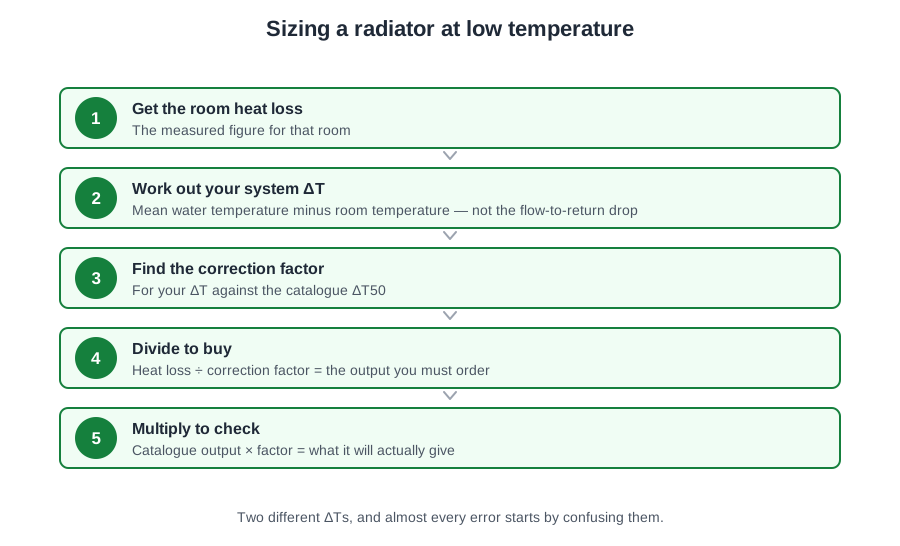
Two completely separate quantities are both called ΔT, and confusing them wrecks the calculation.
System ΔT is flow minus return — 5 K on a 45/40 system. It sets the flow rate: how many litres per second have to move to carry the heat. It has nothing to do with how much heat the radiator gives out.
Emitter ΔT is mean water temperature minus room temperature — 21.5 K on a 45/40 system into a 21 °C room. It sets the output. It has nothing to do with the flow rate.
Say those out loud until they separate. System ΔT sets the flow rate; emitter ΔT sets the output.
Mean water temperature
MWT = (flow + return) ÷ 2
At 45/40 that is 42.5 °C. Into a 21 °C living room the emitter ΔT is 21.5 K. Into a 22 °C bathroom it is 20.5 K. Into an 18 °C bedroom it is 24.5 K.
Note that the same water gives a different ΔT in every room, because the rooms are at different temperatures. The bathroom — the hottest room — gets the smallest ΔT. That is the first half of the bathroom problem.
The correction factor
Radiators are catalogued to BS EN 442 at a reference emitter ΔT of 50 K. So a “1,000 W radiator” gives 1,000 W when its mean water temperature is 50 K above the room — roughly the old 75/65 into 20 °C. It never gives 1,000 W on a low temperature system.
To convert:
f = (ΔTactual ÷ 50)1.3
The 1.3 exponent is the radiator index — it is not linear because a radiator emits by both convection and radiation, and both fall away faster than proportionally as the surface cools. Some manufacturers publish an index between 1.24 and 1.33 for a specific product; use the published one where you have it and 1.3 where you do not.
| System | Room | MWT | Emitter ΔT | Factor f |
|---|---|---|---|---|
| 75/65 | 20 °C | 70 °C | 50 K | 1.000 |
| 75/65 | 21 °C | 70 °C | 49 K | 0.974 |
| 55/45 | 21 °C | 50 °C | 29 K | 0.500 |
| 45/40 | 21 °C | 42.5 °C | 21.5 K | 0.334 |
| 45/40 | 22 °C | 42.5 °C | 20.5 K | 0.314 |
| 45/40 | 18 °C | 42.5 °C | 24.5 K | 0.396 |
| 35/30 | 21 °C | 32.5 °C | 11.5 K | 0.147 |
Read the 45/40 line again. f = 0.334. A radiator on that system gives one third of its catalogue output. That is not a percentage adjustment — it is the central fact of low temperature design, and every conversation with a customer about radiator sizes traces back to it.
And notice 55/45 gives exactly half. Those two lines — half at 55/45, a third at 45/40 — are worth memorising, because they let you sanity-check any emitter schedule in your head.
Sizing: divide to buy, multiply to check
Two operations, and people mix them up.
To find the catalogue output you need to buy:
Required ΔT50 output = heat loss ÷ f
To check what a radiator you already have will actually give:
Actual output = catalogue output × f
Divide to buy, multiply to check. Doing it the wrong way round at f = 0.334 gives an answer roughly nine times out, which at least tends to be obvious.
Worked: the living room
1,196 W at 21 °C, system 45/40, f = 0.334.
Required ΔT50 output = 1,196 ÷ 0.334 = 3,581 W.
So a radiator catalogued at 3,581 W or more. A type 22 would have to be 2,200 mm long, wider than the 1.8 m window it sits under, so go deeper before longer: a 600 × 1,600 type 33 at about 3,680 W ΔT50. Check it: 3,680 × 0.334 = 1,229 W against a 1,196 W loss. Good. The 1,500 would give only 1,152 W, which is why you always do the check.
On the old 75/65 system that room needed about 1,230 W at ΔT50 — a 600 × 1,000 type 21. The low temperature version is a triple panel 1,600 mm long.
The schedule
| Room | Loss | f | Required ΔT50 |
|---|---|---|---|
| Living room | 1,196 W | 0.334 | 3,581 W |
| Kitchen | 1,034 W | 0.396 | 2,611 W |
| Hall | 340 W | 0.396 | 859 W |
| Cloakroom | 144 W | 0.396 | 364 W |
| Bedroom 1 | 418 W | 0.396 | 1,056 W |
| Bedroom 2 | 362 W | 0.396 | 914 W |
| Bedroom 3 | 210 W | 0.396 | 530 W |
| Bathroom | 491 W | 0.314 | 1,564 W |
| Landing | 142 W | 0.396 | 359 W |
| Total | 4,337 W | 11,838 W |
A 4,337 W house needs nearly 12 kW of ΔT50 radiator — a ratio of 2.7, before you round each room up to a size you can buy. That number is the honest answer to “how much bigger will my radiators be?”, and it is better said at the survey than discovered at second fix.
The bathroom
Look at the bathroom line. A 491 W heat loss — less than half the living room’s — needs 1,564 W of ΔT50 output, more than three times its loss. It is the worst ratio in the dwelling, and two things cause it.
The room is designed at 22 °C, the highest in the house, so its emitter ΔT is the smallest: 20.5 K, giving f = 0.314. And it has a high air change rate, and it is warmer than every room around it, so its walls, door and floor to the rest of the house all lose heat as well. Its loss is far larger than its floor area suggests.
Now the practical problem. A typical chrome towel rail of the size that fits a domestic bathroom gives perhaps 400 to 600 W at ΔT50 — and chrome is worse than white, often by 20 to 30%, because the finish emits less radiant heat. At f = 0.314 a 500 W chrome rail delivers about 157 W into a room needing 491.
It heats the towels. It does not heat the bathroom. The honest options are a rail plus a small radiator, underfloor heating in the bathroom, a much larger rail, or a fan-assisted emitter — but not a standard towel rail on its own, and the customer needs to be told at the design stage.
What else can emit at low temperature
Underfloor heating is the natural fit. A large surface at low temperature, typically 35/30, and it works properly there where radiators struggle. Output is limited by floor surface temperature — around 29 °C in occupied areas, 33 in bathrooms and perimeters — giving roughly 70 to 100 W/m² on a screed floor.
Fan coil emitters force air across a coil, so they get useful output at 45 °C from a small casing. Genuinely useful where a radiator will not fit, at the cost of an electrical supply, some noise and a filter to clean.
Oversized conventional radiators — the commonest answer, and there is nothing wrong with it. Type 22 and type 33 give considerably more output for the same wall length than the type 11 in a lot of older houses.
A word on the mixed system: if radiators want 45 °C and underfloor wants 35, they cannot share a flow unless the underfloor has its own blending arrangement. Design that in rather than discovering it.
Getting the output you paid for
A radiator only delivers its rating if it is installed to deliver it. Foil behind a radiator on an external wall, clearance underneath, nothing shrouding the convection path. A full-length shelf or a fitted cover can take 20 to 30% off — and on an 80 °C system that was absorbed by the margin. At f = 0.334 there is no margin to absorb it.
Air is worse. An air pocket across the top of a radiator removes that part of the surface entirely, and on a low temperature system where the emitter is already working at a third of its rating, one un-vented radiator is the difference between a warm room and a cold one. Automatic air vents at the high points and proper venting at commissioning are not optional here.
📝 10-Question Mock Test
Click an option to see whether you got it right. Explanations appear instantly — no submitting at the end.
Flow minus return — it sets how many litres per second must move. The emitter ΔT, mean water temperature minus room temperature, is what sets the output.
Mean water temperature 42.5 °C less the 22 °C room. The same water gives 21.5 K in a 21 °C living room and 24.5 K in an 18 °C bedroom.
Roughly the old 75/65 flow and return into a 20 °C room. A radiator never gives its catalogue figure on a low temperature system.
The 1.3 index reflects radiation and convection both falling away faster than proportionally as the surface cools. Use a manufacturer's published index where one exists.
f = 0.334. Worth memorising alongside 55/45, which gives almost exactly one half — between them they let you sanity-check any schedule in your head.
Divide to buy: 1,196 ÷ 0.334. Multiplying instead gives 399 W and a radiator that heats about a third of the room.
Multiply to check: 1,500 × 0.334. This is the calculation that tells you whether existing radiators can stay.
A ratio of about 2.7, and it is better said at the survey than discovered at second fix.
22 °C gives f = 0.314, the lowest factor in the house, and the high air change rate makes the loss larger than the floor area suggests.
Same reason a radiator cover or a full-length shelf matters more. On an 80 °C system the margin absorbed those losses; at f = 0.334 there is none.
One third of catalogue at 45/40, one half at 55/45. Those two factors decide the radiator schedule, the cost of the job and the conversation you have with the customer — and they are why the emitter calculation cannot be skipped.