Module 8 gave you the devices and the arrangements. This one is the part that actually gets asked on site: what does this particular thing need? A bath, a bidet, a washing machine, a garden tap, a filling loop. It is the largest module on the course, and the reason it is large is that the answer changes with the building.
This article covers Module 9 of the PlumbMate Water Regulations course: the protection required at each common application, the bidet rules, appliances in domestic against commercial against healthcare settings, outside taps and irrigation, and the filling loop rules for sealed heating systems. There is a 10-question mock test at the end.
Baths, basins and showers
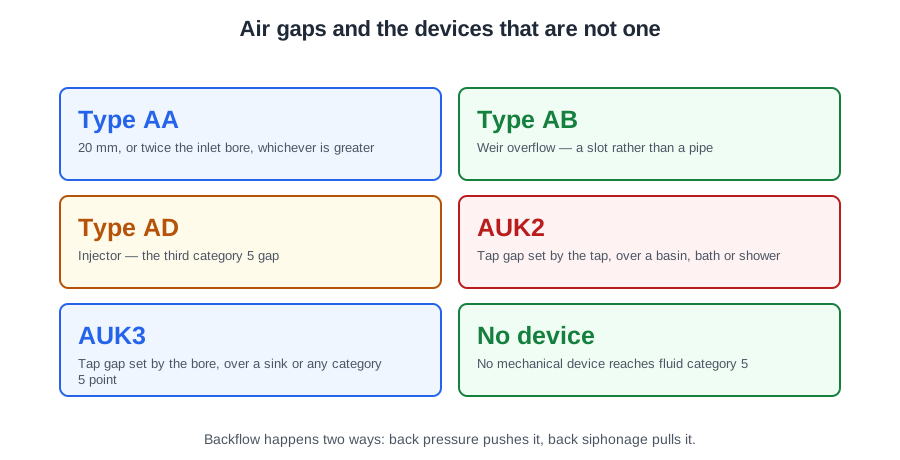
Start with the reassuring case. A bath or basin with separate taps and no hose needs no supply pipe protection at all, provided the AUK2 tap gap is correct. The tap gap is the protection. Nothing else is required, and nothing else should be added.
Change the building and the answer changes. In non-domestic premises — a nursing home, for instance — AUK3 applies: 20 mm or twice the bore, whichever is greater. For a G¾ tap that is 38 mm, nearly twice the domestic figure. And remember Module 7: a hotel is a domestic situation; healthcare premises never are.
Showers
A fixed shower head, or a hose that cannot be submerged, needs no protection. If the head cannot reach the water, there is nothing to siphon.
A submergible hose in a domestic setting needs either an HC diverter with automatic return, or a double check valve.
One prohibition to learn as a hard rule: a DC pipe interrupter must not be used on a shower. The spray head restricts the flow, which forces water out through the interrupter's vents. The device is not faulty; it is being asked to work with a restriction downstream that it was never designed for.
And one that is not a backflow problem at all, though it looks like one: an unbalanced mixer needs single check valves (EB) on hot and cold. That is a cross-flow problem — hot pushing into the cold pipe because the pressures differ — not backflow from a contaminated source. Worth naming correctly, because the fix is different.
Bidets
The bidet is the classic exam question, and the split is worth learning exactly.
An over-rim bidet needs an AUK2 tap gap, and may be fed from a supply pipe or a distributing pipe. Nothing more. It is a basin with taps over it.
An ascending spray or flexible hose bidet is a different object entirely. It is fluid category 5 — the outlet is below the spillover level and the user is above it — and it may never be fed direct from a supply pipe. The permitted arrangements are:
- a type AA, AB or AD air gap serving the bidet only; or
- a dedicated distributing pipe serving the bidet alone; or
- a common vented distributing pipe, where the branch to the bidet is taken 300 mm above the spillover level or the extended spray outlet, whichever is higher.
That third option is the one people get wrong, because they measure from the bidet rim and forget that the spray head on a hose can be lifted higher than the rim. Whichever is higher means exactly what it says.
And from Module 1: an ascending spray bidet is notifiable — item 4(b), anywhere, including in a house. One of the small number of fittings the house exception does not cover.
Sinks and washbasins
Two fittings that sit side by side in the same kitchen and are treated completely differently.
A sink is category 5 in any location, so it needs an AUK3 tap gap. The washbasin next to it needs only AUK2. Same room, same water, different category — because of what people actually do at each one.
Washing machines and dishwashers
This is where the “category follows the use” principle turns into a practical decision tree.
Domestic
Household washing machines and dishwashers are built to satisfy category 3. In a house, no extra protection is needed — the appliance carries its own.
Category 4 premises
Hotels, restaurants, pubs, canteens, launderettes and general commercial laundries. Protection is a BA device — an RPZ — and only a BA device.
Specifically, a DB is unsuitable, for the reason Module 8 gave: the machine's inlet solenoid is a control valve, and an air-inlet device cannot have a control valve downstream.
Category 5 premises
Healthcare residential and day care, laboratories, mortuaries, slaughterhouses, butchery and veterinary premises. No mechanical device will do, so the options are:
- a break tank with a type AB air gap plus a pump; or
- a machine with integral category 5 protection.
Three rules about sharing a device
- One BA device cannot serve a washing machine and a dishwasher. The risk is cross contamination between them — the device protects the mains from both, and does nothing to keep the two appliances apart from each other.
- Two identical clothes washers on one BA device is acceptable zone protection. Identical machines doing identical work have nothing to cross-contaminate.
- A protected source feeding a building-wide circuit does not satisfy the point of use requirement. This is the Module 8 rule again: zone and whole-site protection are additional, never instead.
One detail that is easy to miss: non-approved connection hoses need a single check valve on hot and cold — but not where they are downstream of a BA device, which has already dealt with it.
Commercial and specialist applications
- A glass washer with a submergible spray hose is category 4.
- A hairdresser's basin with a spray hose is category 3. Both have a hose that can be submerged; the difference is what is in the water.
- A drinking fountain needs its nozzle at least 25 mm above the spillover level, with a screen or hood.
- A laboratory needs a dedicated boosted cistern with a type AA, AB or AD air gap at the inlet.
And one requirement that belongs here rather than with hot water: hot water must be maintained to category 2 to be safe for personal washing. Water that has fallen below that is not fit to shower in.
Outside taps, hoses and irrigation
Outside is where the risk jumps, because a hose reaches things nothing else in the house reaches.
Garden taps on houses
For a new house garden tap: a double check valve, located inside the building and protected from freezing. Both parts matter — inside for frost, and inside so that it is where the pipework is rather than in the weather.
For an existing unprotected tap, three routes:
- fit a double check valve inside the building;
- replace the tap with an HUK1; or
- fit an HA continuously to the outlet.
HA and HUK1 are for existing hose union taps in house installations only. They are a remedy for what is already there, not something to design in.
What goes on the end of the hose
The chemicals decide the category, and they sit further apart than people expect. Fertilisers and domestic detergents are category 3. Insecticides are category 5.
Hand-held hoses must have a self-closing mechanism at the outlet — a trigger gun, in ordinary terms. That is a waste requirement as much as a backflow one.
Then the case that catches everybody: soil watering less than 50 mm below the discharge point is category 5, and only AA, AB, AD or AUK1 will do. A hose lying on a border, or a porous hose just under the surface, is that close to soil.
For house garden mini-irrigation: tap protection plus a type DB not less than 300 mm above the highest point of the porous hose. And on rising ground the 300 mm is measured from the highest point of the hose, not from the tap. A garden that slopes up away from the house is the situation that makes a correctly installed DB useless, and it is common.
Non-domestic hose union taps
Likely category 5, requiring a break tank with a type AB air gap, or a gravity supply from a cistern. A double check valve on a commercial yard tap is not protection.
Two practical notes: a tap left running or vandalised is waste under Regulation 3, which is the argument for a lockable or removable-head tap in a public area. And spherical hose union taps split on freezing — the trapped-ball problem from Module 5 — so a BS 1010 Part 2 bib tap is the better outdoor choice.
Heating systems and filling loops
The category first: a primary circuit is category 3 in a house and category 4 by default in any other premises. A non-house system may be risk assessed and downgraded to 3 by the undertaker — never assume it. And a vented system is deemed the higher risk of vented and sealed.
Paragraph 24 sets the rule: no permanent connection to a closed circuit unless an approved backflow device is incorporated.
Sealed systems in a house
The standard arrangement is a double check valve plus a temporary filling loop, disconnected after filling. Partial disconnection is accepted, provided it is made between the loop and the backflow device.
And the point that matters most: leaving a loop connected is an offence — the act of connecting it today is the offence. There is no period of grace and no “I will take it off next visit”. This is the “can convey” principle from Module 6, applied to the commonest fitting in domestic heating.
Two alternatives avoid the problem entirely:
- a CA device, which may be permanently connected; or
- a pressurisation unit with a type AB air gap.
Sealed systems in other premises
Category 4 means a BA device, or a break tank with a type AB air gap. A filling loop with a double check valve is an offence in non-house premises — the same assembly that is standard in a house.
One design constraint that catches people: BA devices need about 0.6 bar to open. A gravity supply usually cannot deliver that, so an RPZ fed from a cistern will simply not work. Check the available pressure before specifying one.
Vented systems
- House: a type AG air gap via a BS 1212 Part 2 float valve. Part 1 valves are never permitted — the close level cannot be adjusted without bending the lever, which is the subject of Module 10.
- Non-house: a type AB air gap, with expansion volume at least 4% of system capacity, and the fluid 25 mm below the overflowing level when fully expanded.
Fire systems
Three different answers depending on what is in the water:
- Sprinklers without additives — category 2.
- Sprinklers with anti-freeze — category 4. One additive, two tiers.
- Water stored for firefighting — category 5. Stored, stagnant, and often for years.
Where a supply serves both fire and drinking water, take the fire connection immediately on entry to the building — as close to the incoming main as possible, so the fire system's risk is isolated at the earliest point and does not travel through the drinking water pipework.
Putting the module together
Three questions, in order, every time. What is the fluid category here — which depends on the building, not the appliance? Which mode of backflow is possible? And is there an arrangement that will do it, before reaching for a device? Answer those and every application in this module falls out of Module 8's table.
📝 10-Question Mock Test
Click an option to see whether you got it right. Explanations appear instantly — no submitting at the end.
AUK3 applies to sinks anywhere, to non-domestic situations and to healthcare premises — and healthcare premises are never a domestic situation, however residential they feel. A hotel, by contrast, does count as domestic.
The device is not faulty; it is being asked to work with a restriction downstream that it was never designed for. A fixed head or a hose that cannot be submerged needs no protection at all; a submergible domestic hose needs an HC diverter with automatic return, or a double check valve.
Worth naming correctly, because it is not backflow from a contaminated source and the fix is different. EB single check valves on each leg.
“Whichever is higher” means what it says: a spray head on a hose can be lifted above the rim, so measuring from the rim is not enough. The alternatives are a type AA, AB or AD air gap serving the bidet only, or a dedicated distributing pipe.
One of the small number of fittings the house exception does not cover. Note also that it is fluid category 5 and may never be fed direct from a supply pipe.
The problem with sharing is cross contamination between different appliances, not the sharing itself. A BA device protects the mains from both and does nothing to keep the two apart from each other.
Healthcare residential and day care premises are category 5, along with laboratories, mortuaries, slaughterhouses, butchery and veterinary premises. Nothing mechanical reaches category 5. Hotels, restaurants, pubs, canteens and launderettes are category 4, where a BA device is the answer.
On rising ground this is the difference between working protection and none. A garden sloping up away from the house is common, and a DB set 300 mm above the tap can end up below the hose it is meant to protect.
A double check valve on a commercial yard tap is not protection. HA and HUK1 are for existing hose union taps in house installations only — a remedy for what is already there, not something to design in.
The same assembly that is standard in a house is an offence in other premises. Note too that BA devices need about 0.6 bar to open, so a gravity supply usually cannot work one — check the pressure before specifying.
The applications are many; the method is one. Category, mode, arrangement before device. The commonest failures are not exotic — a filling loop left on, a double check valve on a commercial yard tap, a DB installed 300 mm above the tap on a garden that slopes uphill.
The one to carry away: leaving a filling loop connected is an offence, and the act of connecting it is the offence. If it is going to stay, it needs a CA device or a pressurisation unit with a type AB air gap instead.