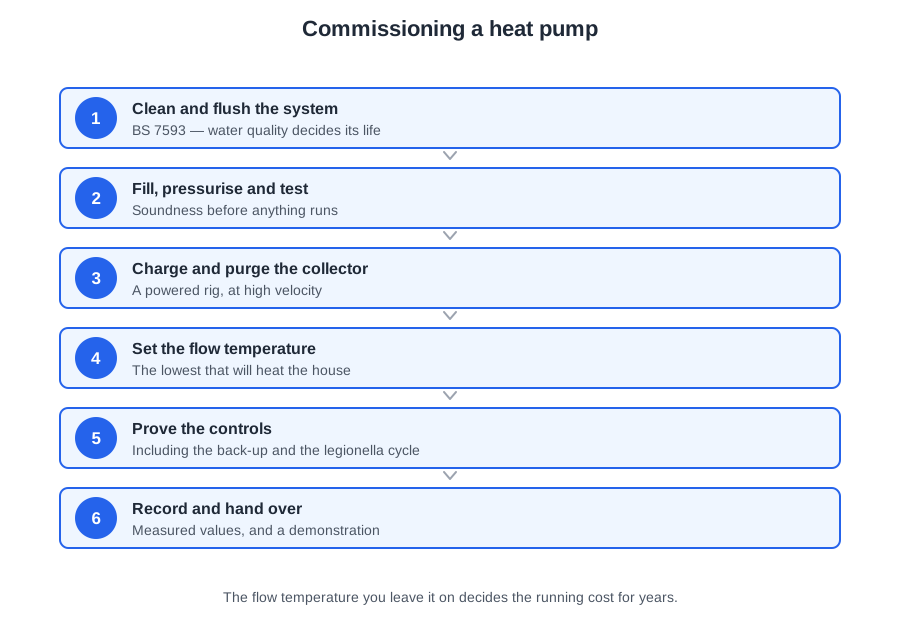
Commissioning is where a heat pump either becomes the system that was designed or quietly becomes something else. The distinction that runs through this whole module is simple: commissioning is confirming and correcting, not recording. An out-of-range reading is not a number to write down — it is a fault to find.
This covers Module 6 of the PlumbMate heat pumps course: what to check before you start, cleaning and flushing to BS 7593, filling and pressurising, purging the collector, setting flow rate and balancing, the controls and hot water, and a handover that actually sticks. There is a 10-question mock test at the end.
Before you commission
Verify the design against what was installed
Commissioning sets a system up against its design, so the first task is confirming that the design you are holding is the design that was actually built. If the flow temperature, flow rate, buffer volume or control strategy on the drawing differ from what is in front of you, commissioning to those figures produces a system that runs but never achieves its designed efficiency — and nobody notices for a heating season.
Verify first, then commission. Where the two disagree, resolve the discrepancy before proceeding rather than picking whichever is convenient.
What commissioning is not
An out-of-range reading means something is wrong: a restricted circuit, a wrong pump setting, an air lock, an incorrect control setting. Investigate, rectify, re-check, then complete. Recording a known deviation and handing over anyway transfers the problem to the customer — and the record shows you knew.
Know where your competence ends
Everything on the water side and the controls is normal commissioning work. Work on the sealed refrigerant circuit is not — it requires an F-Gas handling qualification, and on most monobloc installations there is no reason to open the circuit at all. If commissioning appears to require refrigerant work, stop and involve someone qualified.
Let it settle
Take readings at steady state, not during warm-up. While a system is coming up to temperature the temperature difference is wide, the unit may be at full output and flow temperatures are still climbing. None of that reflects normal operation, and recording it produces numbers that mean nothing to whoever reads them next.
Verify the design, let it settle, then measure. Correcting is part of the job, not an interruption to it.
Cleaning, flushing and water treatment
A heat pump's plate heat exchanger has far narrower waterways than a boiler's. Debris a boiler would tolerate for years will block it, and it is expensive and awkward to clean once blocked. Water treatment therefore matters more on these systems, not less.
New installations carry flux, swarf, jointing compound and general debris. Retrofits carry years of accumulated magnetite sludge. Both must be removed by thorough cleaning and flushing before the system is commissioned.
BS 7593
BS 7593 is the code of practice for system water. It covers cleaning before commissioning, dosing with a suitable inhibitor, testing the water quality, fitting in-line filtration, and verifying inhibitor concentration at each subsequent service.
Inhibitor and filtration
Dose the system with a suitable corrosion inhibitor at the manufacturer's stated concentration for the actual system volume — calculated, not guessed. Inhibitor protects the ferrous components; it does not stop magnetite forming entirely.
So fit in-line filtration as well, normally a magnetic filter. Position it on the return, before the heat pump, with isolation valves either side so it can be cleaned without draining the system. On the flow, debris has already passed through the exchanger — which defeats the purpose entirely.
Antifreeze does not belong in a heating primary as a matter of routine. It belongs in the ground collector, and in external pipework where the manufacturer specifies it. It also reduces the water's heat carrying capacity, which changes the flow rate arithmetic.
Clean, treat, filter, test. The filter goes on the return — protect the exchanger, do not catch debris after it.
Filling, pressurising and testing
Soundness testing comes first
Carry out the soundness test before pipework is insulated or concealed. Once it is boxed in, insulated or screeded over, a weeping joint may not show itself for weeks and will then need destructive work to reach. Same logic as pressure testing a ground collector before backfilling.
The expansion vessel
The vessel's gas charge must be set to match the intended cold fill pressure, and it can only be measured meaningfully with the water side depressurised — otherwise system pressure holds the diaphragm against the gas and the reading tells you nothing. Check and adjust it before final filling.
Remember to include the buffer and cylinder primary contents when calculating system volume for vessel sizing. On a heat pump system those are often the largest single contributors.
Venting
Air pockets stop flow through parts of the system, so emitters stay cold and the heat pump may be unable to dissipate its output. Oxygen in trapped air also drives corrosion, and moving air produces the gurgling customers complain about.
Vent thoroughly, then vent again once the system has run and warmed through, as dissolved air comes out of solution.
Disconnect the filling loop
Once filled and pressurised, physically disconnect the filling arrangement. The Water Regulations do not permit a permanent connection between a heating primary containing inhibitor and the wholesome supply. Leaving a flexible hose coupled at both ends is one of the commonest contraventions found on domestic systems, and it takes seconds to put right.
Charging and purging the collector
Air trapped mid-array is the commonest commissioning problem on a ground source system. It blocks flow through part of the collector, so extraction falls and the unit may go to low-temperature lockout — a symptom easily mistaken for an undersized array, which is an expensive misdiagnosis.
Circulate at high velocity with a powered flushing rig until no further air returns. Then check flow through each circuit individually at the manifold. A loop showing low or no flow has either an airlock or an obstruction, and the manifold is the only place you will ever be able to tell.
Then measure the antifreeze concentration with a refractometer or hydrometer, and record both that and the brine circuit pressure. A buried collector cannot be inspected, so those recorded figures are the only baseline against which a future engineer can recognise a slow loss.
Setting flow rate and balancing
Measure ΔT and you have measured the flow
You cannot easily measure flow directly, but you do not need to. Flow rate and temperature difference are inversely linked, so measuring the ΔT across the heat pump at full output tells you whether the flow is right.
Compare it with the design figure. If the design is 5 K and you measure 9 K, the flow rate is roughly half what it should be. Look for a pump set too slow, a partially closed valve, a blocked filter or undersized pipework. A wider-than-design temperature difference is one of the clearest signs that something is restricting flow — and on a heat pump, low flow leads to high-pressure lockouts.
Balancing
Once the total flow is right, it still has to be shared out correctly. Water takes the easiest path, so without balancing the circuits nearest the pump take more than they need and the index circuit is starved. Balancing sets each circuit's flow to match its emitter's designed output, so rooms come up to temperature together and the system operates at its design temperature difference. An unbalanced system produces the classic complaint that one room never warms up.
Electrical testing and defrost
The electrical installation is inspected and tested to BS 7671 like any other circuit — continuity, insulation resistance, polarity, earth fault loop impedance and RCD operation — with the results recorded on the appropriate certificate. Protective measures must be proved, not assumed, and reversed polarity on a fixed appliance is both a safety defect and a cause of control faults.
Where the weather allows, observe a defrost cycle. Confirm it initiates and terminates correctly and — the part most often left to chance — that meltwater actually drains away rather than pooling beneath the unit. Better to find that out in October than after the first hard frost.
Setting the controls and hot water
The weather compensation curve
Set the curve to the lowest flow temperature that maintains comfort at each outdoor condition. Since efficiency is governed by lift, every unnecessary degree costs the customer money for as long as the system exists.
Setting it high guarantees comfort and terrible efficiency, and it is the commonest way a well-designed system ends up performing badly. Set it low, then review it in genuinely cold weather — a curve set during a mild commissioning week rarely gets revisited.
Hot water settings
Two things must be established and recorded:
- Cylinder storage temperature — typically 45–52 °C on a heat pump, well below a boiler's setting, because a lower target means a smaller lift.
- Pasteurisation frequency and temperature — typically weekly to 60 °C, to manage legionella risk in water stored within the growth range. The whole cylinder volume must reach temperature, not just the top.
Pasteurisation usually runs on the immersion heater at a COP of 1, so an over-frequent or over-long cycle noticeably damages the system's SPF. Set it to what the risk requires and no more.
Zones and timing
Set up the zones, their time channels and their temperature setpoints. In a new dwelling of 150 m² or more, Approved Document L 2021 (paragraph 5.14) asks for at least two independently controlled heating circuits — in practice, each zone with its own time and temperature control. In an existing home, when a heat generator such as a boiler is replaced, paragraph 5.20 asks for thermostatic room controls. Check that TRVs, where fitted, are not going to shut down so much of the system that the heat pump begins to cycle.
Record what you set
Every setting applied goes on the commissioning record. Settings drift — customers adjust curves, other trades alter valves, controls reset after a power failure. Without a record of the commissioned state, an engineer investigating poor performance in three years cannot distinguish a fault from an altered setting.
Records and handover
The commissioning record
Record the measured values and the settings applied: flow and return temperatures, temperature difference, system pressure, inhibitor concentration, brine pressure and concentration where applicable, the compensation curve, cylinder and pasteurisation settings.
A date and a signature prove nothing. Measured values are what let the next engineer see whether anything has drifted — and they are the installer's defence against a later performance complaint.
Handover is an active process
Demonstrate the controls, explain how the system is intended to run, and issue the documentation. Leaving a pack on the side for the customer to read does not teach anyone to operate an unfamiliar system, and it usually goes in a drawer unread.
Explain the operating pattern especially carefully to someone replacing a gas boiler. They will expect short, hot bursts and will switch the system off when out. Both work against a heat pump, and a customer who has not been prepared for that reads normal operation as a fault. Ten minutes here prevents most avoidable call-backs.
What the customer gets
- The commissioning record.
- Manufacturer's user and maintenance instructions.
- Compliance certificates, warranty registration and a system schematic.
- The servicing schedule — what they can check themselves, and what needs an engineer.
The installer's own risk assessment and method statement are internal documents and are not part of the pack.
Leave it running
The system should be left fully operational, correctly set, with the customer able to use it. Leaving it isolated or in an override means their first experience is a system they must configure themselves — which is where misconfiguration begins.
Demonstrate, explain, issue, and leave it running. The paperwork supports the conversation; it does not replace it.
The numbers worth carrying into an exam
| Item | Detail |
|---|---|
| System water code of practice | BS 7593 |
| Magnetic filter position | On the return, before the heat pump, valved both sides |
| Inhibitor dose | Manufacturer's concentration for the calculated system volume |
| Soundness test | Before insulating or concealing |
| Expansion vessel charge | Set to cold fill pressure, measured with the water side depressurised |
| Vessel sizing volume | Include the buffer and cylinder primary |
| Flow verification | Measure ΔT at full output; wide ΔT = low flow |
| Electrical test standard | BS 7671 |
| Cylinder storage | Typically 45–52 °C |
| Pasteurisation | Typically weekly, full contents to 60 °C |
| Zoning threshold | New dwelling of 150 m² or more → at least two independently controlled circuits (Approved Document L 5.14) |
| Filling loop | Physically disconnected after filling |
Where this goes next
A commissioned system with recorded values is what makes the last module possible. Module 7 is fault finding and servicing — and almost every diagnostic in it works by comparing what you measure now against what was recorded on the day.
📝 10-Question Mock Test
Click an option to see whether you got it right. Explanations appear instantly — no submitting at the end.
Commissioning is a process of confirming and correcting, not merely recording. An out-of-range reading means something is wrong — a restricted circuit, a wrong pump setting, an air lock. Recording a known deviation and handing over transfers the problem to the customer, and the record shows you knew.
While a system is coming up to temperature the temperature difference is wide, the unit may be at full output and flow temperatures are still climbing. None of that is normal operation, and recording it produces numbers that mean nothing to whoever reads them next.
The filter exists to protect the plate heat exchanger, whose waterways are far narrower than a boiler's. On the return it catches debris before it reaches the exchanger; on the flow the debris has already been through it. Isolation valves either side let it be cleaned without draining the system.
BS 7593 covers cleaning before commissioning, dosing with inhibitor, testing water quality, in-line filtration and verifying inhibitor concentration at each service. BS 7671 is the wiring regulations, BS EN 12831 heat loss, BS EN 14511 the COP rating conditions.
With water pressure on the vessel, system pressure holds the diaphragm against the gas and the gauge tells you nothing about the charge. Depressurise the water side, check and adjust the charge to the intended cold fill pressure, then fill. Doing it in the other order wastes the exercise.
Same logic as pressure testing a ground collector before backfilling: test while you can still see and reach the joints. A slow weep behind boxing, under insulation or below a screed is expensive to find and expensive to reach.
Trapped air is the commonest commissioning problem on a ground source system, and it produces exactly the symptom of an undersized array — which makes it an expensive misdiagnosis. Purge at high velocity with a powered rig, then check flow through each circuit individually at the manifold.
Flow rate and ΔT are inversely linked, so nearly double the ΔT means roughly half the flow. Look for a pump set too slow, a partially closed valve, a blocked filter or undersized pipework. On a heat pump, low flow leads to high-pressure lockouts.
Efficiency is governed by lift, so every unnecessary degree costs the customer for as long as the system exists. Setting it high guarantees comfort and terrible efficiency — the commonest way a well-designed system ends up performing badly. A curve set during a mild commissioning week rarely gets revisited, so the review matters.
The risk assessment and method statement are internal documents about how the installer worked safely, not about how the customer operates the system. The pack exists so the customer can run and maintain the system and so a future engineer has what they need.
Practise commissioning on the PlumbMate heat pumps course
Commissioning is a sequence, and sequences are what people get wrong under pressure. The heat pumps course gives you:
- Interactive tasks — place a magnetic filter correctly, set a ΔT, and set a weather compensation curve.
- 30 questions on Module 6, with an explanation on every option.
- Key facts and flashcards per lesson, covering the values that go on a commissioning record and why each one is there.