Testing is the part of the job where the Regulations stop being about what you installed and start being about what you can demonstrate. A system either held the test or it did not. And the single most common mistake is applying the rigid-pipe test to a plastics system, watching the gauge fall, and concluding there is a leak when what you are actually watching is polyethylene doing what polyethylene does.
This article covers Module 4 of the PlumbMate Water Regulations course: the pressure a fitting has to withstand, surge and what to do about it, the rigid and plastics test regimes and why they are different, and the sequence of testing, flushing and disinfection that paragraph 13 requires before a system goes into use. There is a 10-question mock test at the end.
Pressure
Every water fitting must be capable of withstanding one and a half times the maximum pressure it is designed for in operation. That is the design requirement, and it is also where the test pressure comes from.
Establishing the maximum operating pressure is less obvious than it sounds. Two things get forgotten:
- Night-time static pressure. Mains pressure is at its highest in the small hours, when nothing on the network is drawing. The pressure you measured at three in the afternoon is not the pressure your fittings will see at three in the morning.
- Any pumps. A booster or a pumped shower adds its head to whatever the main is doing.
Surge
Surge — water hammer — is generated by the rapid closure of a valve. The usual culprits are float-operated valves, spherical valves and disc valves, all of which can go from open to shut in a fraction of a second. A moving column of water brought to a sudden stop has to put its energy somewhere, and it goes into a pressure spike that can be several times the static pressure.
Here is the point that matters: the test pressure takes no account of surge. One and a half times maximum operating pressure is not a surge allowance, and passing the test does not mean the system will survive water hammer. Surge is a separate design consideration and the designer has to deal with it separately.
The remedies:
- Surge arresters — a cushion for the pressure wave to expend itself into;
- flow limiting — a slower moving column carries less energy to dissipate;
- adequate support — a well-clipped pipe does not move, and much of the noise and fatigue comes from movement;
- reducing the pressure with a pressure reducing valve.
One diagnostic worth carrying: repeated surge makes a relief valve discharge erratically and eventually weep. A safety valve that has started passing for no apparent reason, on a system with no obvious over-pressure fault, is often reporting water hammer rather than a pressure problem. The valve is not faulty. It has been hammered off its seat a few thousand times.
The pressure test
Test pressure = 1½ × the maximum operating pressure. The test covers supply pipes, distributing pipes, fittings and appliance connections — the whole installation, not just the new bit.
Rigid systems
For copper, steel and other rigid materials the test is simple:
- pump up to the test pressure;
- hold for one hour without further pumping;
- no visible leakage, and the pressure holds.
Rigid pipe does not stretch appreciably, so a falling gauge means water is going somewhere.
Why plastics need something different
Plastics pipe expands under pressure. Pressurise a polyethylene or PB system and the pipe swells slightly, increasing the internal volume. More volume for the same amount of water means a falling pressure — with no leak anywhere. The expansion is largest at first and tails off as the material creeps into its new shape.
Apply the rigid test to that and you will fail a perfectly sound system every time. So there are two accepted alternatives, and the shape of both is: let the expansion happen first, then look at what the pressure does afterwards.
Test A
- Pump to test pressure and maintain it by pumping for 30 minutes.
- Stop pumping and reduce the pressure to one third of the test pressure.
- Over the following 90 minutes there must be no drop in pressure.
Dropping to a third is the clever part. At the lower pressure the pipe contracts back and effectively grips the water, so the pressure ought to hold or even creep up. A pressure that falls at one third of test pressure is a leak, unambiguously.
Test B
- Pump to test pressure and maintain it by pumping for 30 minutes.
- Stop pumping. The pressure must not fall by more than 0.6 bar over the next 30 minutes.
- Then it must not fall by more than a further 0.2 bar over the following 120 minutes.
You will sometimes hear 0.8 bar at 150 minutes quoted as the pass figure for Test B. That is simply 0.6 plus 0.2 — the arithmetic result of the two staged limits, not an allowance in its own right. It matters because a system that drops 0.8 bar in the first 30 minutes and then holds perfectly has failed, even though it finishes at the same place. Each stage has to be met on its own.
Paragraph 13: the sequence before first use
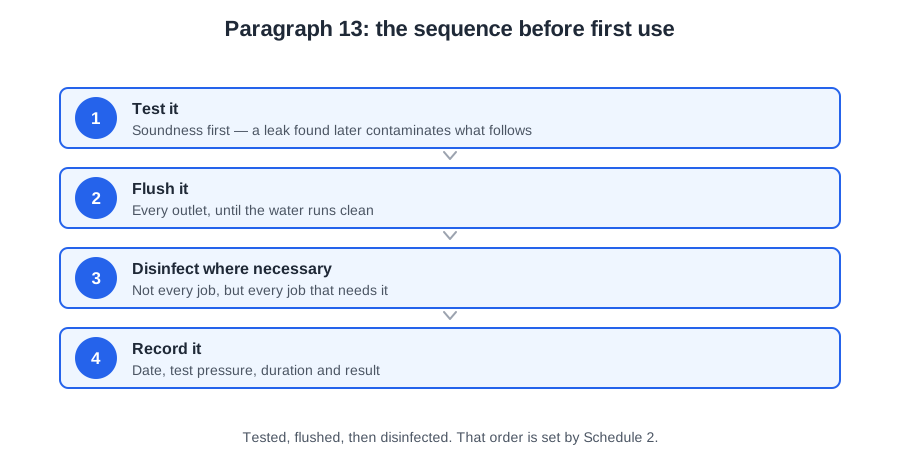
Schedule 2 paragraph 13 sets an order, and the order is the requirement: every system must be tested, flushed, and where necessary disinfected before it is taken into use.
Flushing
Flushing is not optional and it is not a rinse. It removes swarf, jointing compound and excess flux — and, from Module 2, flux is an acid that will corrode the pipe from the inside if it stays. Every length of pipe must be flushed, which means running every outlet, not just the nearest tap.
Flushing happens on every installation. Disinfection does not.
When disinfection is required
Five triggers:
- New installations;
- major extensions and alterations;
- underground pipework — except a localised repair or the insertion of a junction;
- where contamination is suspected;
- where a system is not in regular use and not regularly flushed.
The exception, and how far it reaches
There is an exception for a private dwelling occupied by a single family — and its scope is precise. It covers new installations and major extensions only.
Read that carefully, because it is the point people get wrong in both directions. It does not exempt a house from disinfection where contamination is suspected. It does not exempt underground pipework beyond the new-installation case. And the exception is about a single-family private dwelling, so it does nothing for a house in multiple occupation, a block of flats' communal system, or anything commercial.
Working the other way: localised repairs and the insertion of junctions do not require disinfection, anywhere. Cutting into an existing underground main to add a branch is a repair-scale operation, not a new installation.
Pumps and the 0.2 l/s threshold
A figure that comes up constantly and is worth pinning down. Written approval from the water undertaker is required before connecting a pump or booster to a supply pipe where it draws more than 0.2 litres per second.
That is the same figure as the 12 litres per minute notification threshold from Module 1 — 0.2 × 60 = 12. Two ways of expressing one limit, and seeing that they are the same number saves learning it twice. The reason for the limit is the neighbours: a pump drawing hard off the main can pull the pressure down for everyone on that stretch, and in the worst case create the low-pressure conditions that backsiphonage needs.
One application catches people out. A pumped shower drawing more than 0.2 l/s needs written approval whether the pump sits upstream or downstream of the mixer. The main does not care where in the shower assembly the impeller is; it cares how fast water is being taken.
Putting the module together
Design for one and a half times maximum operating pressure, remembering that the maximum includes the night-time static and any pump. Deal with surge separately, because the test does not cover it. Test rigid systems by holding for an hour; test plastics with Test A or Test B, both of which give the pipe time to expand before judging it. Then flush everything, and disinfect where one of the five triggers applies — noting that the single-family exception is narrower than its reputation.
📝 10-Question Mock Test
Click an option to see whether you got it right. Explanations appear instantly — no submitting at the end.
One and a half times maximum operating pressure — and the maximum has to account for night-time static pressure, when the network is drawing least and pressure is highest, plus any pumps on the installation.
The 1½ factor is not a surge allowance. Surge comes from rapid valve closure — float-operated, spherical and disc valves — and is dealt with separately by arresters, flow limiting, adequate support, or reducing the pressure with a PRV.
A recognised symptom. The valve is not faulty in itself — it has been hammered off its seat a few thousand times, and eventually it stops sealing.
Pressurising plastics swells the pipe and increases the internal volume, so the gauge drops with nothing wrong. Both alternative tests work the same way: let the expansion happen first, then judge what the pressure does afterwards.
Dropping to a third is the point of Test A. At the lower pressure the pipe contracts back and effectively grips the water, so any fall over the following 90 minutes is unambiguously a leak. The 0.6/0.2 staging belongs to Test B.
The 0.8 bar figure people quote is just 0.6 plus 0.2, the arithmetic result of the two staged limits rather than an allowance in its own right. Each stage has to be met separately.
The order is the requirement. Flushing happens on every installation — it removes swarf, jointing compound and excess flux, and flux is an acid that corrodes the pipe from the inside if left. Disinfection happens only where one of the five triggers applies.
Localised repairs and inserting junctions are repair-scale operations, not new installations, and do not require disinfection anywhere. The five triggers are new installations, major extensions, underground pipework, suspected contamination, and a system not in regular use.
Precise scope, and people get it wrong in both directions. It does not exempt a house where contamination is suspected, and it does nothing for an HMO, a block of flats' communal system or anything commercial.
0.2 l/s is 12 litres per minute — the same limit as the Regulation 5 notification threshold, expressed two ways. The main does not care where in the shower assembly the impeller sits; it cares how fast water is being taken, because a hard-drawing pump pulls pressure down for everyone on that stretch.
A test result is only worth having if the method matched the material. Most disputed “failures” on plastics systems are the rigid test being applied to a pipe that was always going to expand.
The one to carry away: the test pressure takes no account of surge. Passing at one and a half times operating pressure says nothing about what a fast-closing float valve will do to the system on a Tuesday morning — that is a separate design problem, with its own separate remedies.