Parts-swapping is expensive, and it usually leaves the real fault in place. This module is about the alternative: a repeatable method that starts with the customer's account and ends with a proven cause. Most of it rests on one thing — a commissioning record with measured values on it, which is why the previous module laboured that point so hard.
This covers Module 7 of the PlumbMate heat pumps course: the fault-finding method, routine servicing, water-side and source-side diagnosis, refrigerant leaks, and re-commissioning after a repair. There is a 10-question mock test at the end.
The fault-finding method
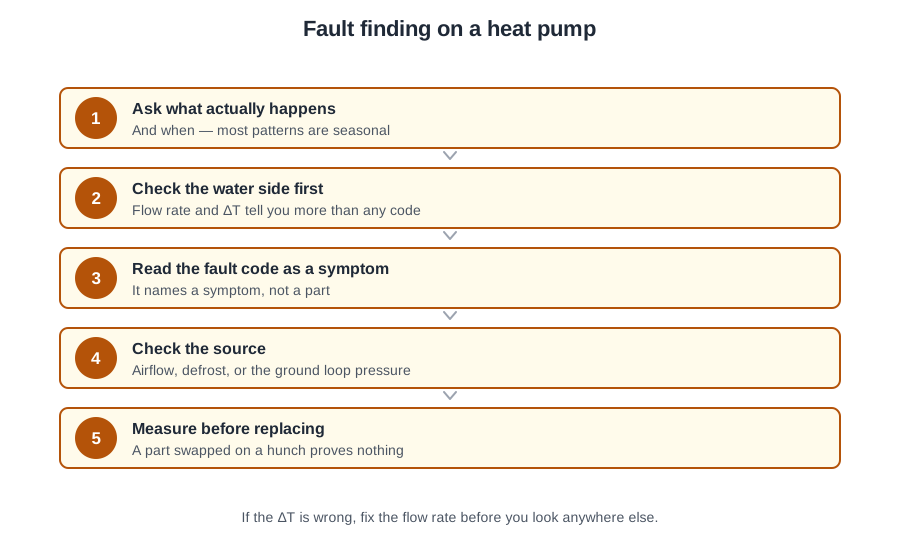
- Gather information. What is the reported symptom, when does it occur, and what changed just before it started? Customers frequently tell you the answer without realising — “it has never been right since someone adjusted it” is a diagnosis.
- Verify the symptom. Confirm that what was reported is what is actually happening.
- Read the fault code and consult the manufacturer's schematics. Fault codes are manufacturer-specific — the same number means entirely different things on different makes.
- Compare against the commissioning record. This is what turns a reading into information.
- Test to prove the cause before replacing anything.
Why the commissioning record matters so much
Without a baseline, a flow temperature of 52 °C or a ΔT of 8 K is just a number. Against a record showing 45 °C and 5 K, the same readings say something has changed — a setting altered, a filter blocking, a pump slowing. It converts guesswork into comparison.
Four documents should be to hand: the manufacturer's service schedule, the commissioning record, previous service records, and the system schematic. The commissioning record is the one most often missing and the one that makes diagnosis quickest.
Resetting is not fixing
A reset clears the symptom without addressing the cause, and the fault returns. A pressure lockout in particular is a protective device doing its job — the question is why it tripped, not how to clear it.
Listen to the customer, read the code, compare with the baseline, then test. Replace last, not first.
Routine servicing
Servicing splits neatly into two halves, plus two extra checks on ground source. The sealed refrigerant circuit is checked for signs of leakage but not routinely opened — that is F-Gas work.
Air side
- Coil condition. A coil clogged with leaves, seeds or pollen collapses output long before it triggers a fault code. Isolate first, then clean gently — the aluminium fins flatten easily, and bent fins block the very airflow you set out to restore. Straighten any with a fin comb, and never use a high-pressure jet at close range.
- Clearances, obstructions and fan operation.
- Meltwater drainage — check it in autumn, once summer's debris has accumulated and before it matters. A blocked route means pooling, freezing, ice building into the unit and a slip hazard on the path.
Water side
- System pressure against the commissioning figure.
- Magnetic filter — clean it every visit. A filter full of magnetite becomes a restriction in its own right, and how heavily loaded it is tells you whether corrosion is continuing.
- Inhibitor concentration — verify, do not assume. It depletes over time, and any draining or repeated topping up dilutes it. Once it falls below the effective level, corrosion resumes silently.
- Flow and return temperatures at steady state.
Ground source additions
Two more, both indirect because the array is buried: brine circuit pressure against the commissioning baseline, and antifreeze concentration by refractometer. A falling pressure points to a leak in the array; weakening concentration risks ice in the evaporator.
Record the readings, not just the visit
“Serviced, all OK” records nothing. Individual readings mean little; the sequence means a great deal. A ΔT creeping from 5 K to 6 K to 8 K across three services describes a circuit slowly restricting, and it can be dealt with cheaply. Noticed only when it locks out on high pressure, the same problem is a callout and possibly a damaged component.
The single most useful rule in heat pump diagnosis
Before the detail, learn this, because it sorts most faults into the right half of the machine immediately:
High pressure sends you to the water side. Low pressure sends you to the source side.
The heat pump takes heat in at the evaporator and rejects it at the condenser. If it cannot reject what it makes, condensing pressure climbs and it trips on high pressure — a water-side problem. If it cannot absorb enough, evaporating pressure falls and it trips on low pressure — a source-side problem. Keeping the two sides separate in your head is most of the skill.
Diagnosing water-side faults
The signature: wide ΔT plus high-pressure lockout
A temperature difference far wider than design means the flow rate has fallen. With too little water passing through the condenser, heat cannot be carried away, condensing pressure climbs, and the unit protects itself.
Check in order of likelihood: blocked magnetic filter first — commonest and quickest to eliminate — then a partially closed valve, then a failing or wrongly set pump, then undersized pipework.
Cycling in mild weather
Frequent starting and stopping in mild weather is the signature of an output-versus-volume mismatch. Demand is at its lowest, so an oversized unit — or one whose emitters have largely closed off — puts in more heat than the system can absorb.
A common version: another trade fits TRVs throughout. As the valves close they cut both the water in circulation and the surface available to give off heat, and the system starts cycling. The fix is volume, better modulation, or a control strategy that keeps a path open.
Reason from what works
This is the habit that separates a diagnostician from a parts-swapper. If hot water is satisfactory but the radiators stay cold, the heat pump is clearly making heat. The fault is therefore in what happens to that heat afterwards — most likely a diverter valve stuck in the hot water position, or not receiving its call for heating. A failed compressor would have taken out both.
Equally, a fault affecting one room only must lie in that room's circuit or emitter: a balancing problem, a closed valve, an air lock, or an emitter that was never large enough for the room's heat loss.
Pressure loss
A sealed system should not lose water. Repeated topping up introduces fresh oxygenated water and dilutes the inhibitor, so corrosion accelerates. Find the loss — a weeping joint, a discharging relief valve, or a failed expansion vessel forcing water out through the relief. Check the relief discharge for evidence.
The immersion running constantly
An immersion heater runs at a COP of 1, so anything driving it wrecks running costs. Investigate why the heat pump is not satisfying hot water demand: a cylinder setpoint above what the unit can reach, an undersized or fouled coil, a pasteurisation cycle set too frequently, or a diverter fault. Check the settings first — they cost nothing to correct.
Diagnosing air-side and source-side faults
Air source: persistent icing
Heavy ice that the defrost cycle is not clearing has three plausible causes, all on the air side:
- Meltwater not draining, so it simply refreezes where it sits.
- Restricted airflow — debris in the coil, or inadequate clearances allowing recirculation. This lowers the coil surface temperature and accelerates frosting.
- The defrost cycle failing to initiate or terminate correctly. Check the fault codes and manufacturer's documentation.
Note what is not a cause: inhibitor concentration, system pressure, or anything else on the water side.
Ground source: low pressure and a falling brine pressure
Low-pressure trips with a brine pressure below the commissioning figure point to a loss from the sealed loop — which on a buried array means a leak. Use the manifold to isolate and test circuits individually; it is the only access point a buried array has. Air trapped in the array produces similar symptoms without any leak, so check the purge before assuming the worst.
Noise
Follow the evidence to where the noise actually is. A whine traced to the fan assembly, with no fault codes displayed, means the control system sees nothing electrically abnormal — so look at the mechanical and airflow condition: clearances against the manufacturer's figures, obstructions, debris in the coil, or a fan or mounting defect.
Poor performance with no fault at all
Sometimes nothing is broken. Check the current control settings against the commissioning record — a compensation curve altered after a power cut, or a customer who has been switching the system off overnight, will produce exactly the complaint of a system that “never gets warm”.
Refrigerant leaks
Immediate actions, in this order
- Ventilate and keep people away from any enclosed or low-lying space. Refrigerant is heavier than air and can displace oxygen, causing asphyxiation without warning. This is the immediate danger to anyone present.
- Eliminate ignition sources. Apply no naked flame or heat. Some refrigerants are mildly flammable, and all of them decompose into highly toxic and corrosive products when heated — far more dangerous than the refrigerant itself.
Do not keep the system running to disperse the leak. That releases more refrigerant, which is both a hazard and an offence under the F-Gas Regulations.
Who may repair it
Work on refrigerant circuits requires an F-Gas handling qualification. If you do not hold it, your role is to make the situation safe, isolate the system, inform the customer, and arrange for a qualified engineer.
That is not a limitation to apologise for. Recovering and recharging without the qualification is unlawful regardless of technical ability, and knowing where the line sits is professional judgement rather than a shortcoming.
Never top up and walk away
Recharging without finding the leak means the new charge escapes as well. It is an offence, it is a waste, and it leaves the customer with the same fault in six months.
The F-Gas Regulations require records of refrigerant quantities recovered, added and lost. Beyond compliance, those records have diagnostic value: a system topped up twice in two years has a leak nobody has properly found, and the paperwork is what reveals the pattern.
Ventilate, no flames, isolate, report. Then hand it to someone qualified.
After rectification: re-commissioning and records
Two things must follow every repair
- Re-commission the affected parts and confirm the system is operating correctly. This proves the fault is genuinely cleared and that nothing was disturbed in the process. Prove it works before you leave, rather than assuming the repair was sufficient.
- Record it — the fault, the cause, the action taken, the readings obtained — and tell the customer what was wrong and what you did.
Do not reset all controls to factory defaults to “clear any residual errors”. That destroys the commissioned configuration and creates a new problem in place of the old one.
What goes in a service record
The date, the checks carried out, the readings obtained, any parts fitted, any defects found, and when the next service is due. Recording only defects loses the readings that would have shown a developing problem before it became a defect.
When to escalate
Competence and authorisation set the boundary. Refrigerant circuit work needs F-Gas qualification; some diagnostics need manufacturer-specific tools or software; warranty conditions may require an approved engineer. Escalate when the fault lies beyond that boundary — not immediately on arrival before any investigation, and not after replacing every component in turn.
What to tell the customer
Between visits they can usefully check anything visible and safe: the pressure gauge, that nothing is blocking the outdoor unit, that the drainage route is clear, and that the system is behaving as it normally does. A customer who notices a falling gauge early saves themselves a corroded system.
Anything requiring tools, isolation or panel removal belongs to the engineer. Never suggest a customer opens the unit.
The diagnostic shortcuts worth memorising
| Symptom | Points to |
|---|---|
| High-pressure lockout | Water side — it cannot reject its heat |
| Low-pressure lockout | Source side — it cannot absorb enough heat |
| Wide ΔT | Low flow: filter, valve, pump, pipework — in that order |
| Hot water fine, heating cold | Diverter valve or the heating call — the machine is making heat |
| One room cold | That room's circuit or emitter, never the heat pump |
| Cycling in mild weather | Output versus volume mismatch |
| Persistent icing | Drainage, airflow, or the defrost cycle — all air side |
| Falling brine pressure | Leak in the array — but rule out trapped air first |
| Immersion running constantly | Check the settings before anything else |
| Repeated topping up | A leak, plus diluted inhibitor and accelerating corrosion |
That is the whole course
Seven modules, and every one of them comes back to the same two ideas: temperature lift decides efficiency, and the record you leave is what makes the next visit possible. If you have read the series from Module 1 through to here, you have covered the ground a heat pump installer is expected to know.
📝 10-Question Mock Test
Click an option to see whether you got it right. Explanations appear instantly — no submitting at the end.
Without a baseline, a ΔT of 8 K is just a number. Against a record showing 5 K, the same reading says something has changed — a setting altered, a filter blocking, a pump slowing. It converts guesswork into comparison, which is the whole point of recording measured values rather than just a date and a signature.
A pressure lockout is protection working correctly. Repeated resets treat the alarm rather than the fault, and the fault returns. On a high-pressure trip specifically, look to the water side — the machine cannot reject the heat it is making.
Low pressure is an evaporator problem: not enough heat coming in. On air source think icing, restricted airflow or a defrost fault; on ground source think trapped air or a loss of brine. High pressure is the mirror image and sends you to the water side.
Wide ΔT means low flow, and a blocked magnetic filter is both the commonest cause and the quickest to eliminate. Then a partially closed valve, then a failing or wrongly set pump, then undersized pipework — in that order of likelihood.
Reason from what works. If the cylinder is heating, the machine is making heat, so a failed compressor is impossible — it would have taken out both. The fault lies in what happens to the heat afterwards: most likely a diverter stuck in the hot water position, or not receiving its call for heating.
Mild weather is minimum demand, so an oversized unit — or one whose emitters have largely closed off — puts in more heat than the water content can absorb. A common version is TRVs fitted throughout by another trade: as they close they cut both circulating volume and emitting surface.
Icing is an air-side problem, so the causes are all on the air side: drainage, airflow, or the defrost cycle itself. Inhibitor concentration is a water-side matter and has no bearing on it. Keeping the two sides separate in your head is most of the skill in diagnosis.
Isolation first, because the fan can start. Then gently: aluminium fins flatten under very little force, and flattened fins restrict the airflow the clean was meant to restore. Straighten any that are bent with a fin comb, and keep high-pressure jets away.
Refrigerant is heavier than air and can displace oxygen, causing asphyxiation without warning — the immediate danger is to people present. Then ignition sources, because refrigerants decompose into highly toxic and corrosive products when heated. Running the system to disperse it releases more refrigerant and is an offence under the F-Gas Regulations.
A factory reset destroys the commissioned configuration — the compensation curve, zone settings, cylinder and pasteurisation settings — and creates a new problem in place of the old one. The system then performs badly for reasons unrelated to the original fault, and the record no longer matches what is installed.
Finish the job on the PlumbMate heat pumps course
Fault finding is a skill you build by doing it repeatedly against realistic symptoms. The heat pumps course gives you:
- An interactive diagnosis task that presents symptoms and makes you reason to the cause rather than guess at it.
- 30 questions on Module 7, with an explanation on every option — including why the plausible wrong answer is wrong.
- 47 lessons across all seven modules, a 242-question bank, flashcards and short-answer practice, with anything you get wrong resurfacing until it sticks.