Six checks, none of which takes more than a few seconds, and between them they catch nearly everything that turns a power tool into an electric shock.
The short answer
Six checks before you switch on: PAT label, cable, plug, fuse, RCD, casing. Before every use, not weekly.
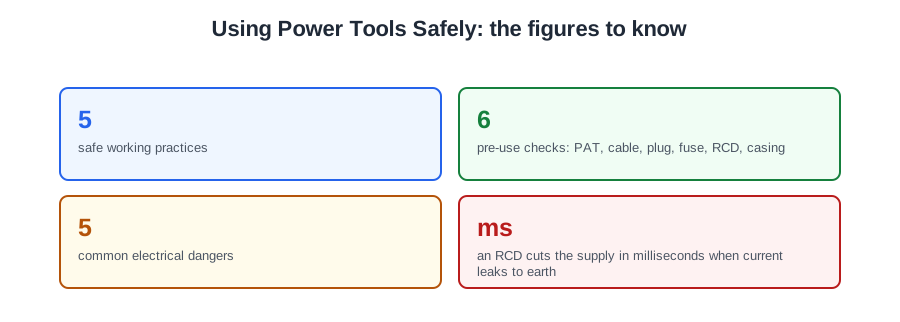
An RCD compares the current flowing out with the current coming back. If some of it is going somewhere else — through you, through a wet wall — it cuts the supply in milliseconds.
A fuse and an RCD do completely different jobs
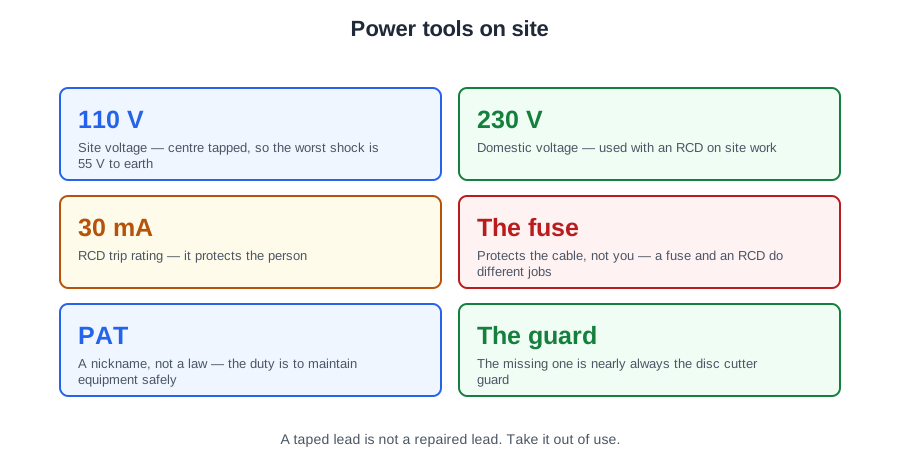
Worth being clear about, because they get treated as the same idea. A fuse protects the cable. It blows when the current is high enough to overheat the wiring, and the current that does that is far more than the current that stops a heart.
An RCD protects the person. A 30 mA device — the standard for personal protection — trips at thirty thousandths of an amp of leakage, long before a fuse notices anything is wrong at all. Someone gripping a faulty drill in a damp cellar is not drawing enough current to blow a 13 A fuse; they are just dying quietly at a current the fuse considers normal.
Which is why fitting a bigger fuse to stop it blowing is such a bad answer. A fuse that keeps blowing is telling you something about the tool, and the fix is to find out what, not to give the cable permission to overheat.
The damp work area is one we create
Of the five electrical dangers, the damp one is the one plumbers should read twice. Every other trade turns up to a damp site. We turn up dry and then make it damp: draining a system, cutting into a live pipe, working in an unheated cellar, mopping up after a burst.
Water lowers the resistance of your skin by a very large factor. The same fault that gives you a jolt with dry hands is a different event entirely with wet ones. Anything electrical in a room you have just drained deserves the full six checks and an RCD.
Where cables actually run
"Do not drill above a socket" is the short version. The full version is the safe zones, and knowing them tells you where cables are as well as where they are not: straight up and straight across from any socket or switch, within 150 mm of the top of a wall, and within 150 mm of a corner.
That is where an electrician is permitted to run a cable without extra protection, so that is where cables mostly are. Anywhere else, a cable should be armoured, in earthed conduit or at least 50 mm deep — but "should be" is doing a lot of work in a house somebody's uncle rewired in 1994.
So: use a cable detector, sweep it in both directions, and treat every zone as occupied. Drilling a fixing for a radiator bracket is one of the most common ways a plumber hits a cable, because a radiator goes under a window and so does the wiring.
The injury nobody sees coming
Electric shock is the danger this lesson is about. The one that actually ends careers is hand arm vibration syndrome — permanent nerve and circulation damage from breakers, SDS drills and grinders. It builds up over years, it does not recover, and it takes the fine grip you need to hold a compression nut.
The exposure action value is 2.5 m/s² over an eight hour day and the limit is 5. In practice that means a heavy breaker has a daily trigger-time budget measured in tens of minutes, which is why site kit now carries vibration ratings on the label. It is not on the Level 1 paper. It is worth knowing at nineteen rather than at forty.
What comes next
The six checks stay with you unchanged. What changes at Level 2 is what you are allowed to do about a fault you find — isolation procedures, lock off, and proving dead before working on anything electrical connected to plant.
🔢 The numbers worth memorising
- 5
- safe working practices
- 6
- pre-use checks: PAT, cable, plug, fuse, RCD, casing
- 5
- common electrical dangers
- ms
- an RCD cuts the supply in milliseconds when current leaks to earth
⚠️ Where people go wrong
- Inspecting a tool weekly rather than before every use.
- Not knowing what an RCD does. It compares current out and back, and cuts the supply if they differ.
- Fitting a bigger fuse to stop it blowing. The fuse rating has to match the tool.
- Drilling above a socket. Cables run vertically and horizontally from sockets and switches.
- Forgetting that the damp work area is one we create ourselves.
📝 8-Question Self-Test
Straight from the Level 1 course question bank. Click an option to see whether you got it right — the explanation appears instantly, and there is nothing to submit.
A Residual Current Device cuts the supply within milliseconds if current leaks to earth — for example if you cut through your own lead.
Select the right tool, follow the risk assessment and manufacturer's instructions, use PPE, and inspect the tool before every use.
The five practices are: select the appropriate tool, follow the risk assessment, follow the manufacturer's instructions, use appropriate PPE, and carry out a visual inspection before use.
The right tool does the job with less force, and force is what causes slips.
The Portable Appliance Test label shows the tool has been tested and when it is next due. An out of date label is one of the named faults.
An RCD cuts the supply in milliseconds if current leaks to earth — which is what happens when you cut through your own lead.
The checks are: current PAT, cable, plug, fuse of the correct rating, RCD in use where required, and no damaged casing.
All four are named dangers, but the damp or wet work area is the one plumbers create themselves.
Going deeper: the same ground at Level 2
Level 1 gives you the shape of this. The Level 2 guides below take it considerably further — the regulations, the calculations and the detail you will need next. Free to read, same as these.
- Start here: Site Preparation for Level 1 Plumbers — the whole unit in one piece
- All 72 Level 1 guides — one per lesson, across all ten units
- The Level 1 glossary — 620 terms in plain English