Most plumbing happens in people’s homes. How you behave there decides whether the firm gets recommended or complained about — and it is examinable, not just advice.
The short answer
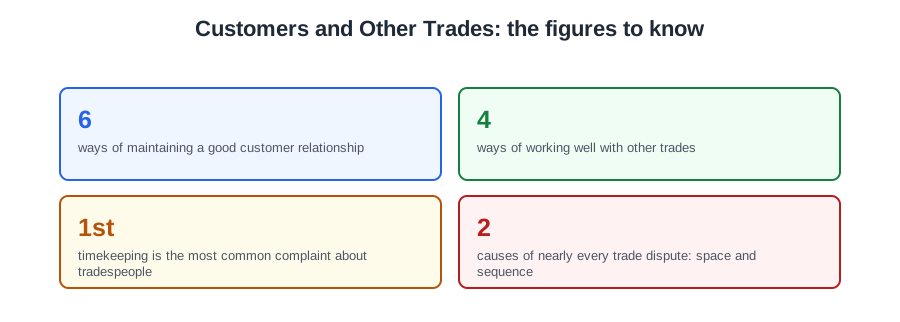
Six ways of maintaining a good customer relationship, and four ways of working well with other trades. Both lists are assessed — this is not general advice attached to the end of a unit.
The recurring answers: turn up when you said, protect the property before you start, tell people before you turn the water off, keep the place clean, and take a problem to your supervisor rather than to the other trade.
Protection goes down first
Before, not after. Dust sheets, board over carpet, and a look round for damage that was already there — a chipped bath, a scratched worktop, a cracked tile — before you carry anything in.
That last check protects you at least as much as the customer. Anything you find after a plumber has been in the house was caused by the plumber, in the customer's honest recollection, and a note or a photo taken at the start ends that conversation before it starts.
Timekeeping is the complaint, every survey, every year
Not the price, not the quality — the not turning up. It costs nothing to fix and almost nobody does it.
The reason it matters so much is that the customer has arranged their day around you. They have taken a morning off, or kept a child home, or cancelled something. Arriving two hours late without a call is not a small discourtesy; it is spending something of theirs that they cannot get back.
A text saying you are running an hour behind converts an angry customer into a patient one, entirely, every time. If the job is going to overrun by a day, say so on day one rather than at four o'clock on the last afternoon.
Water off is the one that ruins days
Turning the supply off without warning is the specific thing that gets plumbers complained about, because it stops the household functioning — no kettle, no toilet, no washing a child's hands.
So you say when, and roughly how long, and you turn it back on for lunch if the job allows it. In a flat or a shared building the same applies to the neighbours, and finding out where the stopcock is before you need it is a job for the start of the day, not the middle of an emergency.
Space and sequence: nearly every trade dispute
Trade arguments are almost never about competence. They are about two things: space — two people needing the same wall on the same day — and sequence — somebody arriving before the work they depend on is finished.
Both are fixed by talking early. The plasterer wants your first fix finished and tested; the electrician wants the same wall you want; the tiler wants to know exactly where your pipe centres are before they set out. Five minutes at the start of the week prevents most of it.
And when it does go wrong, the rule is: talk to the person calmly first, and if that does not resolve it take it to your supervisor. Not an argument in front of the customer, which damages both firms and gets remembered longer than whatever it was about.
Working in somebody’s home
Most plumbing is domestic, which makes this trade unusual: you are working inside a home, with the people who live there present. That means asking before you use a socket, keeping doors shut where there is a cat or a dog, watching your language, and not having the radio on loud in someone's front room.
It also means clearing up properly at the end of every day, not just the last one. A customer judges the standard of a soldered joint they cannot see by the state of the floor they can.
Why it pays
Domestic plumbing runs on recommendation. Firms that keep customers are not usually the cheapest or even the most technically able — they are the ones who turn up, say what they are doing, and leave the place clean. Every one of those is on this list, and every one is free.
What comes next
At Level 2 this becomes part of handover: explaining the system to the customer, showing them the controls and the isolation points, and leaving the documentation. Same skill, later in the job.
🔢 The numbers worth memorising
- 6
- ways of maintaining a good customer relationship
- 4
- ways of working well with other trades
- 1st
- timekeeping is the most common complaint about tradespeople
- 2
- causes of nearly every trade dispute: space and sequence
⚠️ Where people go wrong
- Putting protection down after you have started. It goes down before.
- Skipping the check for existing damage. It protects you as much as the customer.
- Turning the water off without warning anybody.
- Arguing with another trade on site. Talk to the person calmly, then go to your supervisor.
- Treating this lesson as advice rather than assessed content. Both lists get asked about.
📝 8-Question Self-Test
Straight from the Level 1 course question bank. Click an option to see whether you got it right — the explanation appears instantly, and there is nothing to submit.
Checking for pre-installation damage and pointing it out protects the customer and protects you.
Checking for pre-installation damage protects the customer and protects you from being blamed for something that was already there.
Timekeeping — turning up when you said you would, and ringing ahead if you are going to be late.
Most disputes are about space and sequence — two people needing the same void, or one arriving before the other has finished. Both are solved by looking at the programme and talking early.
The work programme says who is where and when. Follow it and your work fits between everyone else's.
Resolving disputes: talk to the person first and calmly; if that does not work, raise it with your supervisor or the site manager rather than arguing on site.
Check and record existing damage or marks — the walk round with the customer before you start. A mark you did not make is impossible to argue about afterwards if it was written down before.
Ask for valuable items to be removed. If you pick up an ornament and it breaks, it broke while you were holding it — and that is a conversation with no good ending.
Going deeper: the same ground at Level 2
Level 1 gives you the shape of this. The Level 2 guides below take it considerably further — the regulations, the calculations and the detail you will need next. Free to read, same as these.
- Start here: Site Preparation for Level 1 Plumbers — the whole unit in one piece
- All 72 Level 1 guides — one per lesson, across all ten units
- The Level 1 glossary — 620 terms in plain English